Zooks Gets Granted an EU Long-Term Residence Permit.

Tere!

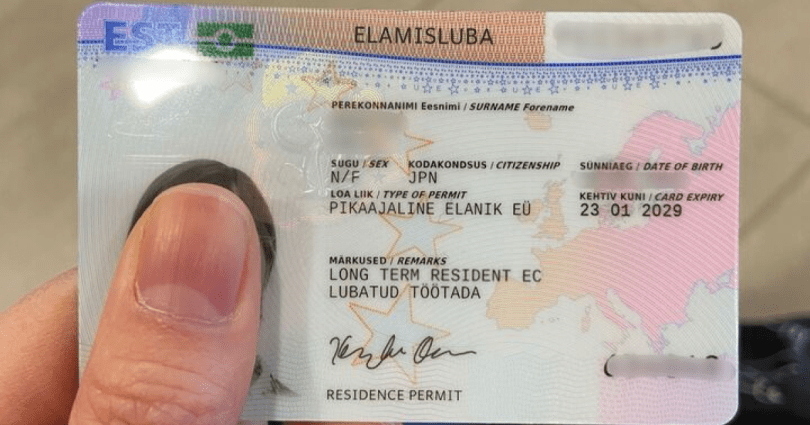
On the 19th of January, 2024, I announced that an EU long-term residence permit was granted to me on some of my social media channels! Recalling an article titled “How to Get the EU Long Term Residence Permit in Estonia.” that I published In December, 2023, this new article is a developed version of it. However, truth to be told, my mind was unstable until I made the final decision to apply for the EU long-term residence permit. Sometimes I wanted to apply for it and some other times I planned not to do it, which I repeated over days and months… The reason why I decided to apply for it eventually is too messy to explain so I skipped it here, but it is relevant to the article “Zooks Decides To Stay in Estonia”.

When I applied for the EU long-term residence permit, I was in quite a special situation. Hence, here I will talk about three things: documents I prepared, a flow till I went to a PPA office in Tallinn and how I was treated at a window in the PPA office. (In other words, if you have lived in Estonia for more than five years legally, worked for an Estonian company, and passed an Estonian language exam at the level of B1 or higher, you don’t really need to worry about it!)


Table of Contents

     1. Documents I Prepared
          1.1 Legal Income
          1.2 Health Insurance
          1.3 Language Proficiency
          1.4 Application Form
          1.5 Payment Certificate
     2. The Flow till I Went to the PPA Office
     3. How I Was Treated at a Window in the PPA Office
     ★Summary


1. Documents I Prepared

Let’s begin with the required documents. Roughly speaking, I needed the below documents:

  • Certificate of a legal income
  • Certificate of health insurance’s coverage in Estonia
  • Proof of a language proficiency (B1 or higher)
  • Application form
  • Certificate of the payment for the application

Let’s take a look one by one.

Generally, if you work for an Estonian company, you can probably just bring your work contract. Or, as PPA can see your information, you may not rather need any documents for this purpose. (I was told so after graduating from a postgraduate school when changing my student TRP to the TRP for a graduate.)

However, in my case, due to the fact that I was already working as a freelancer when applying for the EU long-term residence permit, I had to prove that my income was legal. Here “legal” basically means that you pay tax in Estonia. If you work as a freelancer or remotely from Estonia, your taxation can be complicated. Also, based on your gross income, the tax rate may differ. I will write another article about taxation in Estonia. Here I’m just talking about my case.

I use LHV’s entrepreneur account. With LHV’s entrepreneur account, once you add your funds, the income tax (including the income tax, social tax and pension) is deducted immediately. Therefore, you might just need to submit a balance statement on your LHV’s entrepreneur account, and yet my reality wasn’t so simple. 🥹

As a freelancer, even though my income was legal for me because the tax was deducted, the PPA who assessed my application had no idea what kind of business I earned from. It could be selling the weed. What is worse, it could be prostitution. Hence, I reckoned they may not grant the permit as “earning might not be legal” without any documents which would prove the source of income, and they might have asked me for additional documents, which seemed to be troublesome. For this reason, I submitted the documents on the source of my income as well. However, my case was still intricate, so I wrote down the flow of paying a salary to myself, and collected all the necessary documents as earning in USD was one of the reasons as well that made the situation complicated.

The flow was [(1) earning → (2) remitting from the work platform to my PayPal account → (3) remitting from PayPal to Wise → (4) converting from USD to EUR in the Wise app → (5) remitting from Wise to my LHV entrepreneur account → (6) remitting from the LHV entrepreneur account to my Estonian bank account].

This is why I had to submit all these documents. The most burdensome part was [(1) earning] since the work platform did not have any function to export all the earnings in PDF by just a few clicks. What I did was save the whole screen one by one in a printout mode on a browser, and merge all the files into one on the site called Smallpdf. For the fact that I had to prove my income for two months, there are more than 200 pages in the file in total.

The number of pages of partial income of a month

Then I printed these out on both sides…

Although the documents were only for two months, it was onerous.

1.2 Health Insurance

Given that you work for an Estonian company, you will automatically be covered by Tervisekassa (the Estonian Health Insurance Fund), but in my case, since I intentionally set my income as low as possible, the social tax I paid was below the minimum amount to get covered by Tervisekassa. Therefore, logically, I didn’t have any health insurance.

A private health insurance like ERGO is also acceptable, but my past experience of depression was utilised here.

In summer in 2021, I published a blog article titled “Zooks Got the Work Ability Card Issued in Estonia.”. This was it. The certificate of “partial incapacity of work” took advantage at this time. Strictly speaking, I didn’t bring any copy of this per se as the PPA could see that I was covered by Tervisekassa.

Then, here is the reason why this certificate of “partial incapacity of work” is relevant; as long as this card is valid, regardless of the amount of social tax I pay, I have Tervisekassa’s coverage.

Since I always bring my card anywhere, when a PPA lady asked me about the health insurance, she made a copy of it.

I know it was really troublesome. 😂

I finally thank a lot the Brazilian customer support manager who depressed me, tormented me, didn’t provide me as a new employee with any training at work, limited my access to necessary platforms for work and prioritised her own profits, two Russian colleagues who were perfect frenemies and takers, the Nicaraguan marketing manager who discriminated at work, and the CEO who asked me to work from the hospital while I was taking a sick leave. I will never forgive them all and I do believe sooner or later they will be destined to come across a complete hell in their life at some point, which I think of in this way only when I remember them owing to some trigger. Right now I am happy without them in my life and I do not care what will happen to them. What is more, thanks to them, I can still have Tervisekassa’s coverage without meeting the minimum amount of social tax. 😛

1.3 Language Proficiency

I really didn’t have to print this out, but just in case I brought it there. I am not sure if only completing a language course is sufficient as a proof. I took Harno’s official language exams, which results are visible on Estonia’s national portal.

1.4 Application Form

As for the application form, you need to download it on the PPA’s website, fill it out, print it out and bring it to the PPA office. You don’t need to add your photo there. You can take a photo in the photo-shooting machine in the PPA office, and the machine will send the data to your ID. The machine also lets you have your fingerprints, so I recommend you to do so while waiting for your turn at the PPA office. (However, I’m not sure if you would be asked for your fingerprints at a window.)

What is more important, you must fill out the application form in Estonian. It’s nothing big if you need to just fill it out. However, in my case, I had to explain the above information on my income in the note section of the application form. (I wasn’t really told to do so and it might not be mandatory, but since it was onerous, I wrote it in advance in order to avoid being asked a lot later.)

1.5 Payment Certificate

You don’t need to worry about this either as you will have to pay for the application fee at the window. Should you apply for the EU long-term residence permit by snail mail, you need to pay online and send the receipt as a document.

2. The Flow till I Went to the PPA Office

Since my legal stay turned out to be 5 years as of the 11th of November 2023, I decided to apply for the EU long-term residence permit after that date. In terms of time, I had stayed in Estonia for more than six years as of that date, and yet in terms of a residence permit it was five years.

On PPA’s website there was a reservation option, so I tried to book an appointment, but it was impossible. Therefore, I went to the PPA office directly and a PPA lady at a window just told me to book an appointment.

Asking her further, she told me to book an appointment on the coming Monday because then there will be new appointment calendars for December and January, and this happens specially for the fact that there will be many TRP applicants who will come to Estonia based on their employment in winter.

If you are thinking of booking an appointment in winter, keep this in mind;


You can book from 8 am but all the slots will be taken within 15 minutes.

I was really struggling with the booking page after taking a shower in the gym. Consequently, I successfully booked an appointment on the 5th of December, 2023. It wasn’t an ideal date and time and yet better than nothing.

However, I still wanted to have applied during November so that I didn’t have to prepare such a lot of paper documents to prove my income. 😅

3. How I Was Treated at a Window in the PPA Office

On the 5th of December, 2023, I went to the PPA office again.

Just like the first visit, when they came to know that I went there to apply for the EU long-term residence permit, they asked me “Can you speak Estonian?”, and I always responded:

😂

This is because B1 is not enough for fluency (subjectively speaking).

At the window the PPA lady checked my documents one by one.

As for Tervisekassa’s coverage, as mentioned above already, since I had a certificate of partial incapacity to work, I explained it to her at the window and she took some copies of it.

After checking all the documents, she told me that usually the result would be notified within two months, and yet this time it might take up to three months as it was the time that there were a lot of other TRP applications.

Though eventually it didn’t take even two months. 😂

★Summary

As for the notification, since I received an email in Estonian from PPA so suddenly, I thought:

I read it and translated it just in case, and I was like:

So I messaged my previous colleague who I talked about my application with the other day:

And he replied to me:

He sounded so seriously, so I was like:

He still continued to tell me seriously:

Oi. Then I sent him a GIF of a desperately disappointing pikachu. Then he finally said:

“Just tell me that my understanding was right,” I thought. It was sort of startling.

Due to this silly conversation it took time to make sure, and yet anyway I was glad about everything.

Anyway, I will keep living like a weed in Estonia (at least for a while).

Aitäh! 🍊

Zooks Takes Estonian A2 Exam.

Tere!

Do you have any motivation when studying or learning something? From my own experience, taking an exam can be a good motivation (at least in my case), relevant to which it is also important to set the goal. I believe people in Japan can easily set goals as there are many qualifications and certificates in a language or accounting, from technology to art.

When learning a foreign language, setting a goal is crucial, and a language exam can be one of the goals.

In Estonia, language exams occur four times a year for non-Estonians who live in Estonia. (This is a language proficiency exam which is different from the one to get citizenship. This seems to happen every month.)

I thought I can’t acquire the language in this slow pace in a good way or lazily in a bad way, so I set the goal which was to pass the Estonian A2 exam.

★How to register for the exam

In order to take an Estonian language proficiency exam, you need to register online, by email or via mail, but of course doing online was faster. It seems you can register from the national portal site, but I felt it was faster and easier to register directly from the exam portal. This exam portal is available only in Estonian and Russian by the way.

On Innove’s web page, there is a PDF file which explains how to register an exam from the exam portal, but

selection of how to receive the exam result

was no longer available as of September 2021. They said once I register the exam online, the result will be automatically sent to the registered email address. (I contacted Innove a lot to ask how to receive the result.)

★Exam consultation

The exam consultation was held at the high school (?) where the exam would also take place. I arrived a bit early, and one staff member asked me

Eksam? (Exam?)

so I answered yes, and then he guided me to one of the classrooms.

After waiting for a while outside the classroom, other staff members checked our ID and the COVID certificates. Then they told me to find my name and sign the paper, but I could not find any. I also found that one elderly lady was in the same situation, and they told us to wait until everyone will be checked. However, suddenly they asked us

“Consultation?”

and the lady and I said yes. Then they explained that the A2 consultation took place in another room, and it seemed that where we were was the exam room.


I thougth it was about only the consultation as I had no idea if the real exam would also take place.


We went to another room and attended the consultation.

In the email that I received, it was written that it would take up to 6 hours, which was unbelievable, but in fact it finished in 90 minutes.

★Exam

Before the exam, I had received some emails about the exam, and they said that it was good to arrive at the venue 10 to 20 minutes before the exam started. I went to the same school, and found several papers on the wall in which there were examinees’ names and the classrooms. I checked mine, and a staff member told me where to go.

I went to the classroom but was not allowed to enter until the examiner would come. This seemed not only because of checking the COVID certificate but also checking the ID. The spot in the classroom was random but we had to sit just behind the front examinee/s. (I guess it was to prevent cheating. It made sense as if we sat behind but diagonally, we could have seen the front people’s answers.)

The brief exam explanation was in Estonian, and as for the speaking part, the schedule was not written on the blackboard so I wondered when, but the exam started without asking.

At the exam we all had the exam numbers, but we did not need to worry because the examiner told us the numbers while we were working on the writing tasks.

The first part was writing. It had two tasks and took up to 30 minutes. After that there was the listening part for 30 minutes as well as the reading part for 50 minutes.When writing the answers, we had to use black or blue pens. No pencils were allowed.

This time the task 1 for the writing was to describe the business card of a kindergarten in more than 25 words, and the task 2 was about the invitation to a friend to a water park (veekeskus) in more than 30 words.

Personally I has slight difficulty in writing in the second task about the water park


as I had never been there for more than four years since I came to Estonia.


Anyway, I had to write so I imagined and wrote “I want to swim in a pool”, “There is a sauna”, etc. (It sounds real, doesn’t it?)

Then we had the listening part. It ended while I was even not sure if I understood or not. (I’m sure the result will be bad.)

However the reading part seemed better although I don’t remember anything anymore.

After writing or answering the reading test, even before the end of the parts, we could submit if we thought it was all fine. I checked twice or three, and thought it would be okay, so I submitted, and finally could go outside of the classroom.

Outside the classroom, there was a list of the examinees in that room beside the door. They divided us into four pairs. In each pair there were two examinees. I was in the third pair, and this pairing was the order of the speaking part.

At the speaking part, the examiner recorded, and before the real tasks (?), she asked me and my speaking partner some basic information such as how old I was, where I was from, and where I worked. I was a bit nervous, and made a mistake that I don’t usually make. (I literally thought “Oh no”, but after that I concentrated on the speaking part so I didn’t care that much.)

The first task was to describe what we could see from a picture. The theme was sweets, and in my picture there were three people and their pieces of cakes on a table.

I had to speak for some seconds, but I could only said

  • They are eating cakes
  • They seem to be in a cafe
  • This woman/man wears a XX coloured shirt/jumper

However, my speaking partner had a better picture in which there was a woman and her kid in a park, eating sweets. He could talk about the weather, clothes, a place, and what kind of sweets they ate.

He had much more information.

The second task was the same theme, and the examiner asked us several questions.

She asked me how often I eat sweets, which I like to buy sweets or make sweets and so on. My fault was to have used the same grammatical sentences, but I could understand her questions. On the other hand, my speaking partner seemed to have difficulty.

I don’t remember if it was the final task or not anymore, but it was about nine pictures, so we had to ask questions to each other. I was not sure how to conduct that task, but after understanding it was alright.

My questions theme was clothes to wear in winter, and the questions from my speaking partner was about activities.

After the speaking session, I could go home.

The result will come in about one month.

Result

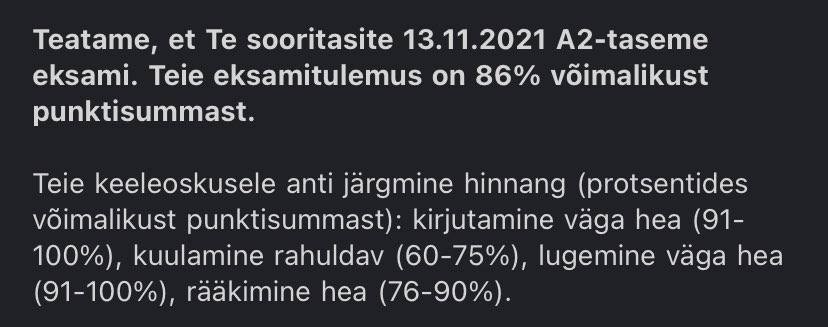
On the 13th of December 2021, exactly one month after the exam, I received an email with the result.

  • Writing – very good (91~100%)
  • Listening – satisfactory (60~75%)
  • Reading – very good (91~100%)
  • Speaking – good (76~90%)

The total score was 86%, and I passed!

I will take a B1 exam next summer. (But I’m not sure if I will write about it here.)

Aitäh! 🙂

Zooks Completes Keeletee in 6 Months.

Tere!

Pretty long time ago, I talked about an Estonian language learning platform called Keeleklikk which I completed in two months. In fact there is a next-level platform called Keeletee. This time I spent six months completing it.

★Course Structure

The course structure of Keeletee is almost the same as Keeleklikk. However, the videos were not tacky animation where kid characters have a fully grown man voice but authentic interviews with real people. There are a couple of animations but the quality is better than the ones in Keeleklikk.

One chapter consists of interviews or animation videos, phrase quizzes, grammar tutorials and word quizzes. 

★Grammar

In terms of the Estonian language grammar, you complete the basics by the A2 level, so when I started Keeletee I was wondering about what I would learn as a grammar.

In fact, I felt there were more like how to use some particular verbs. This is probably because in Estonian some verbs need objectives in the second form but others require the third form. Other than that, I learnt the form of verbs to say “it is reported” or idioms. (Actually I quite forget what I learnt in the beginning as I spent six months this time…)

While learning on Keeletee, I took notes on Evernote because the data will not possibly disappear by saving online, and each note can be compiled as a notebook. (More strictly speaking, I took notes on paper while watching the grammar tutorials or finding new words, and after learning I summarised them on Evernote. It’s good for me because I can think about the layout of the learning results later.) 

★Certificate

On Keeleklikk, after completing all the chapters you can take a final exam, and if you passed, you can get a digital certificate. However, Keeletee doesn’t have such a system. (There are tests after each chapter though. Personally I set the minimum score which was eight out of ten.)

This is my guess, but the reason why Keeletee doesn’t have such a certificate is that even the certificate from Keeleklikk is not official. (Some people might try to use it as an official certificate which is not accepted, so they may have assumed the questions regarding that and wanted to avoid immigrants’ confusion.) If you want to get an official language certificate, you need to take an official exam by the government.

It seems this exam is held every month and the fee is free. Since I graduated from the postgraduate school in Estonia, I’m not required to acquire the language, but the regular people may need it on the B2 level or something within five years. 

However, I completely have no idea as it doesn’t matter to me.

★From Now

As the COVID-19 situation has gotten better, the bars and shopping centres are open, and it’s not mandatory to wear masks for the face-to-face meeting, I assume that the Estonian language courses will open in autumn again. If I’m not too busy at work, I want to register for it. 

But still I have a few months by then, so I will learn it again at my own pace. (On the contrary, I want to focus on learning CSS now, personally.)

Thus, learn the Estonian language at your own pace and enjoy your Estonian/foreign language learning life!

Aitäh! 🙂

Zooks Watches Estonian Film “Talve”.

Tere!

This time, to begin with a short review of an Estonian film, I’ll tell you about my background a bit. When I was in Japan, I went to Kyoto University of Foreign Studies, where I studied in the Department of British and American studies. 

As getting into the university, I was put in one of the middle levels of English classes. This means that my English level was not as good as now. Also it was mandatory to take a class to enhance the listening skill for me based on my TOEIC’s score.

However, I still think that I had a great encounter in this university — I could know the best way to enhance the listening skill (besides the classes). As far as you read my blogs, your English must be fine, but I’m telling you how to do it

One day a few final-year students who studied abroad like in the U.S. or UK had a presentation about strengthening the listening skill. This is how to do:

  1. Prepare your favourite film or series. I chose one of glee’s episodes about Michael Jackson. (I’m not a huge fan of him but the episode was great.) I chose it because it’s short, I like music, and I like glee.
  2. The first actual step is to watch what you selected in your mother tongue once. (Just once!)
  3. Then you repeat watching it with English subtitles and English audio. At this stage, it’s okay to check the meaning by switching the subtitles.)
  4. Finally you watch it without subtitles.

I really liked this method, and I could actually enhance the skill by watching only two episodes. (The other episode was regarding Whitney Houston.) Of course classes and studying for TOEFL or IELTS helped me as well, but I think this method was the base.

So if you know the way, you can apply it to any languages.


But!


The problem is that it is really difficult nowadays to get films or series with subtitles in English and other languages . In my case, that was English and Estonian. I wanted to train my listening skill with favourite films or series, but in Estonia even “Frozen” is not available in Estonian subtitles. (I’m so curious considering the deaf people.)


So!


I tried an Estonian film, which is “Talve” that is also in this article’s title.

Reference

“Talve” was in cinema in 2020, which depicts Estonia in 1942. The original novel was written by Oskar Luts, and the word “talve” comes from the word “talv” which means “winter” in Estonian. (I don’t know why it is “talve”.) There are films of this series as well.

I was still poor when buying this DVD. I hesitated to buy it a bit because I was afraid not to see it. (As an additional information, when I watch something new, my expectation is super low.) Besides, the reason why I chose this film was because I didn’t know any other suitable films for language learning.

Now I watch it almost twice a day in the way that I mentioned above. Of course there’s no Japanese, so I watched it in English and then in Estonian.

As a review of this film, I kind of enjoyed it since the genre is more likely a comedy. However, at some points the “funny” scenes depend on the original language (Estonian), so without knowledge of the Estonian language, it’s not easy to understand how funny it is. What is more, the English subtitle isn’t that great overall, but it’s good not to get tired while watching as the length is only 90 minutes.

There is a scene of sauna, drinking vodka, etc, which sounds Estonian, so perhaps it’s useful to understand Esotnian culture a bit. 

I don’t know how many times I have watched so far due to the repetitive watching habit as mentioned, but it’s also good to have some sounds as I live on my own without any flatmates now. I hope I can enhance my listening skill with the Estonian film. Are you interested in it? It seems you can rent it online.

Aitäh! 🙂

Zooks Uses Estonian Children’s Literature Centre.

Tere!

How often do you read books? In my case, I buy a book whenever I feel like reading it. (But I’ve been in a not ideal situation because the COVID-19 situation in the UK has compelled me to wait for about a month now. It’s been two months since I ordered.) This time, in addition to the previous article on “Talve”, I’m going to write about Estonian literature…no, about extensive reading. The extensive reading is one  of the ways to learn a language.

The extensive reading is reading as many books that are at your language level as possible. When I was in a university in Japan, I was in the Department of British and American Studies, where we had to read books in English, take and pass the quizzes to gain the word counts. (And it’s totally okay to exceed the minimum word count.) We also had the minimum number of words of books, depending on the classes or levels.

It might sound that with this method we could enhance our reading skill, but I believe this would rather strengthen the vocabularies. (In fact, some researchers have the same opinion as mine, others not. In my opinion, without increasing the reading speed, the extensive reading cannot enhance the reading skill.)

I wish Estonia had such a system, but anyways they don’t have it, so I thought I should find at least something to read. Then I went to the library in the Old Town!

When doing the extensive reading, there is a criteria to choose a book. For example, you are fond of the Harry Potter series, and your English level is A2 to B1. Then if you try to read one of those books, it would take hours to read and understand a few pages, which is not the extensive reading.

This happens because of insufficiency of vocabularies.

Then, how can you choose a book? Pick up one book and read the first page. Provided that you have less than a few words that you do not comprehend, the book suits your level and you can start reading that book.

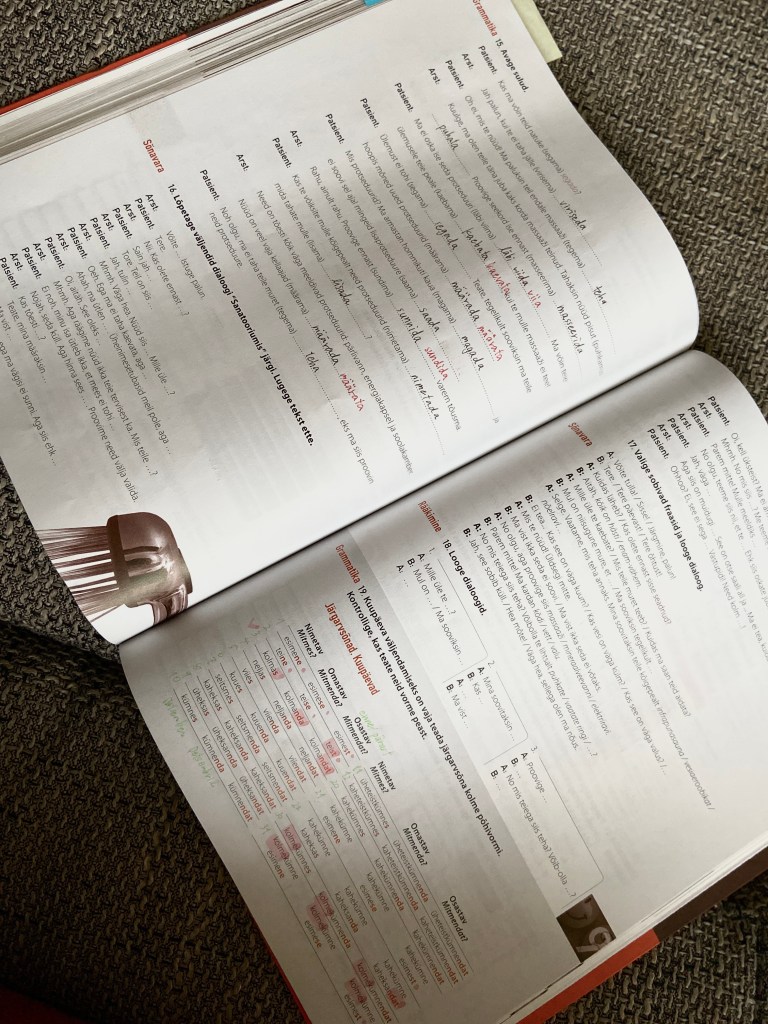
In my case it’s Estonian. Of course I consult a dictionary a lot to read not only the Harry Potter series but also some short articles in a textbook. However, I knew that if I would start doing the extensive reading, I will gain more vocabulary, and it will lead to a result in reading itself in the end.

Even though the target language is different, the criteria is the same. I should read a book which has less than a few words that I do not understand in one page. Also as far as I know, there are no books that are rewritten specifically for the Estonian language learners, I needed to choose ones from a general lineup. It means I should choose literature for kids. (However, it’s still difficult.)

In Tallinn there are some libraries. In addition to universities’ libraries, there is the National Library of Estonia, Tallinn Central Library and so on. In the Central Library, there are books in English or other foreign languages such as Spanish.

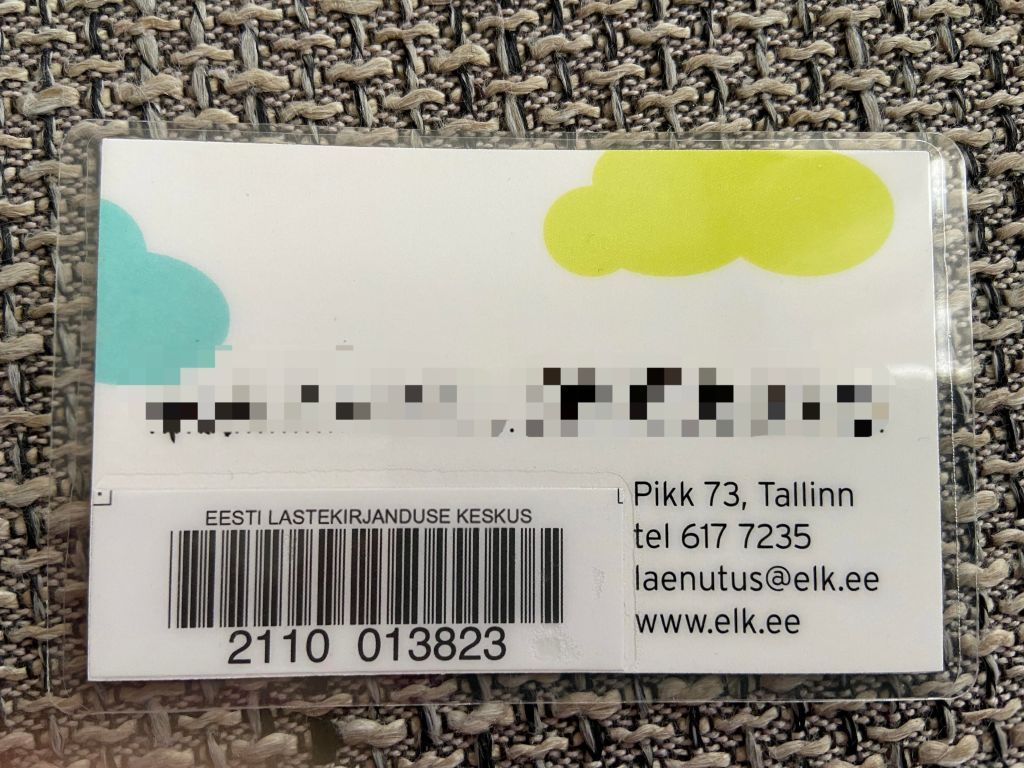
However, what I wanted was books in Estonian for kids. I had no idea which branch library of the Central Library has such. (Perhaps they don’t really have any.) Then I did some research, and found Estonian Children’s Literature Centre in the Old Town.

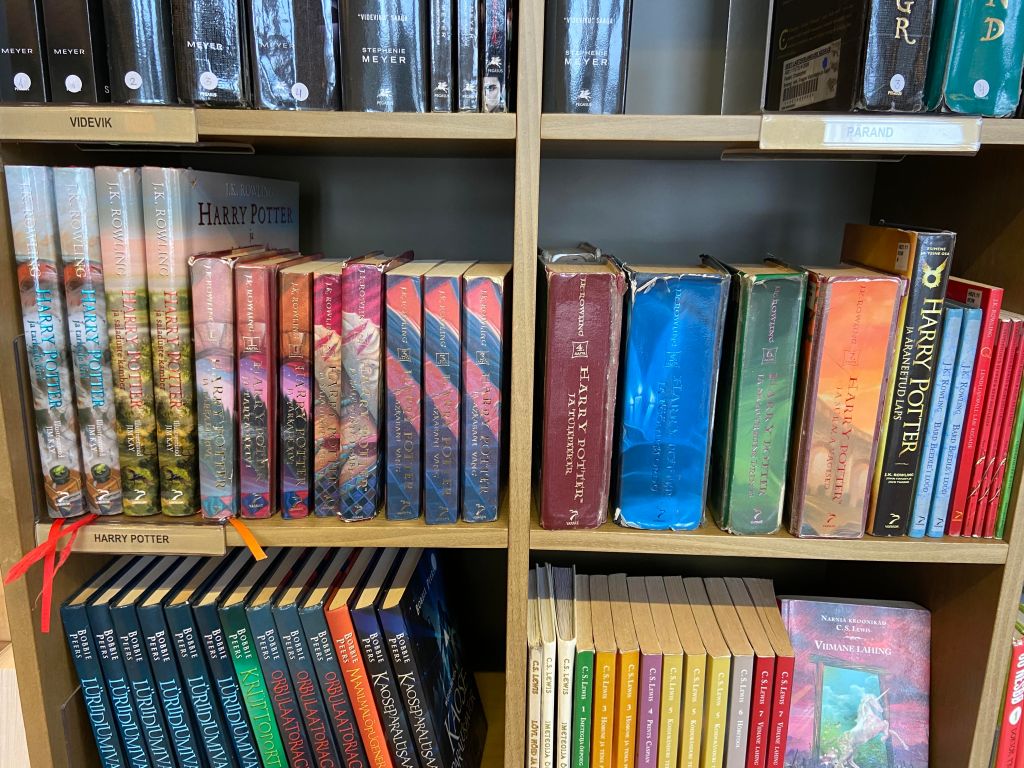
Like its name, they do have lots of books for kids (until teeneagers). I was wandering around there and found Harry Potter, the Song of Fire and Ice.

The Song of Fire and Ice
Harry Potter
Original book of “Talve”

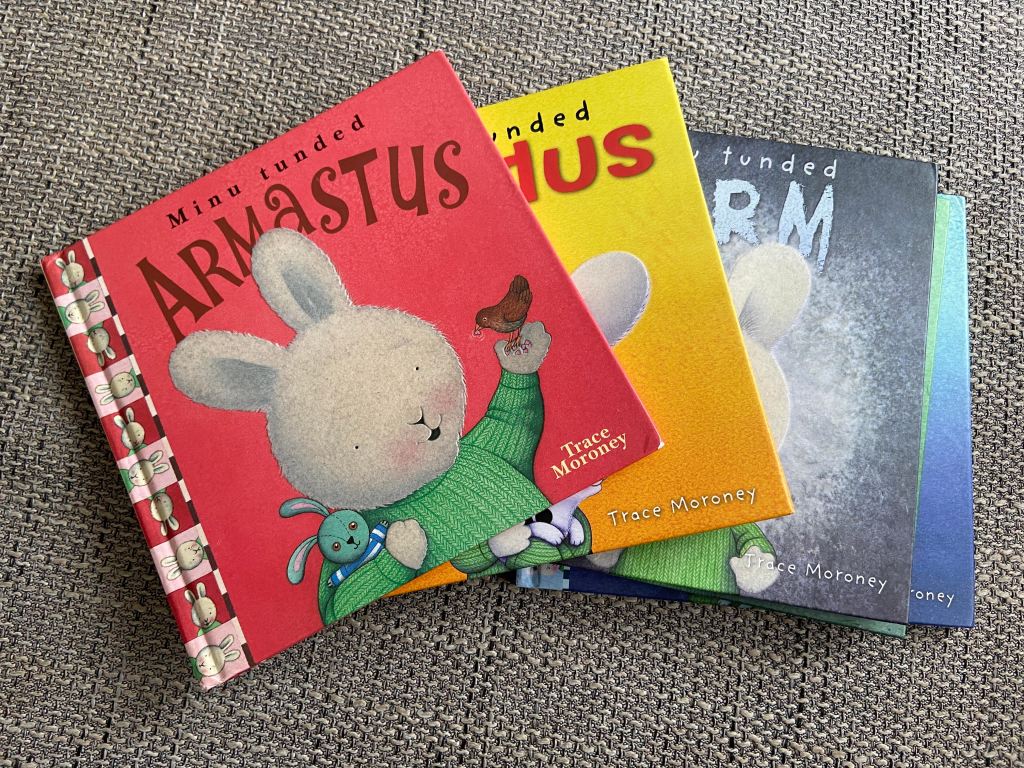
I know those stories so I wanted to borrow but I thought I shouldn’t because I wouldn’t be able to understand them properly. So I decided to borrow five picture books for toddlers. What I borrowed was translated from English, but rabbits were cute so I decided to borrow them.

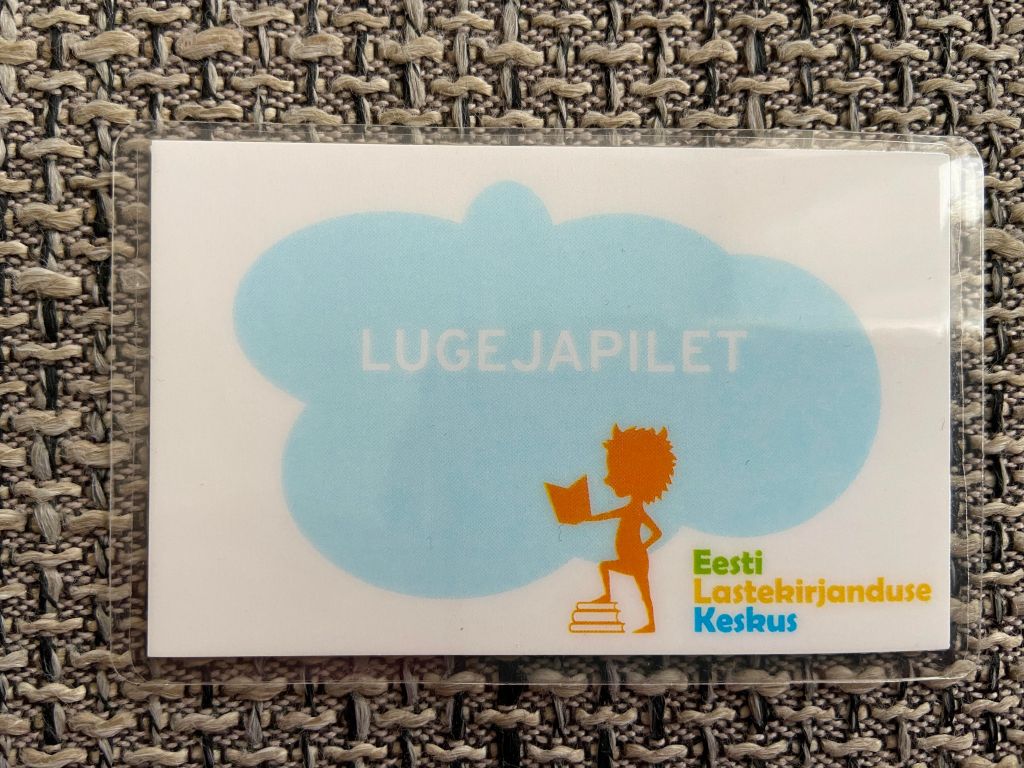
When borrowing books at National Library of Estonia, Tallinn Central Library or universities’ libraries, you can use your Estonian ID card as a library card, but in this centre, it costs one euro to make a library card. But it’s still cheap considering the number of books that I can read. It was a self-investment. The librarian was a middle-aged female but she could speak English.

Eventually I borrowed five books for two weeks.

My speaking level is not that high although I finished the B1 course, so I want to increase my vocabulary little by little. (It sounds as if the vocabularies are everything, but without them we can’t really talk.)

It’s a key to enhance each skill in balance when learning a foreign language.

Aitäh! 🙂

Zooks Completes Estonian B1 Class.

Tere!

Do you remember that I was going to publish blog articles about my Estonian language course? Due to hospitalisation, I couldn’t actually continue. (Sorry to those who were looking forward to it.) Ergo, I’m summarising how my Estonian B1 course was this time.

After getting back to the Estonian language course, I went to the language school, but since the 25th of November we started learning online. This is because the Estonian government announced that hobby classes can be held in class only if the number of participants is below 10 or 15 or something like that. (I can’t remember that much.) 

In summer I also had an Estonina language course online, but my teacher wasn’t used to the IT gadgets. This time my teacher is an expert of Zoom (she looked like that), so the quality of the class was way better. (I thought if the online class was like this, it could be an option.)

Anyways, I’m gonna introduce what we learnt from week 9 that I got back from the hospitalisation. 


★Week 9★

It was the first language class since I was discharged from the hospital. There was nothing new for me. We learnt how to use “kuhu” (to where), but I already learnt in the A1 course last year, so there was no difficulty.


★Week 10★

I learnt two things this day — how to use “kuhu” and “kus” as well as the conditionals.

Regarding “kuhu” and “kus”, I write down for those who are not familiar with them below. “Kuhu” uses the verb “minema”, and “kus” uses “käima”, both of which mean “to go”. They use the former one when expressing going somewhere (one direction), and use the latter one when stating going somewhere regularly. Also, according to the interrogative, the form of the noun of the destination also changes.

For example,

  • Ma lähen koju
  • Ma käin kodus

Both mean “I go home” but the former one indicates “I’m going home (returning home)”. The third word of each sentence means “home”, but the case changes based on “kuhu” or “kus”.

In terms of the conditionals, the Estonians use -ks-. For instance, “tahtma” (which means “to want”) will be

Ma tahaksin 

to be more polite. (In English it means “I would like”.) There is another example. They have a verb “saama” (which means “can”), and they say “I could” by inserting -ks- and making it “Saaksin”.

We learnt such things that day.

Also, I got a small glossary book, which seems very useful.


★Week 11★

This week we shifted learning from offline to online. On Monday we learnt how to express time. I learnt time at A1 level, but this time it was “from what time to what time”.

As a grammar, the form is “kellast (from what time)” “kellani (to what time)”, and you need to insert the second case of numbers. For example, if it’s “from 8 to 5”, it wil be

kaheksast viieni.

We also learnt how to express “8.15” or (8.30).

From this Wednesday, we had an online class. We kept learning “time”, but this online class was splendid.

When learning or acquiring a language, speaking is a tricky part because it is hard to practise on our own. However, my teacher knew Zoom so well, so she created pairs or groups in three, and we could practise speaking by using breakout rooms.

In such a situation I do agree to learning a language online.


★Week 12★

We continued “time”, but this time we learnt “at what time”. To express such, they use “-ks”. For instance, if you want to say “at 8”, it will be

kaheksaks.

Like the previous section, it also uses the second case of the numbers.

Plus, we learnt half of the time (e.g. “8.30) or 15/45 (e.g. 8.45) as well.

On Wednesday the class was about verbs. In Estonian there are the -ma infinitive and -da infinitive. Which form we use is depending on the first verb. Here “verbs” includes auxiliary verbs in English too. I had a pair practice with an Russian student, who advised me

  • They use the -ma infinitive when the first verb is some sort of action (in many cases);
  • They use the -da infinitive when the first verb is some sort of emotion or ability (in many cases).

For example,  “I have to read a newspaper” will be

Ma pean ajaleht lugema

We didn’t deepen into the -da infinitive this time, and finished with the -ma infinitive.


★Week 13★

We learnt the -ma and -da infinitives, and a different case of numbers.

I’m gonna explain how to use the -da infinitive as I did for the -ma infinitive above. If a sentence is like “I can find a solution”, the Estonian sentence will be:

Ma saan lahenduse leida

You don’t have to pay attention to the position of the objective.

In terms of the numbers, we learnt the second and third case. (It means the way to use numbers differs depending on the context. It’s a bit complicated so it may be time-taking to get used to it, but I believe that practice makes perfect!)

When they use such weird forms of numbers is when saying “from when to when” or “before” and “after”.

The below is how to say “from when to when” in Estonian. Here “from when until when” is in Estonian is ”Mis kuupäevast mis kuupäevani”.

I exemplify from the 14th of March (Märts) to the 18th of April (Aprill), it will be 

neljateistkümnendast märtsist kaheksateistkümnenda aprillini.

Fucking long.

Grammatically the second case of the numbers and months have “-st” or “-ni”.

Another explanation is about enne, pärast — “before” and “after” (in Estonian). They use the third case here. For instance, “What don’t you do before the 1st of January?” will be

Mida te ei tee enne esimest jaanuari?

We use the same logic to “pärast”.

These were quite hard exercises.


★Week 14★

We had a class on Monday and a test on Wednesday.

We learnt the third case of plurals of nouns and adjectives. Oh, these are harder to acquire!

Some nouns and adjectives require us to add a few alphabets to the second case of their singular form. Others need to change the third cases of their singular forms. It’s so hard to remember. By the way, the Estonian language is like Spanish, so the adjectives get influenced by the nouns that attach those adjectives. In short, if a noun is a plural, its adjective is also a plural, and the noun is a third case, the adjective also becomes the third case.

I believe all I can do is just practise.

On wednesday, we checked the homework, and spent the rest of the time for the test. I felt the test was easy.


★Week 15★

We checked the points at the test, and then talked about how the Estonian language course was in a pair in Estonian. After that we presented our partner’s difficult points and good or interesting points regarding the class.

As for the test, I do have no idea where I made mistakes, but my point was so few.

Since I don’t know my mistakes, I cannot do anything for that.

However, although I don’t have much vocabulary yet, indeed I gained a few, and could speak more freely than before.

In terms of the afterwards, since I’ll start a new job in January, and I think I should get used to it first,I decided not to take any Estonian language course for this semester. Instead, I will do self-study by using my spare time.

Aitäh! 🙂

Estonian Language Course B1 – Week 1

Tere!

I have mentioned that I completed Keelekilkk long time ago, but haven’t said that I took an A2 course in summer, have I?

There’s an opportunity to take a free Estonian language course. I took the A2 course online by using this opportunity in summer. This time I knew this “hack” so I used it again and got the opportunity to attend the B1 course.

The class is taken place twice a week, Monday and Wednesday evenings. Each session lasts three hours including a 15-minute break.

I published my school report when I was a student in Tallinn University (in Japanese). Since the coronavirus has prevented me from going to somewhere out of Estonia, I decided to resume this “project”. Ergo I’ll write a post about the Estonian B1 classes.


★Monday

This was the first class. There were around 15 to 20 people in the class and most of them are Russian speakers. Otherwise there’s one Japanese (me!), Korean (maybe, guessed from her name), Spanish, Indian or somewhere from South East Asia. Our teacher is an Estonian middle age old woman.

In the first class, we revised something from the precision level such as ordinal numbers, and some adjectives. We had some group work for ordinal numbers by using UNO cards and introduced ourselves with adjectives that started the same alphabet as our names. (For example, my teacher’s name is Kaja, and the adjective is Kuldne = gold in English.)

I knew that I didn’t have many vocabularies but the class made me realise that I literally didn’t have.


★Wednesday

On Wednesday, we did some activity while using numerical numbers and adjectives. It was like this: we made a big circle in the classroom, started saying number from one (1) and if someone had the magnification of five (5), they had to say some adjectives. That was actually fun.

In addition, we tried some quizzes in the A2 level online in the whole class. I wasn’t confident to answer the questions but it was quite easy.

On the other hand, when it came to speaking, I really couldn’t speak at all because of my weak vocabulary. We made a pair and each one of us had a partner who is a mentor for the other. So it’s like a peer system. I got one Russian speaking guy who can speak Estonian quite fluently in my opinion, which made me wonder why he was in the B1 class. His vocabulary is succinct but mine isn’t. Therefore I though I needed to increase my vocabularies again.

Overall, it seems the class is fine though my mentor is annoying (because he doesn’t speak clearly but speaks murmuring). Well, it’s the beginning of the class so let’s see.

Aitäh! 🙂

Zooks Completes Keeleklikk in 2 Months.

Tere!

One day in 2020 there was a conversation before the general meeting in the office:

Me: Mine…
CTO: Mine?
Me: Toasse! Toasse? Tubasse?
CEO: I don’t think we say “tubasse” (but she could understand what I meant)
Me: How do you say (“to the room” in Estonian)?
CTO: Tuppa

I dashed to the developers room and said:


Mine tuppa!!!


One developer: We heard. lol


It’s a very good circumstance to learn a language, isn’t it?

As you might have guessed, it’s Estonian. I couldn’t register a public language course in January because too many people accessed, which led a server error. Then I (re)started learning Estonian online by myself and I tried to use what I learnt in the office as a practical lesson.

This time the article is about the online Estonian language learning. I completed the Estonian language learning platform called Keeleklikk, so I summarise here how it was. (If you read this article you will figure out but just in case you won’t misunderstand – it does not mean that I acquire the Estonian language in two months.)


What is Keeleklikk?

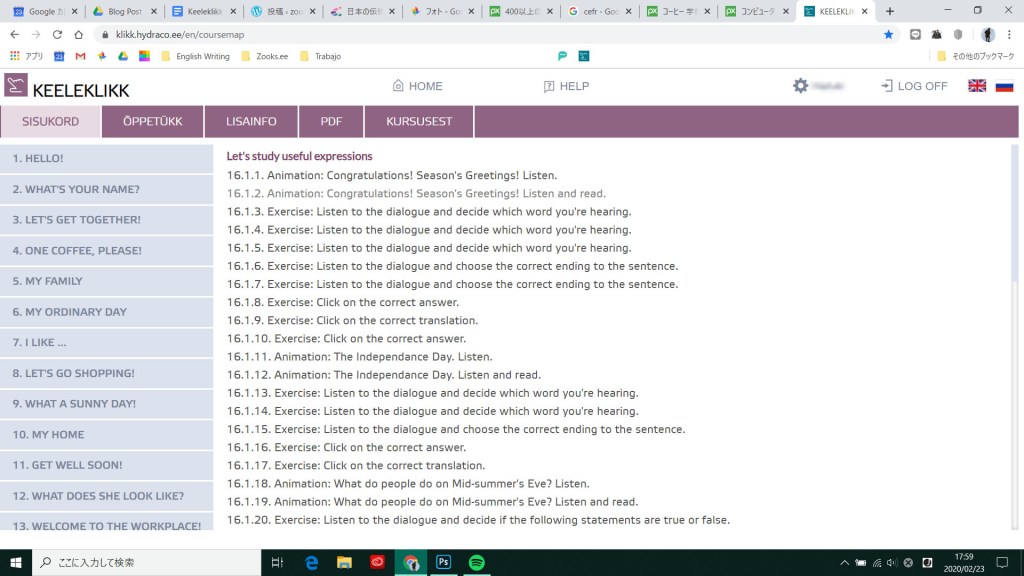
Keeleklikk is an online Estonian language learning platform. It’s easy to register by using facebook, Google or simply email address. As of the 24th of February 2020, Keeleklikk has two versions: the older version and the newer one. It totally depends on you which one you want to use. Here are my viewpoints on both versions for those who have slightly difficulties to choose:

The older Keeleklikk

  • Advantage
    • No system error (as far as I experienced).
  • Disadvantages
    • Tacky design.
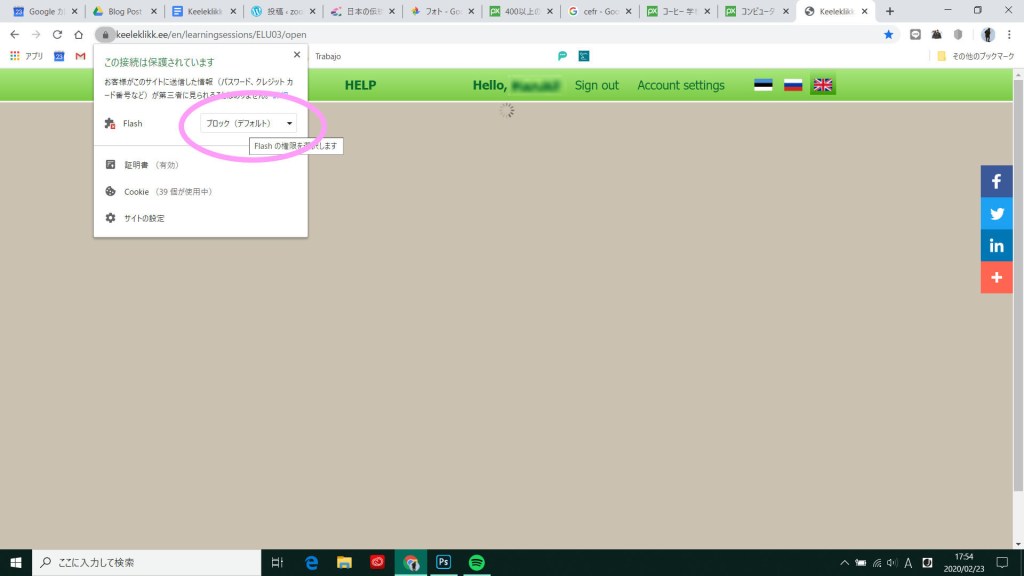
    • Since it uses Flash, Google Chrome users (probably) get automatically blocked so whenever they log in, they need to “permit” the Flash.

The newer version

  • Advantage
    • Stylish and minimalistic trendy design.
    • Since it doesn’t use Flash it’s easier and smoother to start lessons
    • It keeps you logging in.
  • Disadvantages
    • There are frequent system errors.
    • Even after the final exam, it doesn’t completely show the result, which means it doesn’t produce the result in PDF (but I’ve been asking so if there are any progress on it I will add it).
    • The animation videos sometimes (deliberately?) doesn’t have subtitles.

However, personally I preferred the newer version so when the animation video didn’t have subtitles, I just had one more tab on the browser and read the English translation of the script in the following lesson, listening to the dialogs. To sum up, it is possible to make up for the disadvantage in the newer version!

If you want to continue to learn Estonian on Keeleklikk, according to your progress you may decide which version is more suitable for you.

Keeleklikk itself has advantages!

I’m not sure how people learn foreign languages in your countries but in Japan they tend to buy some text books when they want to learn English, for instance. If it’s going to be their skill, I think it’s good to “invest” money on themselves. However, there is nothing better than something free with fine quality.

Keeleklikk is an online Estonian language learning platform as mentioned, everything there is free of charge. There are around 16 chapters and each chapter consists of three to five lessons.

One lesson usually includes: animation videos with English subtitles, the transcripts of the videos (which provides the English subtitles as additional options), quizzes, grammar tutorials (which usually lasts one to four minutes), grammar quizzes, speaking practices with the computer by translating English sentences and email writing to the teacher about the lesson topic.

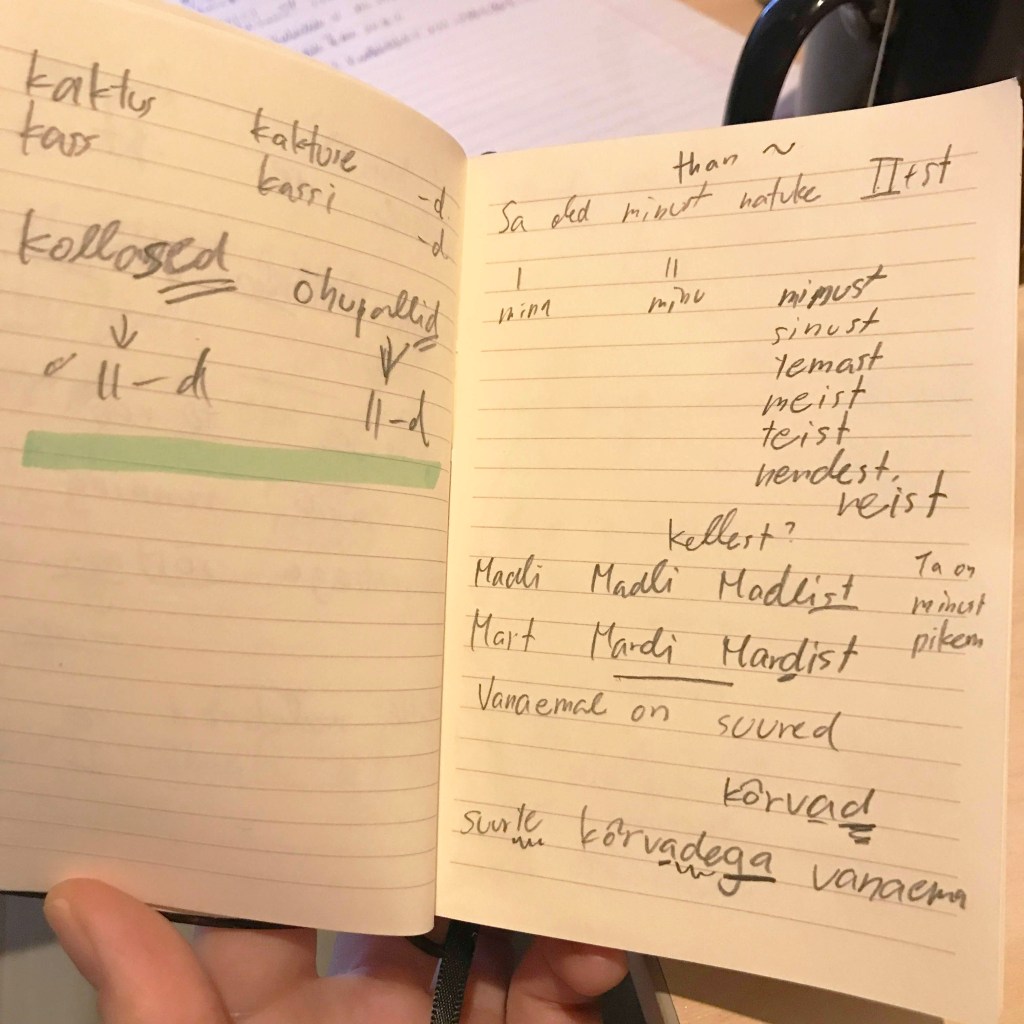
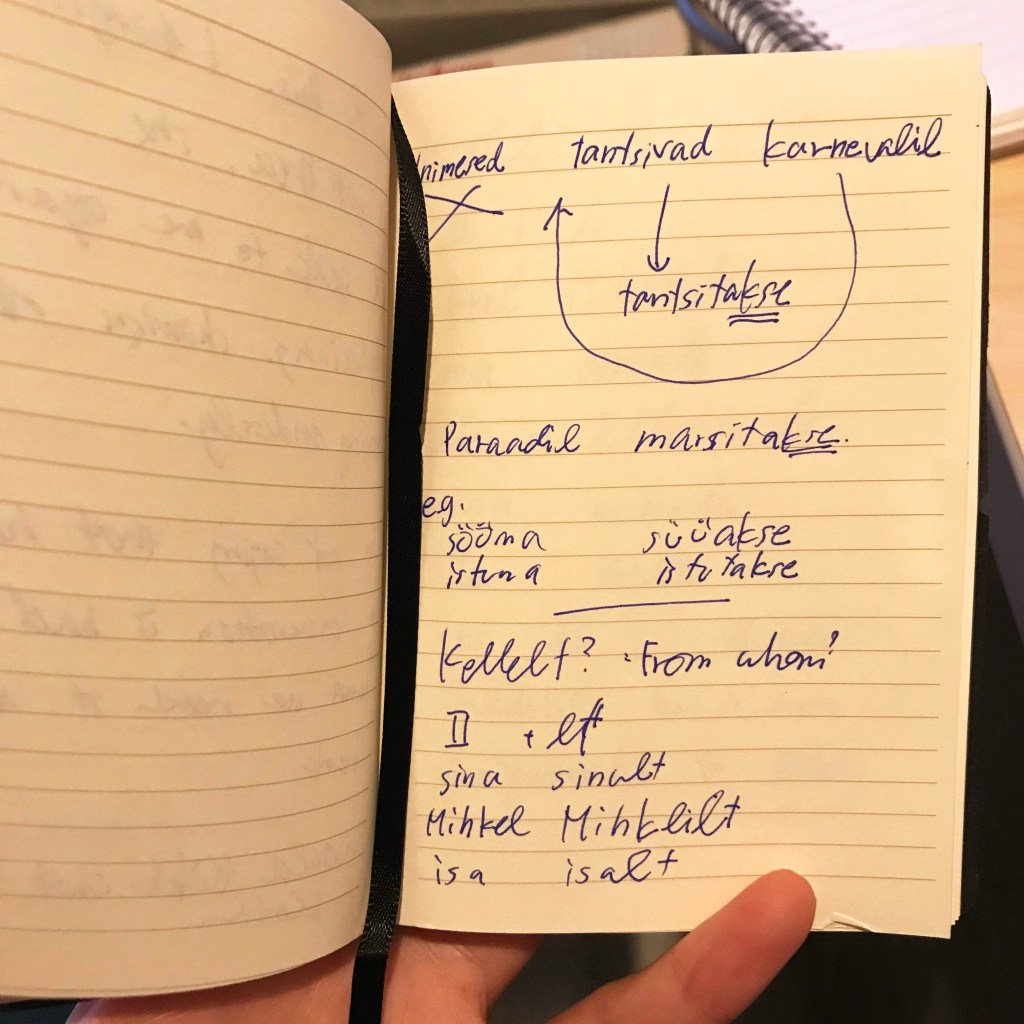
When it came to the grammar tutorials, I just had notes on thephysical memo pad and summarised and organised what I learnt on Evernote where I created a “notebook” for Keeleklikk after each lesson.

The reason why I had notes on only the right side is because it was faster to take notes on the single side on this notebook. No worries, I’ll use the other side later. No waste.

I personally think that any language learning platforms (especially available in Japan) should “mimic” one of the styles of Keeleklikk, which is the speaking practice with the laptop and email writing. It is difficult to practice these skills but it’s more difficult to improve those skills by using textbooks. Also, usually a lot of similar online language learning platforms like Keeleklikk are liable not to reply or correct learners’ texts by email even though they say “Let’s write an email!”. 

However, Keeleklikk does.

In addition the teacher usually replies with corrections within 20 – 30 minutes.

I don’t have much vocabulary so it was really exhausting and I didn’t write for the last three chapters but I did when I had energy to do. It’s always important to continue.


Keeleklikk aims A1 to A2 (for beginners)

In Japan we don’t have clear levels for language learning unlike Europe. Normally the range is beginner-intermediate-expert. However Europe has CEFR (even though it seems some schools have similar systems of level cetegorisation).

As repeated Keeleklikk is an online Estonian language learning platform for beginners, that is, until the A2 level. (There seems to be another platform for Estonian language learning from B1 but let’s just keep it in mind and talk about it sometime in the future.)


After finishing all the lessons you may take an exam there. (Oh, it doesn’t mean that you must complete every lesson one by one. You may skip some if you wish and may take the exam right after the registration but you need learning first of all, don’t you?)


I actually took the exam twice but still haven’t got the certificate.


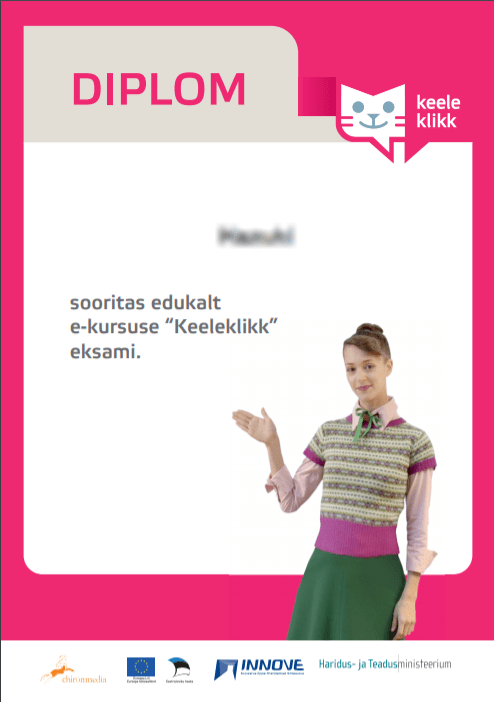
Keeleklikk provides you with the certificate after the exam!

Maybe because I took the exam in the newer version but not sure. Anyway I couldn’t download my result in PDF even after the exam and clicked everywhere but it always just went to the first blank page of the exam.


(Sigh.)


Moreover, the newer version of Keeleklikk had a contact form but the “I’m not a robot” button was broken so I couldn’t send the message. I went to the older version and found the email address in a tiny font below the webpage and finally emailed.

As of the 24th of February 2020 I still haven’t got any reply but probably because I sent the email on Saturday. If there’s any progress I will renew the article. 

Since we don’t have good Estonian language learning books or equivalents in Japan(ese), learning it in English is the (only) way and yet I personally believe that it may be easier to learn it from Japanese. Anyway, you can access Keeleklikk no matter where you are as long as you have the internet. If you are enough fluent at English, why don’t you try to learn Estonian?

★Addition on 29th March 2020

Since I sent an email to Keeleklikk, we had communicated approximately once a week and three times in total. On the 29th of March I finally could get the diploma on Keeleklikk.

I took the exam around five times in total.

Yeah I didn’t expect that I would take the same exam five times due to the errors… Now you can get the diploma on the new version of Keeleklikk and I also reported them some errors so you may not see any errors while learning the language.

Aitäh! 🙂