Zooks Concludes Agreement to Spend Comfortable(?) Life in Estonia.

Tere!

As previously mentioned in the an article about moving to the third flat in Estonia, I have two flatmates now: one Hong Kong guy and one Lithuanian girl. In my opinion we’ve been good.

So far I don’t have any complaints (except for the fact that the Hong Kong flatmate revealed what would happen to one of the main characters in “Supernatural”). Anyways, he made a welcome dinner and we talked about ourselves and the flat on my first weekend here.



How are they like?

Humanity and personalities are very crucial since lacks of these may cause issues but I rather wanted to know more about the flat rather than the people to be honest. After introducing ourselves, we talked about the rules in the flat but


Jesus here’s real Sheldon.


Do you know “The Big Bang Theory”?

It’s an American comedy show which lasts until the 11th season (though each episode takes only 20 minutes or so). One of the protagonists of this show is named Sheldon, who is a genius physicist and shares a flat with another protagonist Leonard who is also a physicist. Leonard has concluded a roommate agreement that consists of tens of pages made by Sheldon.

Alright, let’s get back to the topic: my Hong Kong flatmate. After the talk about ourselves, he opened the Word file with his laptop and showed “Flatmate Agreement” like the “Roommate Agreement” that Sheldon made for Leonard.

The differences between ours and Sheldon’s are the volume of the agreement and unnecessity of signature.

We agreed orally and he shared the file of the flatmate agreement with us.

For those who are currently fighting with your flatmates or who are planning to share a flat with someone unknown, you may use or refer to our flatmate agreement to spend a peaceful life. I uploaded it in PDF so please find and download the file at the end of this article.

So, in terms of the flatmate agreement, what exactly did we talk about and agree to? Basically these are rules/tips to keep our flat clean and socialisation among us.


1) Secrets to keep the flat clean

Bathroom

・Avoid SLAMMING the door/toilet cover after use
→ I guess this is because this Hong Kong flatmate’s room is just in front of the bathroom. lol The Lithuanian flatmate and I don’t mind that much but it doesn’t mean we were resistant to do this, so we don’t slam but just close the door.
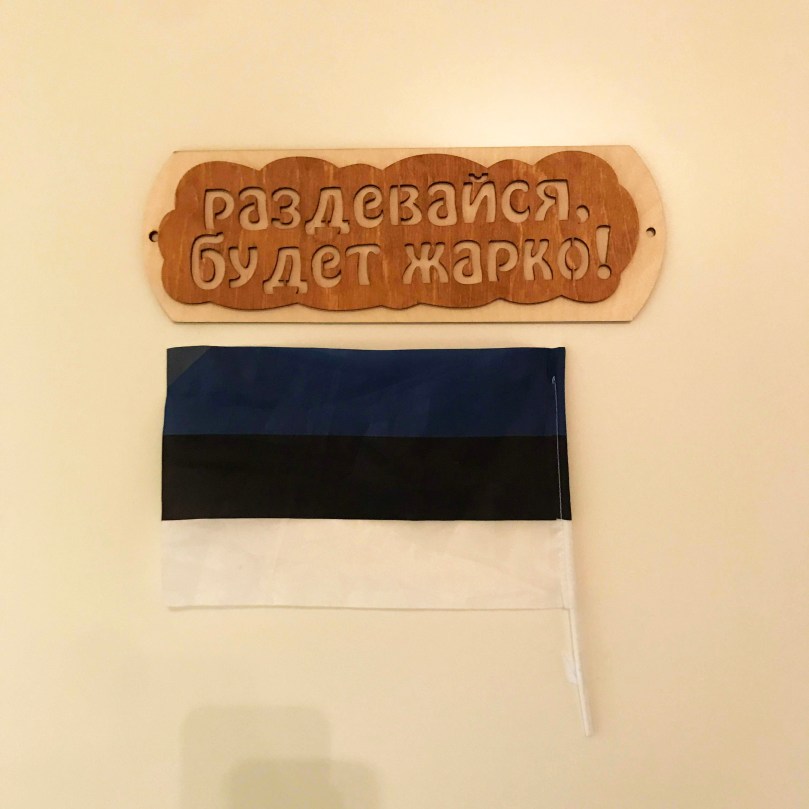
It’s written “Be careful, the inside is hot!” or something like that in Russian (according to the Hong Kong flatmate).

・Use it (the bathroom) for maximum 30 mins
→ This one was made considering the “congestion” of the shower use but both the Hong Kong flatmate and Lithuanian flatmate take showers in the morning and I do before going to bed so it wasn’t problematic. (Besides the Hong Kong flatmate wakes up at 5.30 every morning and the Lithuanian flatmate does at 9 am. After that they seem to take showers so it’s also not problematic even for them.)
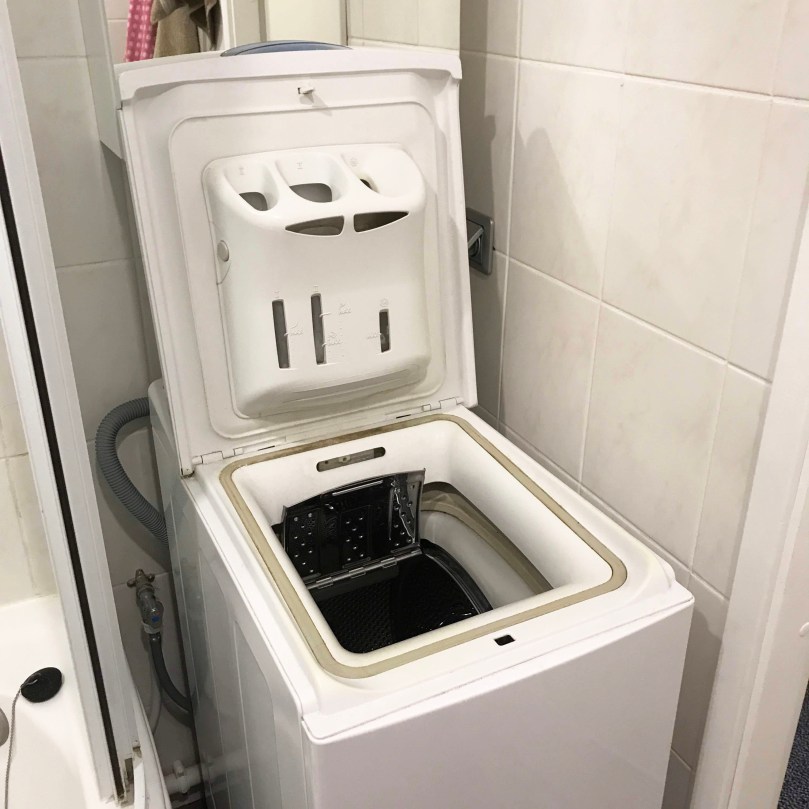
It’s also a rule to open the washing machine for at least one hour after the use because of the humidity inside.

・Clean the toilet bowl THOROUGHLY after use every time
→ Actually this doesn’t happen that often. I just flush normally as long as there is no significant dirt. However, it is true that we can always keep the clean toilet if we deal with our own dirts right after the use.
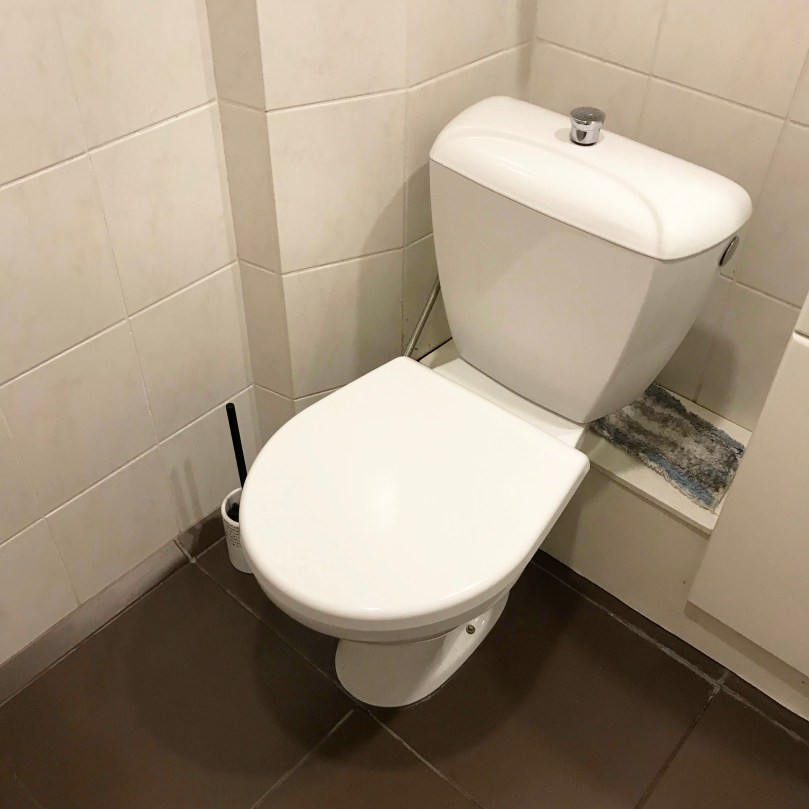
How to flush: pull the silver thing on the toilet.

・Take away personal items after use EVERY TIME (except towels) 
→ There are shelves in the bathroom so I keep mine such as a toothbrush there. Also there are towel hooks on the wall. That’s why this item says “except for towels” but I personally have one face wash headband that I bought in Disney Sea last October. My previous one was Elmo from USJ where my mam bought for me. I’d used it for a quite long time.

・Clean all the hairs of the tub after showering
→ This a common sense and yet there are the certain number of people who do not have the ability to do this. (Yeah, I experienced already. It happened in the first flat in Estonia, and everytime after the German or Italian girls used the showers their hair was literally everywhere. It was disgusting and shocking even though I’m a girl too.)
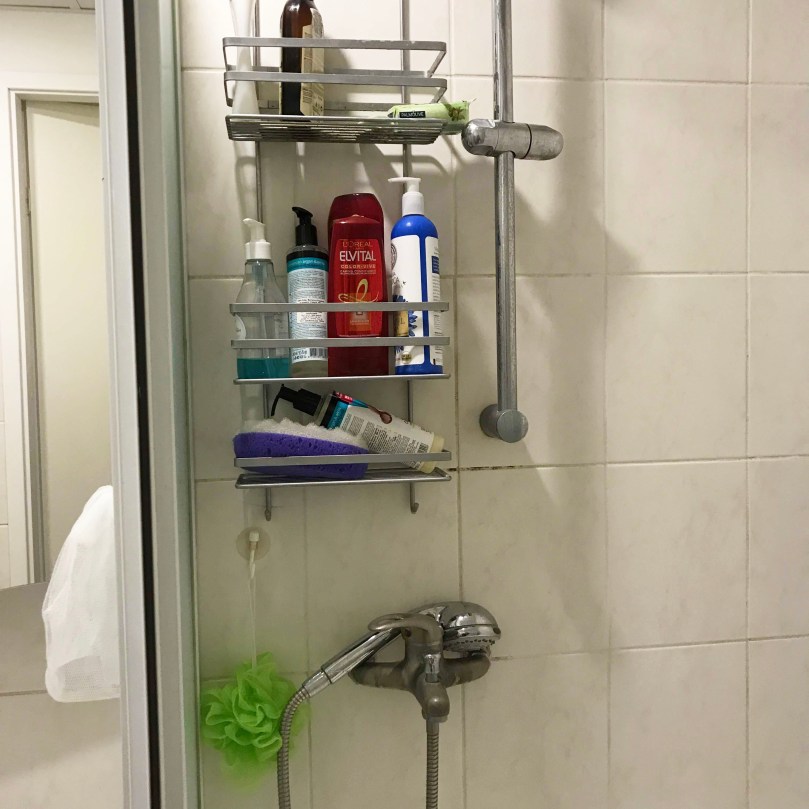
It’s exceptional if there are spaces to place the stuff. In other words, don’t put personal belongings anywhere which are not racks or shelves. 


Kitchen

・Clean all areas (stove, sink, table) IMMEDIATELY after use except emergencies (flatmates must be alerted)
→ There is also no wonder but what I personally do is to put my stuff aside not to bother the flatmates’ cooking. 
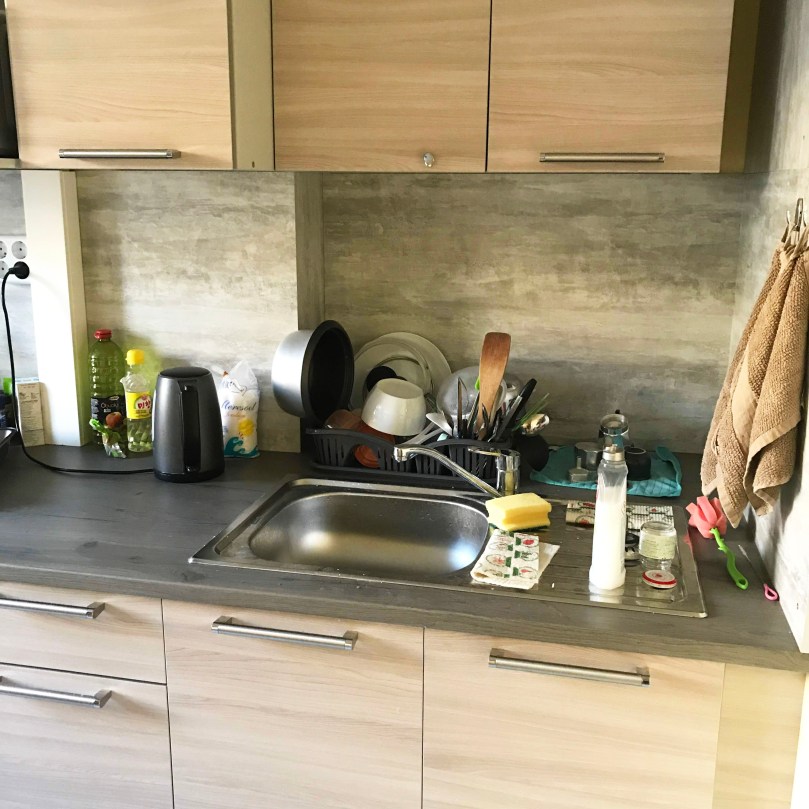
There are stoves on the left of this area and the kitchen is quite spacious. It’s really pleasant for me like a person who likes cooking.

・Never switch the stove to the maximum heat for a long time
→ This rule was made because they experienced to have a pot with too boiled stuff but I believe that it’s because the one who cooked was just not good at the kitchen management/cooking rather than the heating system was too strong… I agreed though, because still I can cook with lower heat.

・Store leftover properly with a cover 


Wait, if we store foods without any cover in the fridge, they would get super dry.


Corridor

・Both inner and outer doors must always be closed
→ Our house entrance has two doors and if we keep the inside door open, there’s no space for the Hong Kong flatmate when he leaves his room. So this is also irrelevant for my and the Lithuanian flatmate’s lives but keeping it close would not cause any annoys among us.

・Boots must be put on the upper side of the shoe rack


First of all, boots cannot be fitted in the lower case.


・Other shoes (e.g. slippers, sneakers etc.) must be placed on the lower side
→ We concluded this flatmate agreement quite recently, that is, in winter. We also agreed that it’d be better to keep the shoes on the rack depending on the season. Come to think of it, where did I put my other shoes…

・Always empty the corridor
→ My room slippers are not exceptional but it doesn’t mean that I have complaints about it. I just take them off in my room as I leave. That’s it.


Weekly cleaning

・Everyone takes turn per week
→ Someone has to be in charge of cleaning the flat once three weeks (obviously because we are three of us here). It may sound like something big since one tenant has to clean the whole flat but also it’s confusing and troublesome to manage the cleaning schedule if all of us clean the flat dividing into three parts, which may get more troublesome when someone cannot handle it for some reasons (as far as I experienced) so this is actually the best way.

・The person-in-charge has to buy all necessary detergents
→ Well, we have different time tables every day so it’s not always possible for someone in charge of cleaning the flat to buy necessary things. Therefore, actually someone who has time to go shopping buys and later on the rest of us pay back. I think this is the best way so that we can be financially equal.
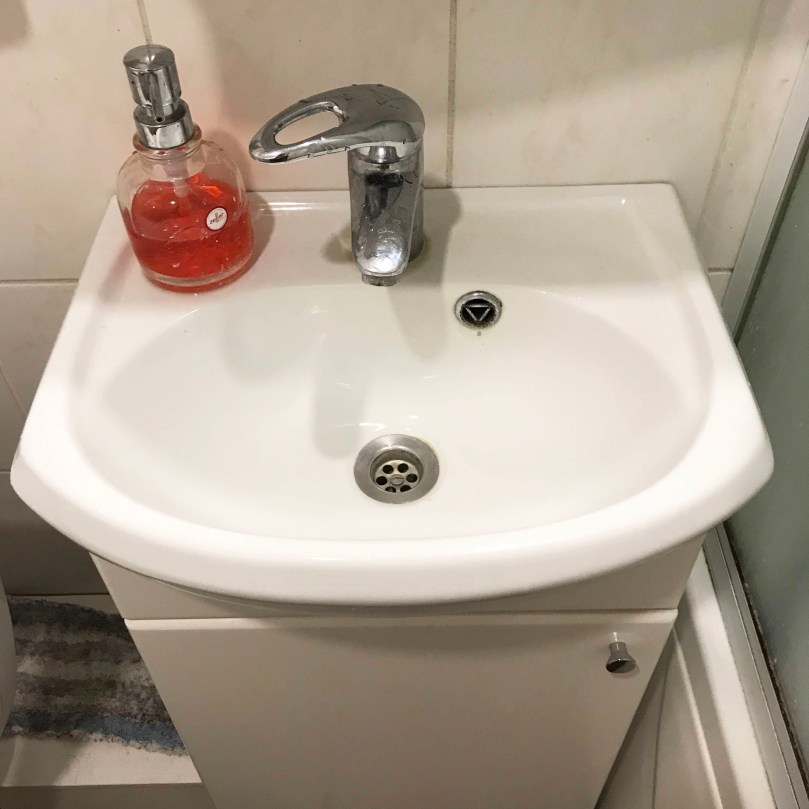
This sink is really small so I always use water from the shower when washing the face in the morning.


2) Socialising

Active hours

・Be quiet before 7am & after 11pm
→ I don’t think this is our flat-specific rule. In Estonia (or in Europe? in Ireland where it may have been the same), there are active hours. (It might be 7 am to 10 pm in public like a supermarket.)
This is to avoid the neighbour issues. It didn’t surprise me but because of my work I once in a while have to make calls in the early morning to New Zealand which has a 10 or 11-hour time difference with Estonia. (I try to tell my flatmates beforehand but it’s not always possible so I apologise in my mind.)

・Family calls can be made not more than 30 mins agreed by other flatmates
→ Our Lithuanian flatmate often talks with her husband who is in Lithuania but I’ve never been bothered due to this so I really don’t mind. I can sleep anywhere and don’t talk with my family. If I talk with my friends in Japan, it takes at least one hour though.


Internal

・Everyone takes turn to cook for the rest twice a month to ensure sufficient internal communication on a regular basis
→ The aim is to communicate with three of us. (I would have disagreed if the flatmates had been like the tenants in my previous flat.) It may sound too much for some people but the frequency is low and is nearly once a month.
The other day was my turn and I was lazy to think of what to cook so I cooked onigiri (rice balls) and nikujaga (like a stew with meat and potatoes and vegetables). Then I swore to myself: I would never ever buy Rimi’s soy sauce again. It just made the food in black without enough taste of soy sauce. Rimi has Kikkoman’s soy sauce, which is a proper Japanese brand and not cheap but it ensures that we can have the proper taste of soy sauce.


External

・Individual guests must stay at the host’s own room without interrupting shared area
Common sense, isn’t it. However I do know that there are some number of people who do not, again, have any ability to do this. Can you guess how many times the Indian tenant’s guest in the previous flat took my food from the fridge and use my stuff even though I kept them separately or marked as mine?
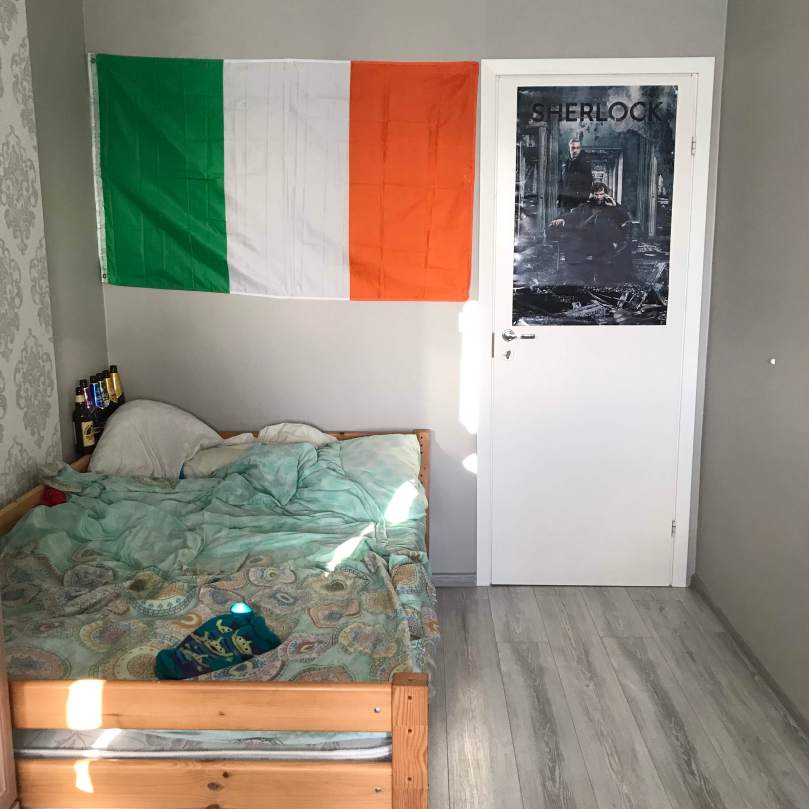
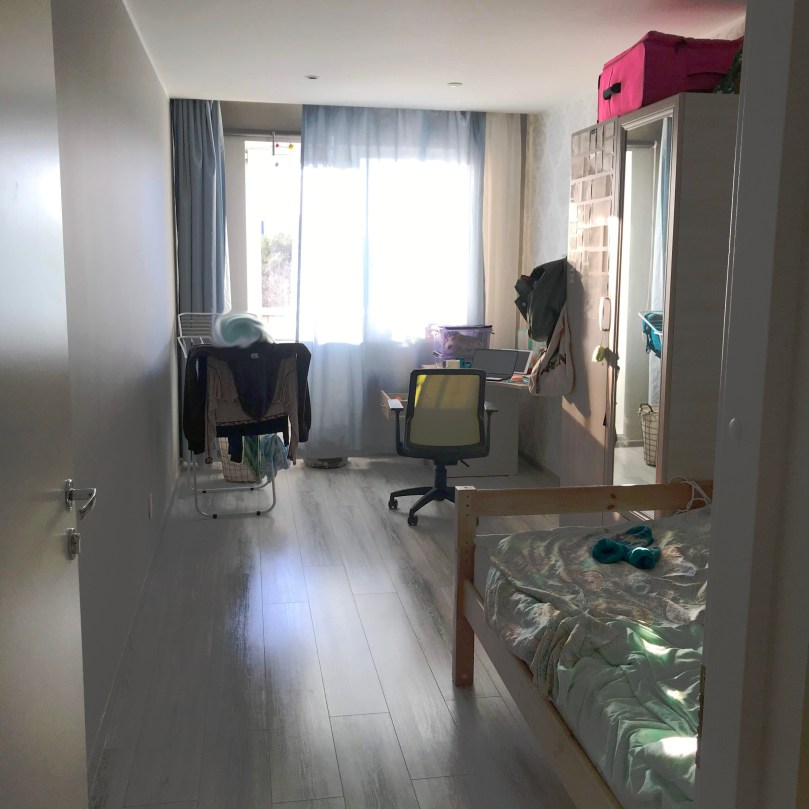
・The presence of individual guests of the opposite sex (of the host) must be informed in this flat prior to his/her arrival 
→ This item was made in case one of us brought their date or partner. lol However we actually let the others know when same-sex friends or someone will come to visit. It’s still better than nothing.

・The presence of groups (>1 person) should only be accepted when there is an unanimous agreement in the flat
→ Yeah it’s gonna be noisy when there are too many people in the small place… In the first flat in Estonia when there was a huge party which around 50 guests came, I was just shutting myself in my room, being annoyed.

…Okay, that’s it. Does it seem too much for you? Some items (or maybe all?) of this flatmate agreement have my comments but so far we have lived peacefully. It may be kind of sad for my flatmates because having my own time is really important to me but they may learn that the world has such a person.
If you want to see or get our flatmate agreement, you can download below. 

Aitäh! 🙂

Vastlapäev! Zooks Makes Estonian Sweets (Vastla)kukkel.

Tere!

There is a “holiday” that I celebrate (?) every year since I spent one year as an exchange student in Ireland, which is

Pancake Tuesday” (Shrove Tuesday).

It’s always Tuesday as you might know. If you google “Pancake Tuesday 2020” or something like that you’ll get the specific date.

I used the word “celebrate” but it doesn’t mean they or we do something very ultimately special. In addition, I’m a Buddhist. (Apparently Pancake Tuesday isn’t a culture from our country.) As its name suggests, however, we/they eat pancakes.

They were selling pancakes at the restaurant (I mean, school restaurant) of DCU (Dublin City University) in Ireland. I really loved and still can never forget how tasty the pancakes with lemon and sugar were!

By the way, in Ireland “pancakes” normally look like crepes. Some people (especially the Japanese) may imagine fluffy huge pancakes like Hawaiian pancakes when hearing the word. I thought that too so I asked one of my Irish friends who was with me at that time and he said:


Because it’s a cake made in a pan


Totally makes sense.

Since then, I always eat pancakes on Tuesday around in the end of February. Even in Estonia too.


BUT!


In Estonia it’s different. Technically speaking this “Estonian” culture came from Sweden but anyways “Pancake Tuesday” doesn’t exist in Estonia but still they have  “Shrove Tuesday”, which means they don’t eat pancakes on this day and is called “Vastlapäev” in Estonian.

As mentioned earlier, this “Estonian” culture is said to have come from Sweden so there’s an alternative dessert replacing with pancakes, which you would often see at cafes in Estonia around from the beginning of February and it’s called “semla” in Swedish. In Estonian, however, it’s called


Vastlakukkel.


It seems that the dessert which they have on Shrove Tuesday is vastlakukkel and in regular days is just kukkel. Maybe. Not sure. Just my linguistic guess. But still you can get one if you say “kukkel” at a cafe or bakery. They would understand.

This year, in 2020, I made some resolutions which brush up my skills, one of which is “to make sweets that I have never made yet” so I decided to enjoy both cultures (Irish and Estonian Tuesdays) and make both pancakes and kukkel for this year’s Pancake/Shrove Tuesday.


1. Upgraded my regular (?) pancakes

I’m pretty sure almost all of you wouldn’t get surprised but flour products in Estonia are cheap from my point of view because Japan has a rice culture and the flour products are pretty expensive. We have a variety of cake flour products, okonomiyaki flour and takoyaki flour like cup cake flour or pound cake flour available in Estonia. We also have Japanese pancake flour called “hotcake”.

Anyways, who cares about the Japanese pancake flour here. This time I bought Vilma’s pancake/crepe flour. Usually you don’t need Google translate for the flour products in Estonia because they have image procedures on the side of the package, which are quite understandable. Vilma’s pancake flour is not exceptional.

If you buy this product, as seen on the side of the package, flour : water = 1 : 2 so I made pancakes with flour 100g + water 200ml. It’s a crepe dough but it doesn’t require the time to rest. Instant cooking.

After mixing the flour and water, just heat the pan and put some oil and then the dough. If the pan is enough warm the dough instantly gets bubbles on its surface so just turn over the pancake. You may fail to get a perfect pancake slice at the first time but it doesn’t affect its taste.

Of course if you eat it with nothing, it just tastes like the dough.

In the old town in Tallinn, there is a pancake restaurant called “Kompressor”, whose pancake with mushrooms and cheese are so tasty. Creamy. So tasty!


Then


One day I talked about this pancake to my Estonian friend and she told me that it’s easy to cook this sauce. She told me the recipe so I made it for my special pancakes for this year’s Pancake Tuesday.

Ingredients (Possibly for two)

  • Small onion x1
  • Relatively big mushrooms x3
  • Sour cream 250g
  • Butter (as much as you wish)
  • Salt (as much as you wish)
  • Pepper (as much as you wish)
  • Dill (as much as you wish)

How to

  1. Mince the onion and slice the mushrooms around 5mm thick.
  2. Heat the milk pan (over medium heat) and put some butter.
  3. Add the minced onion before the butter gets burnt.
  4. After the onion gets half cooked, add the mushrooms and fry altogether.
  5. As everything was enough cooked, heat the pan over low heat and add the sour cream. 
  6. Pay attention not to burn the cream and add the salt, pepper and dill (which you may exclude) and stir it.
  7. If you think it too creamy you may add some water or if you think it less creamy than you expected you may add some cheese.


This is it.

It’s easy isn’t it?

In some countries like Japan it may be hard to find sour cream though…

By the way, the cream would get separated in the end if you heat the pan too much so be careful. Heating the leftover in the microwave oven is also not recommended (as I experienced) not for the taste but for the looking. It’s better to have it with pancakes right after cooking.


2. Made Estonian sweets, vastlakukkel !

And!

As mentioned earlier, I wanted to celebrate (?) Estonian pancake Tuesday called Vastlapäev so I made vastlakukkel! I referred to this recipe. It’s in English and since I made some changes according to ingredients available in Estonia, I’m introducing my recipe. (It takes time and there are lots of procedures but it’s not that difficult. Though it may not enough convincing because I like baking sweets….)

Ingredients

  • Buns
    • Milk 500ml
    • Dried yeast 25g
    • Regular flour 800g (divide into half and sift them before the use)
    • Sugar 3 Tbsp
    • Salt 1 tsp
    • Grounded cardamom seeds 1 tsp
    • Butter (or baking margarin) 200g
    • Egg x2
  • Filling
    • Heavy cream 400ml
    • Sugar 40g 
    • Lemon juice 2 tsp

How to

  • Buns
    1. Take all the ingredients out from the fridge one hour before starting making dough.
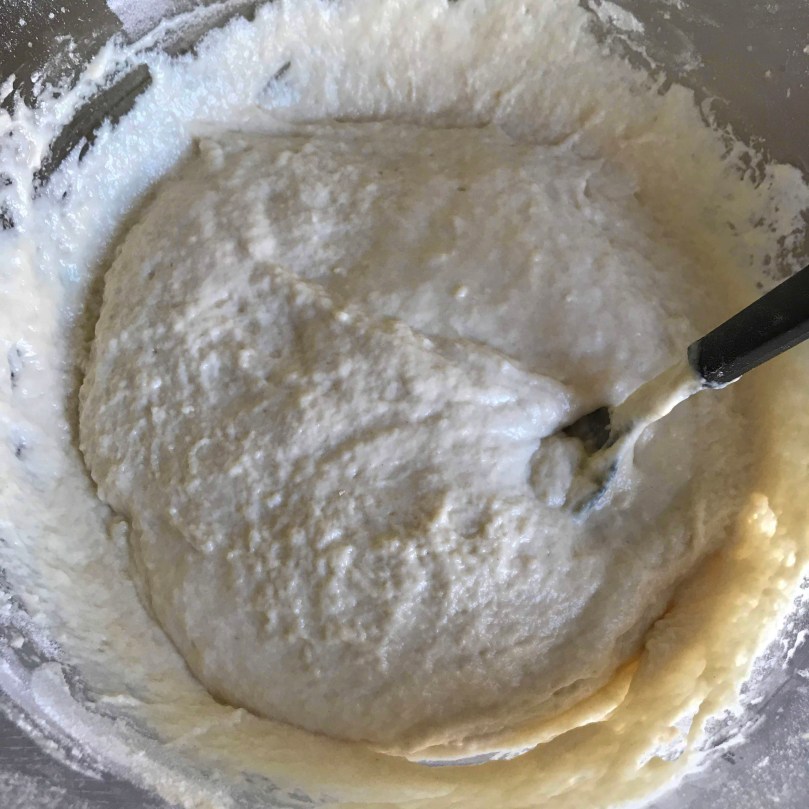
    2. Put the yeast in a bowl and add the milk little by little stirring it with a wooden spoon or spatula. (The yeast that I bought had an explanation of how to use so I heated the milk in the microwave a bit. As for the wooden spoon or spatula, I don’t know the reason.)
    3. Add sugar and the half of the flour (400g) and mix it. (Personally the rubber spatula was better than the regular spoon.)
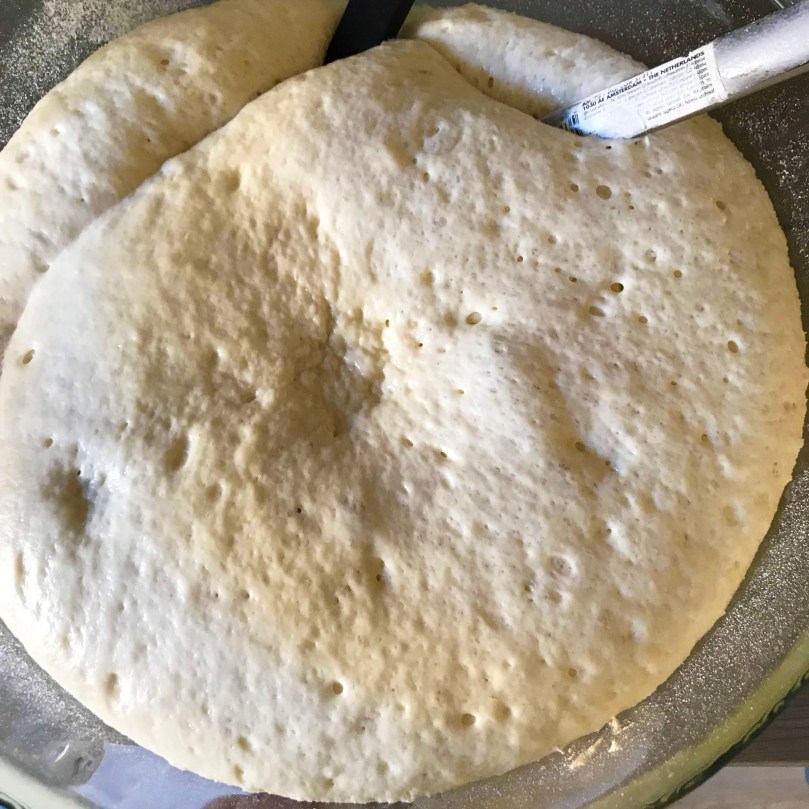
    4. Cover the bowl with a clean cloth or kitchen towel, put it in a warm place and have it rest for 30 to 45 minutes. (Don’t ventilate the kitchen.)
    5. As the dough was sufficiently inflamed, add the salt, cardamom (which I didn’t use), melted butter and whisked eggs and mix them.
    6. Add the rest half of the flour (400g) and mix them.
    7. The dough is not liquid anymore so keep kneading for 10 to 15 minutes. (I kept using the rubber spatula to knead.)
    8. When the dough gets shiny and not sticky to the bowl, cover the bowl with the cloth or towel again and put it in the warm place for 45 to 60 minutes.
    9. Knock the dough in the bowl and have it rest for additionally 30 minutes.
    10. Take an egg-size dough and roll it like using a computer mouse.
    11. Leave the rounded buns for 30 minutes again. (I preheated the oven at this timing.)
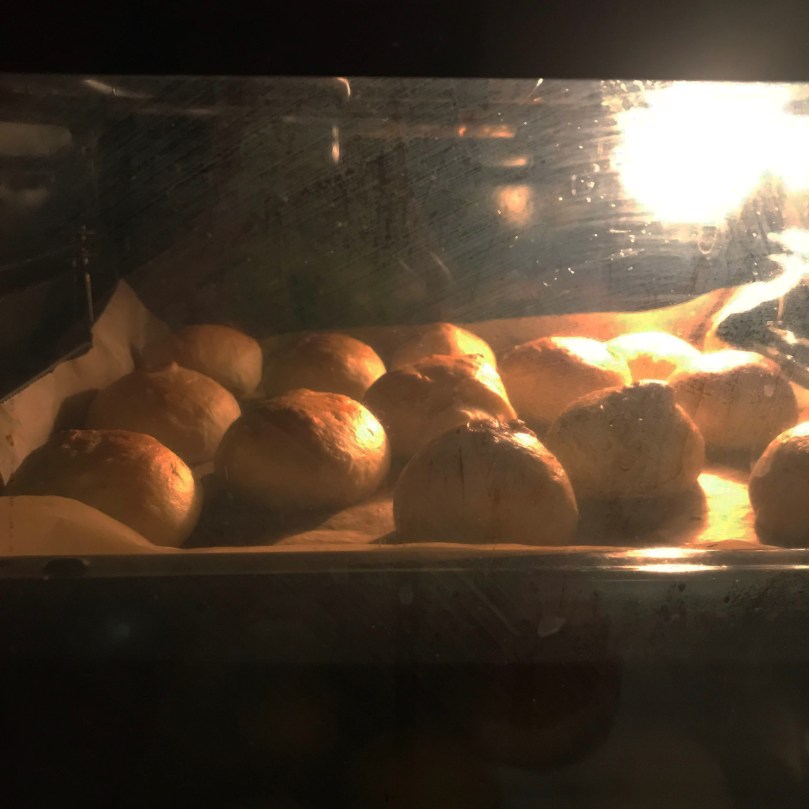
    12. Coat the surface of the buns with milk or whisked egg and bake them in the oven at 200 to 225°C for 15 to 20 minutes.
  • Filling
    1. Have some water with ice in the bowl or something and place another bowl on that, where add the heavy cream, sugar and lemon juice and whip it until it gets 80% thickened.
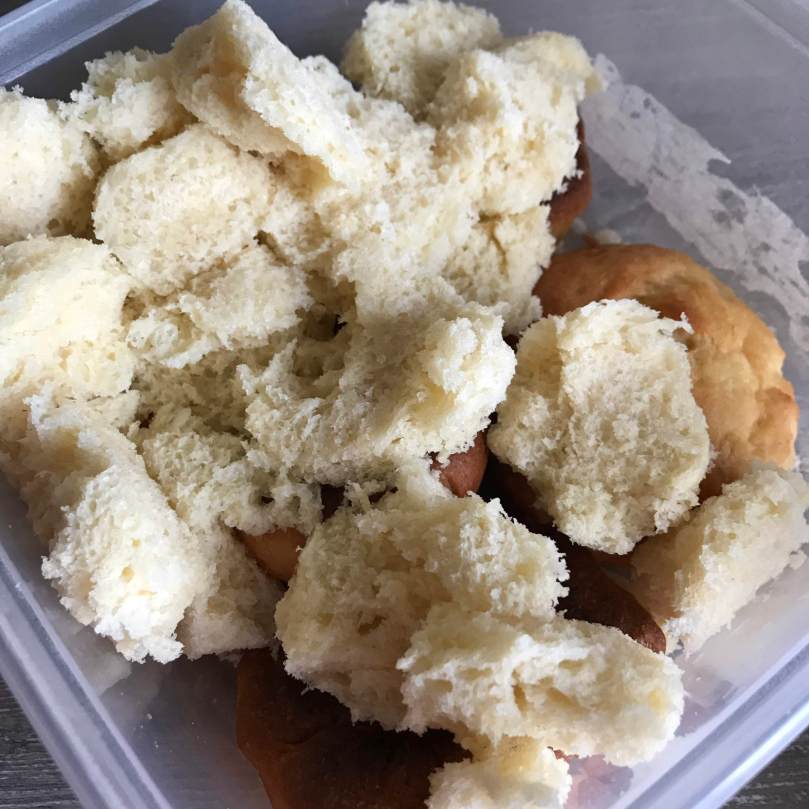
    2. Cut the top of the bun like a lid and scoop out the inside of the bun.
    3. Squeeze the cream in the bun until it slightly has “too much” cream and then place the “lid” on the top.

I forgot to do but you may also add powder sugar on them as decoration.

I also referred to a few Japanese recipes regarding the cream so probably my kukkel is less sweet than the ones available in Estonia. Moreover, the original recipe about the kukkel buns said there would be around 24 buns but

actually I got around 33 buns in the end.

My hands are relatively big among other Japanese girls but I guess the baker who originally made this recipe that I referred to may have bigger hands than mine.

Not sure though.

After all I gave two buns to my flatmates and more than 20 buns to my colleagues.

They seemed happy!
This recipe takes almost a whole day but the ingredients are quite simple so try to bake kukkel in your countries and enjoy Estonian (Swedish?) culture.

But I still believe cream-puffs are tastier.

Maybe next I’ll bake them.

Aitäh! 🙂

Zooks Registers Family Doctor in Estonia.

Tere!

Listen, I finally registered a family doctor (or home doctor or GP, whatever you want to call).

You may wonder how to register a family doctor in Estonia. This article handles topics from how to find a family doctor to how to “use” them, dividing into four sections.

1) Who can register a family doctor?

In order to register a family doctor, you need a residence permit. In other words if you are working for an Estonian company or a degree student in Estonia, you automatically have the right to register a family doctor in Estonia. (See this for more information.)

In my case, since my purpose to come to Estonia was study as a master’s student, two years ago in 2017 I could have registered a family doctor when I got the TRP. With a family doctor, you may get treatment at quite cheap fee or some special services for free so it’s better to register one. When I was in Ireland as an exchange student in 2015-2016, I didn’t catch any cold or get ill at all so I had spent time in Estonia without a doctor. However, I really felt I needed a family doctor as my depression level was still low and tried finding but at that time I was working at full time, suffering from many things and spending time as a depressed individual. It was eventually after leaving the hospital when I got a family doctor.

Also, if you can speak Estonian (or Russian), you may not find any difficulty in getting a family doctor, but in addition to the fact that there are more immigrants in Estonia and that we automatically require English speaking doctors, it’s not easy to find a family doctor in Estonia. In the following sections, I’m writing about how exactly to find a family doctor.

2) How to find a doctor?

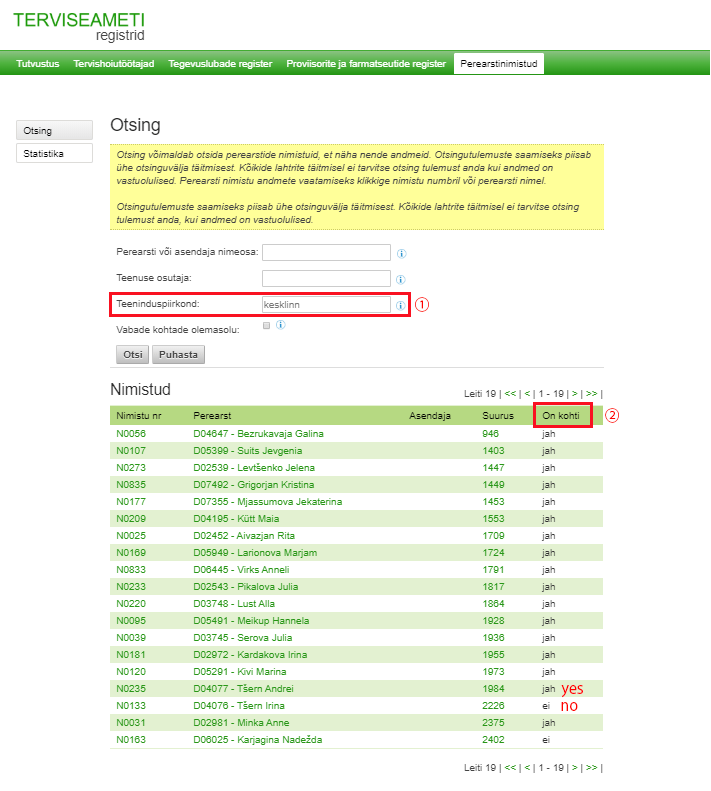
First of all, access the website to search family doctors in Estonia. It’s available only in Estonian but it’s not that difficult to use this website. As accessing, the third box is a search box depending on areas so enter your area that you live in. After the entry, click “Otsi”. The example is below.

I entered “Kesklinn” as an example. (2) in the image measn doctors’ availability. If they can accpet new patients it says “jah” and if not it’s “ei”.

If you found someone who seems to accept new patients, click their name under “Perearsti” column and call or email them.


Usually they say they don’t accpet any new patients.


“What the hell! You just told us!”

You may have thought like that. Sorry 😛 but no worries, I’ll explain another “hack” in the following section, which might surprise you.

3) My case?

Listen, I tried the method above like you might have done. I called and asked them if they could speak English and told them that I wanted to register a family doctor – none of them could accept me.

Then I did this:

Search “Perearstikeskus”.

While in the hospital my friend advised me to ask my doctor there how to find a family doctor. He told me perearstikeskus in Laagri, where are lots of young doctors who might speak English more or less compared to elder doctors in Estonia. However, as mentioned above, they couldn’t accept me as a new patient.

“Perearstikeskus” means “family doctor centre”. I thought there would be more perearstikeskus in Estonia so I searched by this word.

I got multiple results online and chose one of them in Lasnamäe. From my experience I thought it was better to use Google translate and read Estonian. Then I found one doctor who seemed to be able to have new patients and called him:

Hi, could you speak English?

Yes I can.

I’m looking for a family doctor but could you accept me as a new patient?

Of course!

Well, I live in XX (the name of my living area) but is it okay?

Sure! Just come here and find my name!


I got panicked.


I called him desiring to get one so I was incredibly happy. It was Friday when I called him so I decided to visit him on Monday. The reason why I asked him the area is because some doctors (are said to be able to) accept only those who live in the area that they are in charge of. (Does this make more sense why I explained to search doctos by area above?)

The medical centre was in a tricky place and quite far from my (previous) place but I was sure I wouldn’t need him that frequently so the distance was not anything big for me.

4) Registration and after that….

Then on Monday after working I went to the medical centre. I asked a nurse and she gave me an application from (paper!) and I just wrote necessary information and the doctor’s name that I wanted. That was it. She said the system would have this information immediately.

Actually, however, it’s from the next month after the registration to have the family doctor available, which means your State Portal wouldn’t have a famly doctor information yet right after the registration. For example, given that you registered a family doctor in January, your doctor is available for you from February.

(However, as February started I checked the portal site but it didn’t have my doctor’s name so I asked Haigekassa and then mymed, which said my doctor would be available for me starting in March. Why the heck…)

It’s hard to find an English-speaking family doctor in Estonia but once you found one everything would be alright. Keep searching and this is the reality to live in a non-English speaking country.

I hope you can get one.

Aitäh! 🙂

Zooks Uses Sick Leave in Estonia.

Tere!

This time the article is about sick leave.

Maybe for some people it’s unfamiliar with it (because in Japan it is for sure.)

No worries even if you are unfamiliar with it, I’ll explain it.

The sick leave is a long-term paid leave due to sickness. In Estonia, though it depends on the work environment or style, it is quite common to work at home when you caught a cold for instance. One of my (Estonian) colleagues who works at part time caught a cold the other day and worked at home. I think this is one of the good points to be an office worker.

In Japan, according to my friends, they need to use their annual leaves when they caught a cold, which never happens in Estonia (as far as I know). Then, what about the hospital stay in Estonia? The sick leave is used for it.

Like the annual leave in Estonia the sick leave also limits the number of days that you can get, which is approximately 6 months for office workers.* You need a proper document for the leave but also can get benefit from Haigekassa (the Estonian health insurance organisation) and your company.

(*Check this website for more details. I definitely ommited the information.)

Here are three items for my case with the sick leave.

1) The unissued sick leave document

On the 31st of December 2019, at the final talk with my doctor he promised to issue the sick leave document. In Japan the first three days of the new year (the first to third of January) are national holidays but in Estonia/Europe they start working from the second. My company started 2020 on the third. However, everything started from the sixth because our boss couldn’t come owing to the cold.

Though it had been a week since January started, netiher my boss or our accountant nor I couldn’t see anything on our State Portal. Then my boss and I called the hospital, who said there was some kind of problem on Haigekassa’s system or something. This is actually a negative point of Estonia.

Any procedures online will be delayed sicne everything is digitalised in Estonia.

Eventually it was already the third week of 2020 when my boss could contact my doctor’s secretary.


Jesus, it took a fortnight to get the sick leave document.


Next day, both my boss and I could check the sick leave document on our State Portal.

Soon after the sick leave document was issued, the system worked so quickly.

I got the benefit on the next day my sick leave document was issued.

In order to get this benefit, you need to register your bank account beforehand on State Portal. Be careful – you can register only one account (= one account per person).

The calculation system is written in the following section.

2) Calculation of the sick leave with two years

In my case although I was officially released from te hospital on the 31st of December 2019, the sick leave document had the date 2nd of Januaru 2020, which means that I had two years in the document (2019 and 2020).

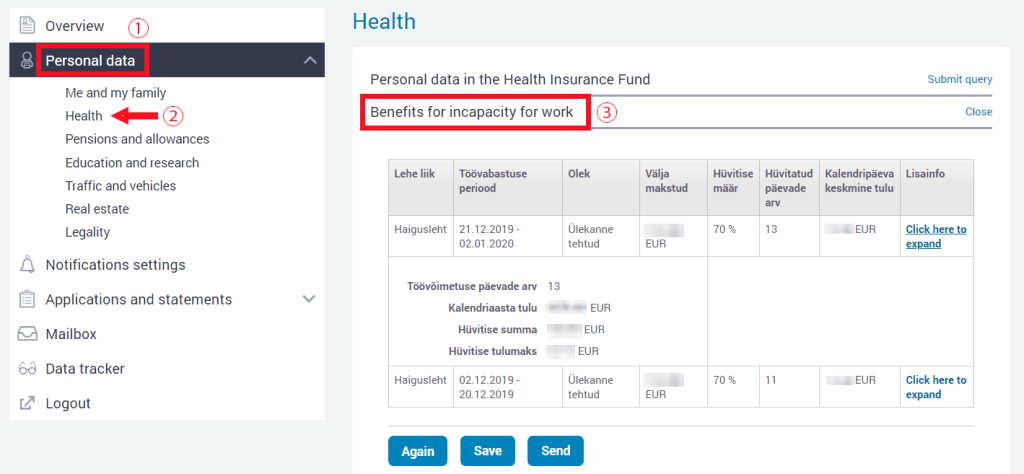
Haigekassa provides you with 70% of the social tax from the previous calendar year according to the number of days that you were in the hospital. The picture below is my actual sick leave document.

The first row of the table shows the benefit for the period that I extended to stay in the hospital (13 days). I was curious because in 2018 I worked at part time and in the half of October and November in 2019 I worked at full time so the social tax that I paid might be different. However, since my sick leave documents had the same number for the social tax, I guess it doesn’t matter whether your sick leave ended in the new year or within the year. Only the starting date seems to be considered. In other words, if your sick leave documents started in 2019 and ended in 2020, because it started in 2019, your benefit is calculated based on the social tax in 2018.

Also as seen in the image above, the third row shows 11 days but you can count 19 days based on the period in the second column. This is because you cannot get the benefit for the first three days (in my case the second to the fourth of December) and your company should provide you with the benefit for five days (the first four to eight days, meaning the fifth to the ninth of December in my case). Thus Haigekassa will give you the benefit based on the period from the ninth to the end of your leave.

In 2018 I worked at part time as mentioned and since I expected that my benefit wouldn’t be that a lot,


Jasus Christ, such a small amount money!!!!


weren’t my words or I had no damage. It was just good to know how much I could get.

3) Expense of the hospital stay

Finally, how much did I pay for the hospital stay for one month?

It cost 0€.

Usually, it costs up to 2.50€ per day and up 25€ per stay but it was an emergency in my case so I didn’t even get any bills and pay at all.

Actually, I still wonder if I do evrything correctly… Even if I have to pay for it, it’s not too much like a hospital stay in Japan. There wouldn’t be any financial issue on my side. (The thing is that since it costs a lot to stay in the hospital in Japan, my mam was worried about my finance.) When I was told to stay in the hospital the psychiatrist said it would cost a bit but there’s nothing (yet). I also asked Haigekassa but they told me to ask the hospital that I was staying and they didn’t deduct the stay fee as giving the benefit. I’m just lucky that I don’t have to pay for it.

In Estonia the medical stuff is way cheaper than in Japan.

I’m pretty sure this is not the major or universal topic but at least you could get some ideas regarding the medical side in Estonia and the sick leave. As for the family doctor, I’ll write another article in the future.

Aitäh! 🙂

Zooks Gets Prescription in Estonia

Tere!

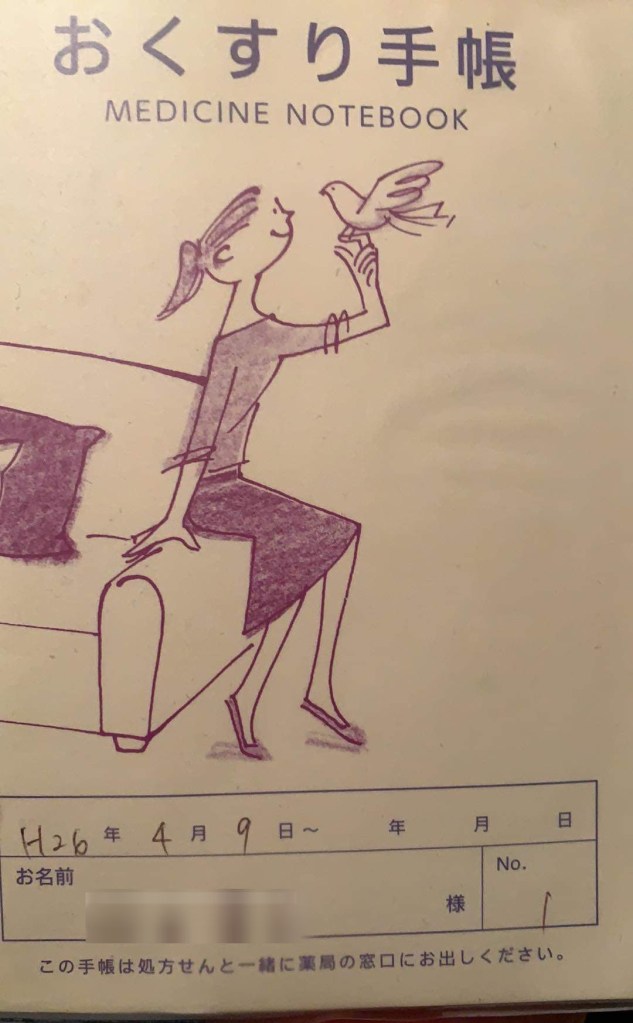
Do you have anything like a medicine handbook in yoru country? In Japan, more specifically as in Wakayama (my hometown) I didn’t have such a thing but I got one when I started my college life and got prescription in Kyoto.

So far I didn’t even think that it was a convenient or incovenient thing but whenever my doctors asked my medicines that I was taking I couldn’t answer at all.

When I got my first medical handbook/notebook it was literally sometihng physical with papers. Of course in Estonia you won’t get such a thing. Then, would they make a card like a consultation ticket (the hospitals in Japan usually make this for you)? Of course not. Here is Estonia, mate. I have once written about the use of this Estonian ID card as a library card in Japanese and the logic is the same; if the Estonian ID card works as a library card, it works as a medical handbook/notebook.

This time the article is about the prescriptions.

My Japanese medical notebook.

Don’t get surprised even though you didn’t know but I stayed in the hospital for a month. (Maybe I’ll write this story in the future.) On the 31st of December 2019, at around 10am I had the final talk with my doctor and my nurse.

We talked about the side effects of the medicines, the minimum period of taking them and the next appointment with another nurse and doctor. My doctor told me to take two kinds of medicines that I had been taking since I was in the hospital as well as vitamin D. He also said that I could buy the medicines not in the hospital but in a pharmacy though I didn’t know anything so he gave me a printed-out document of the prescription. Besides, I was told to keep taking them for at least six months.

Before leaving the hospital, I asked my nurse and she said I could buy the medicines in any pharmacy – like a normal one that you go to when you want to buy, for example, plasters.


Is it really okay to sell such medicines that need prescriptions?


I thought. However, it doesn’t mean you can “pick up” from the shelf in the pharmacy and buy them.

Anyway, I went home and headed to the closest pharmacy. In Estonia a supermarket that is more than medium-size tends to have a pharmacy. (It doesn’t mean that the pharmacy is in the supermarket but it is in the same building.)

I had no idea how to buy the medicines so I made a queue in front of the casher. Then I showed the paper that the doctor gave me and the shop clerk asked me:


Do you have a prescription?

What?

To be honest, I had no idea that my Estonian ID card worked as a medical handbook/notebook at all so I said:


I was staying in the hospital and my doctor gave it to me.

Then the shop clerk asked me if I had the Estonian ID card. I just passed him my card without even wondering about anything. He read the card with a reader and just started picking the medicines from the withdraws behind the casher.

I have used this pharmacy and thought that he was just a shop clerk but (probably) a proper pharmacist. He seemed a polite person and always told me how to take although I always knew it.


Oh, as for the vitamin D, he just got one of the bottles displayed in the shop.


In total I purchased a bottle of 100 tablets of vitamin D, one type of the medicines for 28 days and another one for 30 days, which cost less than 26€.


It’s cheap, isn’t it…?


Usually mental medicines cost more than general medicines like pollen allergy medicines. When I had prescriptions in Japan for something mental, until I applied to the Kyoto city for the special discount, I spent around 80€ (10,000 yen) for two medicines every month. After getting approval of the special discount from Kyoto city, I spent only 10% of the full cost of the medicines, meaning that it reduced 2/3 of the cost that I paid so eventually the total cost was around 28€ (3,000 yen).

From such a experience, I thought “the medicines are cheap in Estonia, aren’t they?” The vitamin would last approximately for three months so I don’t have to pay for it from the next time, meaning that the medical fee wouldn’t exceed 26€.


This made me happy.


After all I got the medicines and the vitamin D and I restarted taking them according to the rule. In order not to forget, I set the alarm that ring at 9 pm every day for the one that I need to take in the evening.

Also at the final talk with the doctor and the nurse, they made the next appointment (as mentioned above) but my new nurse figured out that this initial nurse couldn’t speak English that much so we changed the appointment date and time but I still had the medicines so there was no problem. From my experience I knew how to buy the medicines so there was nothing difficult either. (Additionally, after this appointment I bought the medicines and figured out two medicines for about one month cost only 9€….)

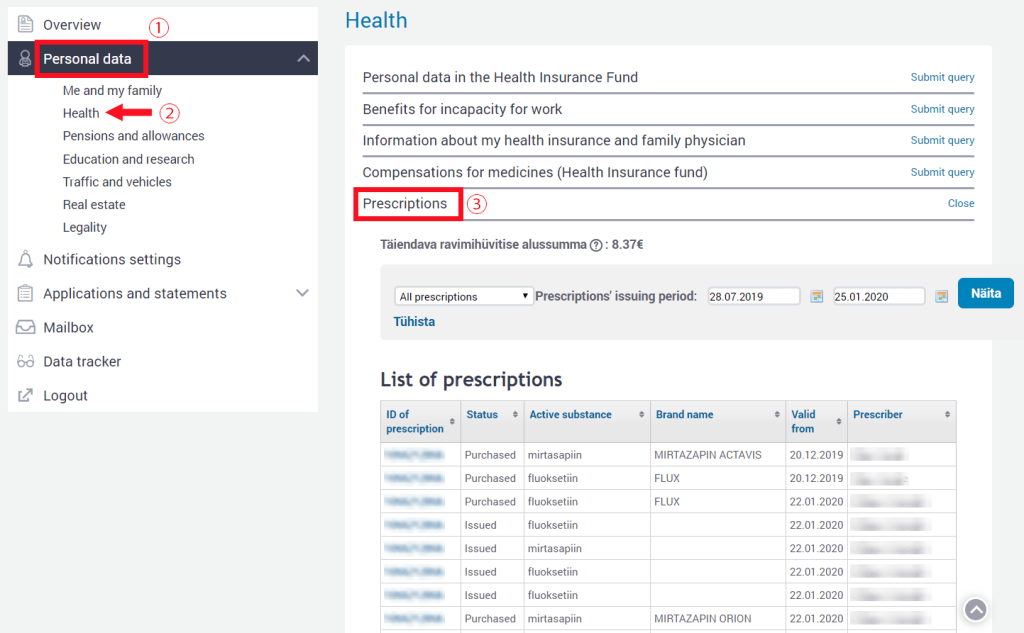
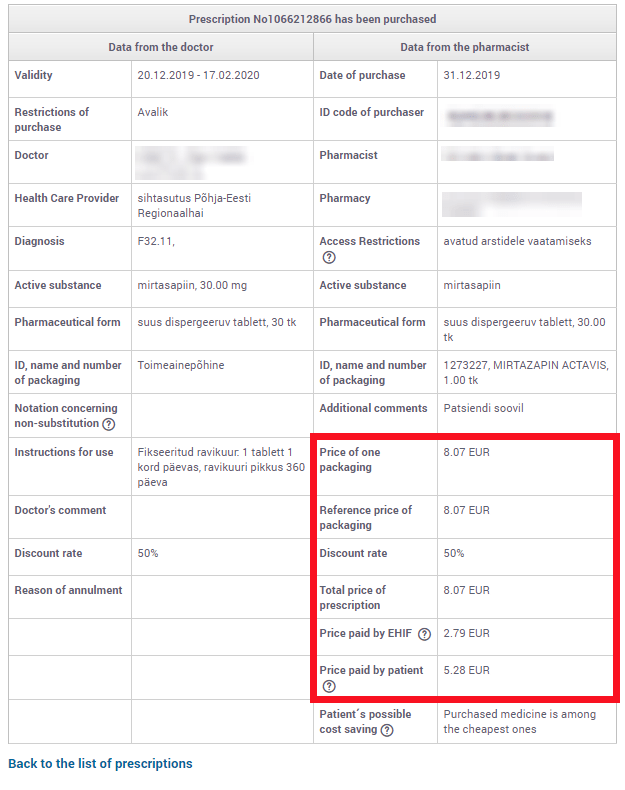
Besides, you can see your prescription on State Portal. The image below is mine.

There is clearly the doctor’s name who prescribed the medicies on the most right and the names of the medicines in the third colum from the left of the table in the picture.

The second image shows the detail after clicking “ID of prescription”. Still cheap isn’t it?


This is the Estonian medical notebook. Huh!


Of course you can buy general medicines at pharmacy without prescriptions. (My Japanese article about it is here.)

That’s all about the story of the prescription in Estonia and the Estonian medical notebook.

Aitäh! 🙂

Zooks’s Moving in Estonia (3rd Time)

Tere!

Listen, I changed a place.

This is actually the third time to chage the flat since I came here. (I mean, this includes my first flat because I spent one night or two in the hostel when I arrived in Tallinn.)

My friends know my first place. It was a hostel-like flat which had 11 rooms shared by 12 people. I met many types of people/students: self-centred German girls, a Ukranian girl who loves Sailor Moon, some Italians, Czech, French, Iranian and Japanese who played games and drink together. It was a really international flat. (Sometimes there were also some Hungarians, Cyprusian, Spanish, Estonians, Thai, American as well as Georgian.) Usually I had meals with some of them and talked with them instead of frequent nights out since my programme gave me and my coursemates too many readings every time.

However, in Autumn in 2018, I started working at part-time being a student as well so I had to go to both school and the office. It wasn’t easy to change the class timetables and I had a lot of readings as assignments as mentioned so even though my working time was 20 hours per week, it was tough to spend 40 minutes including one connection for one way every time I worked.

For this reason I moved to a flat close to the office.


Oh, this is not what I want to talk about this time but the event after this.


The flat which I moved in was a shared one by two other people, had no living room but a small kitchen, a toilet and a shower room. Although my room’s size was spacious – 15㎡ having a double bed, it was weird for me to have meals by myself.

But that doesn’t mean I wanted to eat with the flatmates.

There was one Ukranian guy and one Indian guy. Both graduated universities in Estonia and were working.

The Ukranian was okay. He wasn’t an interesting or fun guy but he wasn’t a bad guy either and he actually kept everything clean. The problem was this Indian one.

It’s not about dirtiness (as the common topic that is raised when it comes to a flatmate issue). When there was a problem or something, he always put (his own reasons and) the cause aside pretending that he was completely innocent and thought that the causes were all lack of communication. If you don’t want to read the followings and skip this and some paragraph beyond and read the next fourth paragraph. In more detail, he always kept 1.5L plastic bottle in the toilet to wash his butt, his “cleaning the toilet” is only to wipe the floor (that is, he didn’t clean the inside of the toilet), used my stuff even though I marked them told him not to do, said that the chopsticks in the dryer basket next to the sink hurt him (I didn’t understand), etc.

But the ultimate thing was that I couldn’t accpet him as a human right after moving in. Imagine, would you be happy when an unknown guy or stranger suddenly said “oh your hair is beautiful”. Creepy. (If you don’t get it then maybe you have never experienced to be hit on by strangers. This is the same thing.) Also my personal space is as small as what the Estonians have – possibly even smaller than theirs.

For this reason I didn’t want to talk with him and he never leant even though I repeated saying something such as not to use my stuff. Such a waste of time.

In addition, while he was in the flat there was always loud sounds of TV, video games and music (I could hear even when I closed the door and sit the furthest position from his room), and after he used the shower room in the morning I hated his spray smell.

Initially I told our flat managers to kick him out, he was one of the causes that I had to stay in the hospital, I gradually felt that it was troublesome to fight again and that this type of self-centred person eventually would be deserted by the societies and people. Then I started looking for a new place. As of Novemeber 2019, my flat manager didn’t have any vacancy in any flats so I also asked one of the teachers at TLU, who contacted her friends. Of ourse I was searching the new one on my own as well. (I checked the websited every day when I was in the hospital.)

Sorry my premise was too long.

Here are finally the main things: there are 3 websites (?) to look for a place to live and the result of my case.

1) City24.ee

First of all, it is a website called City24.ee. I used this website when I was looking for the flat in Estonia while being in Japan. You can change the language but some places lack the information. In such a case I recommend you to change the language into Estonian and use Google translate by copying and pasting the texts written in the website. Mostly it says “only Estonian speakers” or something like that.

If the description says “only Estonian speakers” it is better than “only the Estonians” because it seems there are. Why I used “it seems” is because I just have heard and not experienced. However, if you contact the manager or broker who have described like that and there are no response, just try to think that they just cannot understand English. Don’t say or think that they are racists or something – English is not their mother tongue. If you really want to live in that place, then it is better to make a phone call. In Estonia, it doen’t matter whether the business is toC or toB, normally they don’t reply. (The sad fact for those who have communication disorder 😦 )

2) KV.ee

The next one is KV.ee. I used this website for the first time this time. They have almost the same information as what City24 has but really occasionally they have what City24 doen’t have so it can be your option to check. There is nothing to compare in my opinion and the advice is the same as the above. (I noticed that this website is number one in terms of searching places to live when I got the link.)

3) Facebook

The third thing is not a website but a social media. These days it sees there are a number of people who look for places to live on SNS. It is true that groups like Expats have brokers and flat managers and they posts something to get new tenants, but I personally don’t recommend.

This is becasue the websites are more secure and have higher possiblities that there are actual physical houses or flats, meaning that they mostly don’t lie. (If not, I think that the website stops that company, broker or manager to implement sales there.)

Besides this is not anything about those who want tenants but those who look for places to live, I often see something like “Hi! I’m looking for a place to live! My budget is XX euro! Thanks!”.

Honestly it just looks miserable.


Why do you have such a mentality that “it is natual that people should help me” though you come in other people’s country with your own will?


If the texts were “I’m looking for a place to live! Please let me know if there are any vacant room!”, it is better though. (But I think this kind of people would contact brokers or managers rather than write a post on facebook.) Also I think there is no problem when the brokers or managers say “we are looking for tenants!”.

For those reasons based on my self-judgement and bias, the use of Facebook to look for a place is just one option but not my recommendation. Just consider what is better for you by yourself.

4) Eventually I’m always blessed with good people.

Lastly concerning my new place, as described in this section header, I am really blessed with people in the end even if I have troubles. My flat managers offered me a place in the same district in Tallinn.


Gods.


Saviours.


The flat is located 15 to 20 minutes by walk or 2 bus stops away from the closest stop to the office and has 9 floors, in the middle of which in terms of the height and width they had a shared house.

The house is shared with three people, although the toilet and the shower are in the one room, the kitchen was more spacious having a couter table with three bar stools, has a storage space with many shelves and has my room with a balcony. At that time a German girl, Hong Kong guy and a Lithuanian girl (who I didn’t see) lived there. Since the German girl was leaving, I’ve got an opportunity to move in there. I also talked with the Hong Kong guy, who didn’t seem annoying but nice. They said they lived peacefully. The kitchen and shower room were both clean as well (possible they cleaned because they might have known that I would visit to see there :P)

The building itself is beisde the huge road and my room has a balcony but the house was quite away from the road so it is quiet inside. The rent got 10 euro more expensive and my room is a bit smaller but it was actually hard to find negative points.

My flat manager told me that he was too busy to give me the keys for the new flat on the day that I was moving in so he gave them to me in the previous day, helping me carry the stuff by his car. Nevertheless I repreated going there and coming back to the previous flat FOUR times.


Super exhausting.


Also whenever he said he would come to check or fix the stuff in the previous flat, I tried remembering to ask him to take of “stars” on the celing but I always forgot. (I asked my friend when moving in there but he was for sure working at that time as it was Thursday.) Then I asked one of my colleagues to come and take of the “stars”, but


listen, he changed the history.


Whenever I invited my friends I told them the address (the position of hallway and the floor as well) and the door code. They always successfully opened the door and came to my floor. However, my colleague couldn’t enter the door code and instead rang the bell and called me so I opened the hallway door but still he couldn’t get in so I eventually had to go downstairs – from the third floor to the first floor.

AFTER the FOUR round trips.
(Though it was really appreciating to come and take off my “stars”.)

Then he helped me taking of another decoration as well as the “stars”.


However!


This is not the end of the story.

★How to Change the Address

When you moved out you old place and moved in your new one, of course you need to change your address. As I moved in the second flat, nonetheless I experienced changing the places in Japan, I completely forgot and the got an email from the Estonian population registry.


Then, how to do?


You can access from State Portal but I put the link here so that you can easily access. The website is called e-population register.
There is one thing you should be careful. When it comes to online shopping or asking your family or friends to send something, you may write “StreetName BuildingNumber-(hyphen) FlatNumber, Tallinn, Estonia, Postal Code” (e.g. Jakobsoni 21-4, Tallinn, Estonia, 10120). However, on this registeration, don’t include the flat number (and the postal code). In the case of the example above, type “Jakobsoni 21, Tallinn, Estonia”. (If you start typing, it shows the expectation having the area so no worries about some details. Just start typing the street name.) On the right of the address entry box, you need to type only the flat number. Easy Peasy.

After the entry of all the information, go to the next step, choose the contract type and wait for the approval. (It doesn’t accpet Digi doc files so in case you signed digitally, ask your flat manager their full name and personal ID, enter those, ask them again to approve what you entered and wait for the final approval from the population registry.)

That’s all.

Your Estonian ID card and number are used for the population registry, prescription, family doctor and bank account so once you changed the residential address online and got approved, such information, for instance, the bank account gets the same information so no need to go here and there in the whole town.

I wish Japan would have this system asap.

Surprisingly I haven’t done anything bad so I should be able to get approval. If there’s nothing renewed in this article please consider that I successfully registered my residential address.

Aitäh! 🙂

About

Tere!

Heya, my (nick)name is Zooks. This is my official Irish nickname though I’m not Irish but Japanese. This is my self-introduction page so I’d like to introduce myself and talk about this website.

First of all, let me explain what the first line of this page means. It’s Estonian and means “Hello”. Easy-peasy to remember isn’t it? From today you may use it at the casher, pub or to your Estonian colleagues and friends. Make them happy with this easy start.

Next you may wonder why I’m in Estonia. I have lived in Tallinn for over two years as of January 2020 and I was a postgraduate student at Tallinn University. Almost when turning to be a second-year aka final-year student, I started working at an Estonian start-up company. As finishing my degree programme and graduating from the university, I have beeing working there. This is my brief histroy in Estonia.

You also might wonder about me. I was born and raised in Japan and my hometown is in Wakayama which is located in the south of Kansai area and just below Osaka on the map. I spent 18 years there and moved to Kyoto for univeristy. (It’s impossible to commute there from my hometown so it’s quite normal for people in my home prefecture to live by ourselves.) When I was a third-year student in the university in Kyoto, I went to Dublin, Ireland as an exchange student for one year. Then my Irish friend gave me that nick name based on my given name. Usually the universities in Japan have four-year programmes so after spending three years in Japan and one year in Ireland I graduated. I spent extra about six months in Kyoto working, I came to here Estonia.
The official Instagram of my hometown, Wakayama is pretty great so please follow and go “into the unknown”:

The purporse of this website is to show how my life in Estonia is such as experiences in Estonia, how I handle my culture (not merely Japanese culture!) here, tips to live and important procedures for living as well as trips in the world (but mostly in Europe). This website was created because many non-Japanese people have got interested in when I said “I have my own website” but it was available only in Japanese. (The Google translate was available but it didn’t make any sense since my texts are full of my dialect.) The Japanese website is the main one so this website may not have the same information but you may contact me in case you have questions and comments from the contact page by choosing the one on the top.

Finally, I have some social media accounts so please follow me, get annoucement of the newest blog articles on Facebook and enjoy my lovely photos on Instagram!

Hope you have fun with my website.

Aitäh!/Thank you 🙂