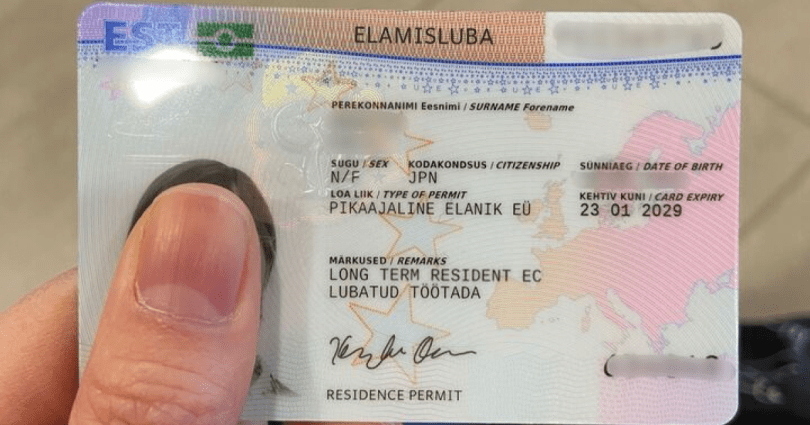
Zooks Gets Granted an EU Long-Term Residence Permit.

Tere!

On the 19th of January, 2024, I announced that an EU long-term residence permit was granted to me on some of my social media channels! Recalling an article titled “How to Get the EU Long Term Residence Permit in Estonia.” that I published In December, 2023, this new article is a developed version of it. However, truth to be told, my mind was unstable until I made the final decision to apply for the EU long-term residence permit. Sometimes I wanted to apply for it and some other times I planned not to do it, which I repeated over days and months… The reason why I decided to apply for it eventually is too messy to explain so I skipped it here, but it is relevant to the article “Zooks Decides To Stay in Estonia”.

When I applied for the EU long-term residence permit, I was in quite a special situation. Hence, here I will talk about three things: documents I prepared, a flow till I went to a PPA office in Tallinn and how I was treated at a window in the PPA office. (In other words, if you have lived in Estonia for more than five years legally, worked for an Estonian company, and passed an Estonian language exam at the level of B1 or higher, you don’t really need to worry about it!)


Table of Contents

     1. Documents I Prepared
          1.1 Legal Income
          1.2 Health Insurance
          1.3 Language Proficiency
          1.4 Application Form
          1.5 Payment Certificate
     2. The Flow till I Went to the PPA Office
     3. How I Was Treated at a Window in the PPA Office
     ★Summary


1. Documents I Prepared

Let’s begin with the required documents. Roughly speaking, I needed the below documents:

  • Certificate of a legal income
  • Certificate of health insurance’s coverage in Estonia
  • Proof of a language proficiency (B1 or higher)
  • Application form
  • Certificate of the payment for the application

Let’s take a look one by one.

Generally, if you work for an Estonian company, you can probably just bring your work contract. Or, as PPA can see your information, you may not rather need any documents for this purpose. (I was told so after graduating from a postgraduate school when changing my student TRP to the TRP for a graduate.)

However, in my case, due to the fact that I was already working as a freelancer when applying for the EU long-term residence permit, I had to prove that my income was legal. Here “legal” basically means that you pay tax in Estonia. If you work as a freelancer or remotely from Estonia, your taxation can be complicated. Also, based on your gross income, the tax rate may differ. I will write another article about taxation in Estonia. Here I’m just talking about my case.

I use LHV’s entrepreneur account. With LHV’s entrepreneur account, once you add your funds, the income tax (including the income tax, social tax and pension) is deducted immediately. Therefore, you might just need to submit a balance statement on your LHV’s entrepreneur account, and yet my reality wasn’t so simple. 🥹

As a freelancer, even though my income was legal for me because the tax was deducted, the PPA who assessed my application had no idea what kind of business I earned from. It could be selling the weed. What is worse, it could be prostitution. Hence, I reckoned they may not grant the permit as “earning might not be legal” without any documents which would prove the source of income, and they might have asked me for additional documents, which seemed to be troublesome. For this reason, I submitted the documents on the source of my income as well. However, my case was still intricate, so I wrote down the flow of paying a salary to myself, and collected all the necessary documents as earning in USD was one of the reasons as well that made the situation complicated.

The flow was [(1) earning → (2) remitting from the work platform to my PayPal account → (3) remitting from PayPal to Wise → (4) converting from USD to EUR in the Wise app → (5) remitting from Wise to my LHV entrepreneur account → (6) remitting from the LHV entrepreneur account to my Estonian bank account].

This is why I had to submit all these documents. The most burdensome part was [(1) earning] since the work platform did not have any function to export all the earnings in PDF by just a few clicks. What I did was save the whole screen one by one in a printout mode on a browser, and merge all the files into one on the site called Smallpdf. For the fact that I had to prove my income for two months, there are more than 200 pages in the file in total.

The number of pages of partial income of a month

Then I printed these out on both sides…

Although the documents were only for two months, it was onerous.

1.2 Health Insurance

Given that you work for an Estonian company, you will automatically be covered by Tervisekassa (the Estonian Health Insurance Fund), but in my case, since I intentionally set my income as low as possible, the social tax I paid was below the minimum amount to get covered by Tervisekassa. Therefore, logically, I didn’t have any health insurance.

A private health insurance like ERGO is also acceptable, but my past experience of depression was utilised here.

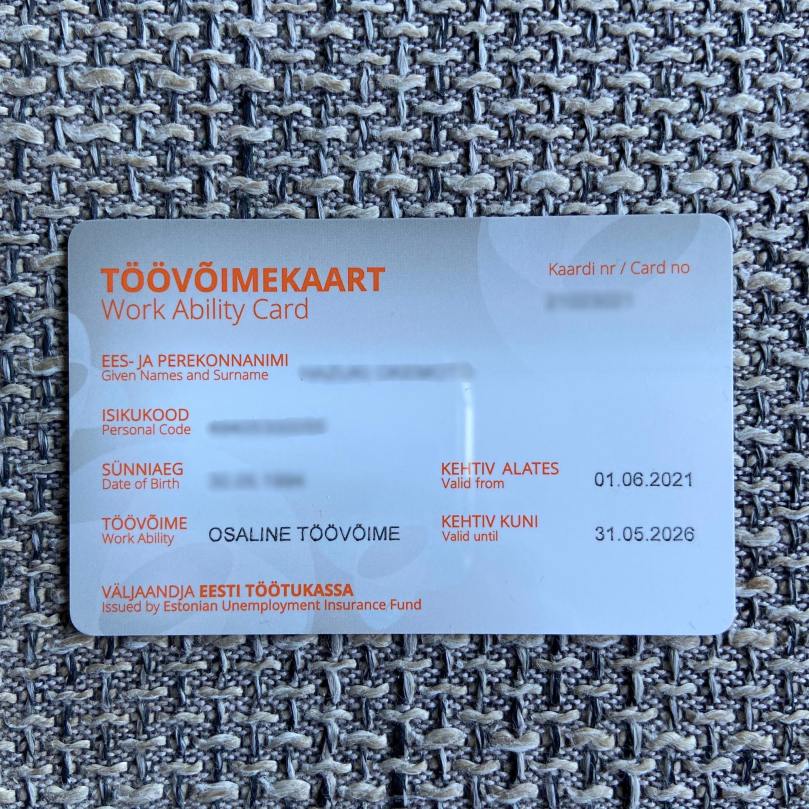
In summer in 2021, I published a blog article titled “Zooks Got the Work Ability Card Issued in Estonia.”. This was it. The certificate of “partial incapacity of work” took advantage at this time. Strictly speaking, I didn’t bring any copy of this per se as the PPA could see that I was covered by Tervisekassa.

Then, here is the reason why this certificate of “partial incapacity of work” is relevant; as long as this card is valid, regardless of the amount of social tax I pay, I have Tervisekassa’s coverage.

Since I always bring my card anywhere, when a PPA lady asked me about the health insurance, she made a copy of it.

I know it was really troublesome. 😂

I finally thank a lot the Brazilian customer support manager who depressed me, tormented me, didn’t provide me as a new employee with any training at work, limited my access to necessary platforms for work and prioritised her own profits, two Russian colleagues who were perfect frenemies and takers, the Nicaraguan marketing manager who discriminated at work, and the CEO who asked me to work from the hospital while I was taking a sick leave. I will never forgive them all and I do believe sooner or later they will be destined to come across a complete hell in their life at some point, which I think of in this way only when I remember them owing to some trigger. Right now I am happy without them in my life and I do not care what will happen to them. What is more, thanks to them, I can still have Tervisekassa’s coverage without meeting the minimum amount of social tax. 😛

1.3 Language Proficiency

I really didn’t have to print this out, but just in case I brought it there. I am not sure if only completing a language course is sufficient as a proof. I took Harno’s official language exams, which results are visible on Estonia’s national portal.

1.4 Application Form

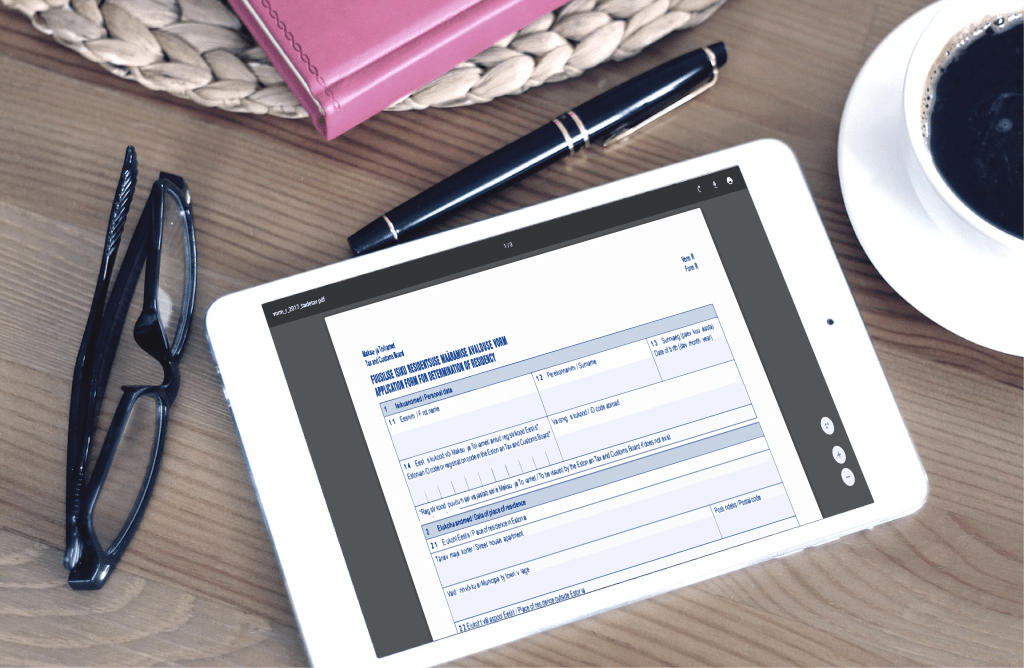
As for the application form, you need to download it on the PPA’s website, fill it out, print it out and bring it to the PPA office. You don’t need to add your photo there. You can take a photo in the photo-shooting machine in the PPA office, and the machine will send the data to your ID. The machine also lets you have your fingerprints, so I recommend you to do so while waiting for your turn at the PPA office. (However, I’m not sure if you would be asked for your fingerprints at a window.)

What is more important, you must fill out the application form in Estonian. It’s nothing big if you need to just fill it out. However, in my case, I had to explain the above information on my income in the note section of the application form. (I wasn’t really told to do so and it might not be mandatory, but since it was onerous, I wrote it in advance in order to avoid being asked a lot later.)

1.5 Payment Certificate

You don’t need to worry about this either as you will have to pay for the application fee at the window. Should you apply for the EU long-term residence permit by snail mail, you need to pay online and send the receipt as a document.

2. The Flow till I Went to the PPA Office

Since my legal stay turned out to be 5 years as of the 11th of November 2023, I decided to apply for the EU long-term residence permit after that date. In terms of time, I had stayed in Estonia for more than six years as of that date, and yet in terms of a residence permit it was five years.

On PPA’s website there was a reservation option, so I tried to book an appointment, but it was impossible. Therefore, I went to the PPA office directly and a PPA lady at a window just told me to book an appointment.

Asking her further, she told me to book an appointment on the coming Monday because then there will be new appointment calendars for December and January, and this happens specially for the fact that there will be many TRP applicants who will come to Estonia based on their employment in winter.

If you are thinking of booking an appointment in winter, keep this in mind;


You can book from 8 am but all the slots will be taken within 15 minutes.

I was really struggling with the booking page after taking a shower in the gym. Consequently, I successfully booked an appointment on the 5th of December, 2023. It wasn’t an ideal date and time and yet better than nothing.

However, I still wanted to have applied during November so that I didn’t have to prepare such a lot of paper documents to prove my income. 😅

3. How I Was Treated at a Window in the PPA Office

On the 5th of December, 2023, I went to the PPA office again.

Just like the first visit, when they came to know that I went there to apply for the EU long-term residence permit, they asked me “Can you speak Estonian?”, and I always responded:

😂

This is because B1 is not enough for fluency (subjectively speaking).

At the window the PPA lady checked my documents one by one.

As for Tervisekassa’s coverage, as mentioned above already, since I had a certificate of partial incapacity to work, I explained it to her at the window and she took some copies of it.

After checking all the documents, she told me that usually the result would be notified within two months, and yet this time it might take up to three months as it was the time that there were a lot of other TRP applications.

Though eventually it didn’t take even two months. 😂

★Summary

As for the notification, since I received an email in Estonian from PPA so suddenly, I thought:

I read it and translated it just in case, and I was like:

So I messaged my previous colleague who I talked about my application with the other day:

And he replied to me:

He sounded so seriously, so I was like:

He still continued to tell me seriously:

Oi. Then I sent him a GIF of a desperately disappointing pikachu. Then he finally said:

“Just tell me that my understanding was right,” I thought. It was sort of startling.

Due to this silly conversation it took time to make sure, and yet anyway I was glad about everything.

Anyway, I will keep living like a weed in Estonia (at least for a while).

Aitäh! 🍊

How to Get the EU Long Term Residence Permit in Estonia.

Tere!

When I moved to Estonia, I didn’t know and didn’t think about the EU long-term residence permit. In the first place, I thought I would go back to Japan right after graduating from the university, and would have to work in Japan before knowing it. However, since I got my first job in Estonia when I was a second year student in Estonia, working in Japan has not been my option anymore. 😂

In addition, I have continued learning Estonian, and eventually my level reached to the one with which I became qualified to apply for the EU long-term residence permit. However, there are some other conditions to get an EU long-term residence permit.

This time I’m going to talk about the EU long-term residence permit.


Table of Contents

     1. Estonian citizenship vs. the EU long-term residence permit
     2. Advantages of the EU long-term residence permit
     3. Conditions to get the EU long-term residence permit in Estonia
     4. Case study: Zooks
     ★Summary


1. Estonian citizenship vs. the EU long-term residence permit

I will discuss detailed conditions on the EU long-term residence permit, and yet if you meet all the conditions, you can apply for Estonian citizenship or the EU long-term residence permit. I guess that without any strong will or lots of advantages, few Japanese people would want Estonian citizenship.

This is because we have to lose our Japanese passports once we get another citizenship in Estonia. Japan doesn’t allow us to have double nationalities.

People from Pakistan, Bangladesh or other African countries whose passport ranks are relatively low seem to tend to get Estonian citizenships. That makes sense as then they can travel to more countries.

On the other hand, as of 2022, our Japanese passports are stronger than Estonian ones, (or even the strongest in the world), getting Estonian citizenship is rather disadvantageous for me in my opinion. However, the EU long-term residence permit is the option for such people.

With the EU long-term residence permit, we can get similar rights as other EU citizens whilst we can keep our Japanese passport as we are not EU citizens. In addition, it is said that we can freely live and work in other EU countries except for Ireland and Denmark. Moreover, (perhaps) depending on the university, the tuition fee appears to be free… (This information is questionable according to my own research. I need to research further. However, it would be more than pleasant if the tuition fee is free or discounted.)

2. Advantages of the EU long-term residence permit

According to EU Immigration Portal, there are several benefits of the EU long-term residence permit. Here is a list (but excluding some):

  • Access to employment and self-employment (this may not apply for some activities which are only for nationals or EU citizens, such as access to some positions in the public administration);
  • Education and work-related training, including study grants;
  • Recognition of diplomas and qualifications;
  • Social protection, social assistance and social security as defined by national law (EU countries can limit social assistance to basic benefits only, such as the minimum income);
  • Tax benefits;
  • Access to goods and services (e.g. transport, museums, restaurants, etc.);

and so on.

As an example, I contacted the Swedish Migration Agency, and figured out that even if I move to another EU country, the EU long-term residence permit is moved to Sweden, which does not mean that I would lose the EU long-term residence permit itself.

This makese sense.

I highly recommend you research as this kind of information should be searched on one’s own.

3. Conditions to get the EU long-term residence permit in Estonia

There are basically two big conditions. One is the residential period, and the other one is the language level.

Let’s talk about the residential period first. This is determined by the EU, and 5 years are minimum. If you come to one EU country as a student, you should probably ask the migration agency or something . (I’ll explain later on.)

The other one is the language level. This seems to be dependent on a country, and yet in Estonia Estonian B1 is necessary.

There are some other conditions such as financial one or health insurance, so you should perhaps check these before or when thinking of applying for the EU long-term residence permit.

4. Case study: Zooks

In my case, I came to Estonia in August, 2017, although I received my first TRP card in September in the same year. Then it expired in June, 2019 when I graduated from the postgraduate school, and the second TRP card was issued in the beginning of September in the same year. In short, I had been a student for approximately 20 months. However, such a period is counted only 10 months. (In other words, they count legal stay as a student by multiplying 0.5.)

Since I got the second TRP card in September, 2019, it means I would legally have been staying in Estonia for literally three years in September of 2022.

Therefore, as of the time I was getting information, I have lived in Estonia for three years and 10 months. I need to stay in Estonia one year and two months more, so in November, 2023, I should be able to apply for the EU long-term residence permit.

I took an Estonian B1 exam, and passed it in June in the same year, so all I need to do is just wait. However, they also have some limit that I can be away from Estonia, hence I need to be careful with that. It has to be no more than six months in a row and no more than 10 months in five years. In Estonia, usually the annual leave is around one month per calendar year, so if you work for one Estonian company, then you will get one-month annual leave five times. Because I had been a student for “10 months”, I will definitely not exceed 10 months in total anyways.

★ Summary

Waiting one year seems long, but considering my career, I still want to be in Estonia at least one more year. Therefore it was good timing. Due to the fact that I still don’t understand a few things, I think I will update this article from time to time whenever I get information.

Aitäh! 🙂

Zooks Gets (Japanese) Voting Certificate in Estonia.

Tere!

This time I’m going to talk about voting for elections in Japan.

Four years ago, I heard that those who live in foreign countries can have a voting certificate, so I went to the Embassy of Japan in Estonia, but they told me that I needed to lose my certificate of residence. Therefore, I did not apply for it. At that time I was still a student, and I was not sure if I would go back to Japan.

Then in Autumn 2021 when the Prime MInister in Japan changed, there was a election of House of Councillors.

I didn’t really let Liberal Democratic Party win, so I wanted to vote. For this reason I applied for the voting certificate.

I emailed the Embassy of Japan in Tallinn, and they said that I would have needed to wait for the certificate for about two months.


Freaking too long.


However, it’s better than nothing, and elections might happen in the future as well, so I applied for it.

I asked the staff of the Embassy, and made an appointment. (This is a necessary step to apply for the certificate.)

In order to apply for the certificate, you will need a passport. Since I had not submitted a notification of residence, I also brought a contract for the flat. (This is used to prove my residence in Estonia.) The application form is available at the Embassy, hence you do not need to worry.

Then I went to the Embassy, and I filled out the form, in which I needed to write a place where I waived the certificate of residence in Japan as well as the date when I did. I had never made any changes in the certificate of residence in Japan, so the place was definitely Tanabe. On the contrary, I did not know when I waived. I asked the staff in the Embassy, and he said:


A rough date is fine


So lax.

Overall it took around 30 minutes to complete the procedure.

Then on the 30th of November 2021, I received an email from the Embassy that I could receive the voting certificate. I had a day off the following day, so I had an appointment at 10.

When I went to the Embassy, a staff member asked me:

Do you have your passport?

What? I hadn’t heard of such a thing…

However, she said something to prove myself, so I passed the TRP card, and waited for a while, after which I got some documents.

These documents are the ones I need for voting at elections.

Honestly I don’t know when I can join elections next time, and there is an online strike to make online voting possible, but anyways, I’m glad that I can finally join the elections.

★Zooks Votes for an Upper House election in July, 2022

Between the end of June and the 1st of July in 2022, the Embassy of Japan in Estonia had accepted votes for the Upper House election, and I went there on the last day. (Because the reception started while I was travelling in Ireland, that was the only day I could go.)

If a Japanese resident in a foreign country has an overseas vote, they also have an option to vote by mail to the Embassy, but since I live in Tallinn where the Embassy of Japan is, I travelled there. 

In Japan now they can obtain the voting right when they turn 18 years old, but in my generation it was 20 years old. Since then this is merely the second time for me to vote for an election. That day, since I had work at noon, I wanted to visit the Embassy of Japan before that, so I asked them how long it would take to complete the voting process, by email. Then they said it would usually take 20 to 30 minutes. (I honestly thought “That long!?”)

The reason why it takes such a (long) time for the process is probably because of the situation. When we vote in Japan, we must vote where we have our residence registry. When it comes to voting overseas (especially for a Constituency election), there are other Japanese citizens from other prefectures, so the voting destinations are different. (For example, in my case, when I was a university student in Kyoto, living there, my residence registry was still in Wakayama, so I was not able to vote for the candidates in Wakayama from Kyoto.) Moreover, we need instructions from the Embassy when voting overseas, which takes time. (It’s not like just writing the Party’s name or the candidate’s name.)

Hence, I booked an appointment in the late morning so that I could go to work straight after that. (As I lived in Ireland, I never asked the Embassy of Japan for anything, so I don’t know in the case of Ireland, but) in the Embassy of Japan in Estonia, we must make an appointment in advance. I asked them if I could visit there on Friday, 11th of July at 11.30.

When voting at the Embassy, we need a certificate of the overseas voting right. That proves that “I am eligible to participate in elections in Japan”. In the process of voting at the Embassy, representatives of the Embassy will give us a stamp of the participation. (Also, for voting overseas the voting certificate number is required, which is written in that certificate.)

At the Embassy, a staff member told me the representatives will instruct and explain to me, so I waited for them. Then two representatives came, and told me how to vote overseas.

This time there was a Proportional representation election and a Constituency election. The documents I needed to fill out were not only the papers for voting itself but also a paper to show which election/s I wanted to vote for. When I voted last time after coming back to Japan from Ireland, there was only a Proportional representation election, but this time there were two elections. I asked one of the representatives, and he said some people voted for one of them, others voted for both.

At one moment, “Maybe just one of them?”, but the idea “that one vote would change” came up to me, so I voted for both elections.

Before visiting the Embassy, I saw one web service where I could check which Party my way of thinking is similar to on Twitter, and I tested. As a result, there was no remarkable answer saying “This party is definitely closest to your way of thinking!” but it was a good reference.

Furthermore, I checked the candidates from my prefecture beforehand. (At the Embassy there is a list, but it contains only the candidates’ names, so it was good to check in advance.)

Voting overseas is very strict. Once I wrote a Party’s name or a candidate’s name in respective papers, I put the paper in a smaller envelope, and glued it to close. After that, I put that envelope containing the voting paper in a bigger envelope with an address, and glued it to close again. Once I glued the envelopes for both elections, I passed them on to the representative at the EMbassy. They checked, and it was completed with their OK.

I know in Estonia they can vote for an election online. The problem in Japan regarding voting is that not everyone changes the resident registry after graduating from high school or universities, living in other prefectures, so such people cannot vote from where they live, and they must vote from the prefectures where they have resident registry. When I lived in Kyoto, it cost at least 3000 JPY (approx. 25 EUR) for a one-way bus trip to my hometown. Why would I pay that much every time? I believe if we were able to vote online, the percentage of voting would be increased. I have thought for years that the voting system should be changed.

Aitäh! 🙂

Zooks Declares VAT in Estonia.

Tere!

Since the 1st of July 2021, regulations about VAT on parcels to Estonia (or maybe I should say the EU) have changed. Before that, we didn’t have to declare and pay for VAT if a parcel’s value was under a certain amount. However, from the 1st of July 2021, we came to have to declare parcels from outside of the EU. (Yet, regulations for gifts from family members or friends are exceptional.)

In the latter half of July 2021, I strongly wanted to learn Swedish from the beginning in addition to Estonian. Then I looked for a Swedish learning textbook at Rahva Raamat (an Estonian book store chain), and found one book called “The Swedish Girl” (because I searched with the word “Swedish”). Reading the overview, it seemed to be a detective story which I like, so I searched for the same book on Amazon DE so that  I could buy it more cheaply.

Then I found a second-hand book. The book itself cost only 4 euro, and the delivery fee was around 3 euro. I’m not sure if it was because of the COVID-19, but it said the book would arrive in a couple of weeks. (Considering the geography, the delivery is pretty slow.)

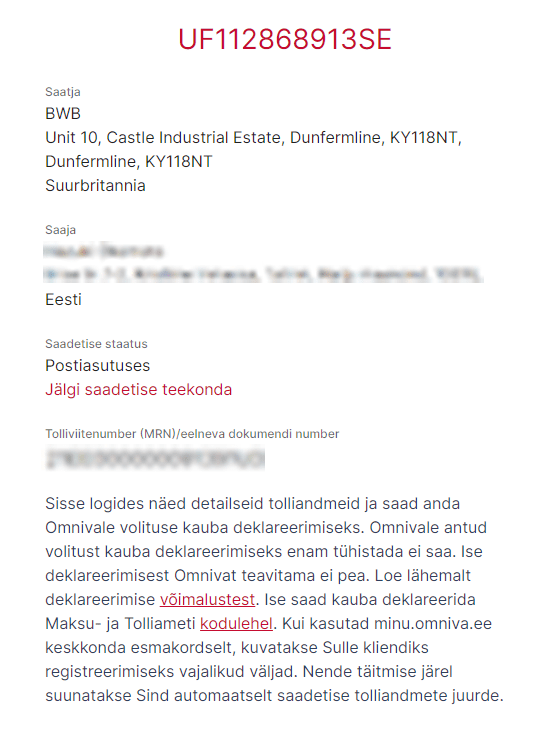
One day in August, I checked my mailbox which I hardly checked, I found two letters from Omniva (an Estonian postal company). One of them was delivered at the end of July, and the other one arrived at the beginning of August. (I thought both were the same contents though.)

Opening the letters, it was written in Estonian, but I roughly understood that

I had to declare the book that I bought on Amazon DE the other day.

However, I still couldn’t believe it because the sender’s country was the UK. (I thought it should come from Germany as I ordered it on Amazon DE.)

Therefore, this time I’m talking about the declaration of the VAT on the book from the UK (or maybe I rather should say this is how to declare parcels).


Table of Contents
★How to Declare
1) Check the letter from Omniva
2) Access MTA
3) Log in EMTA
4) Specify the Parcel
5) Enter Items
6) Error Occured
7) Payment
8) Finishing
★Arrival of the Book
★In Case of Gifts

★How to Declare

1) Check the letter from Omniva

First of all, roughly check the contents of the letter from Omniva. There are two sections in the letter.

In fact there are two ways to declare: one is to do it on your own, and the other one is to ask Omniva to do it. The latter costs, so I did it by myself. (Later I noticed that the order of the sections seemed random.)

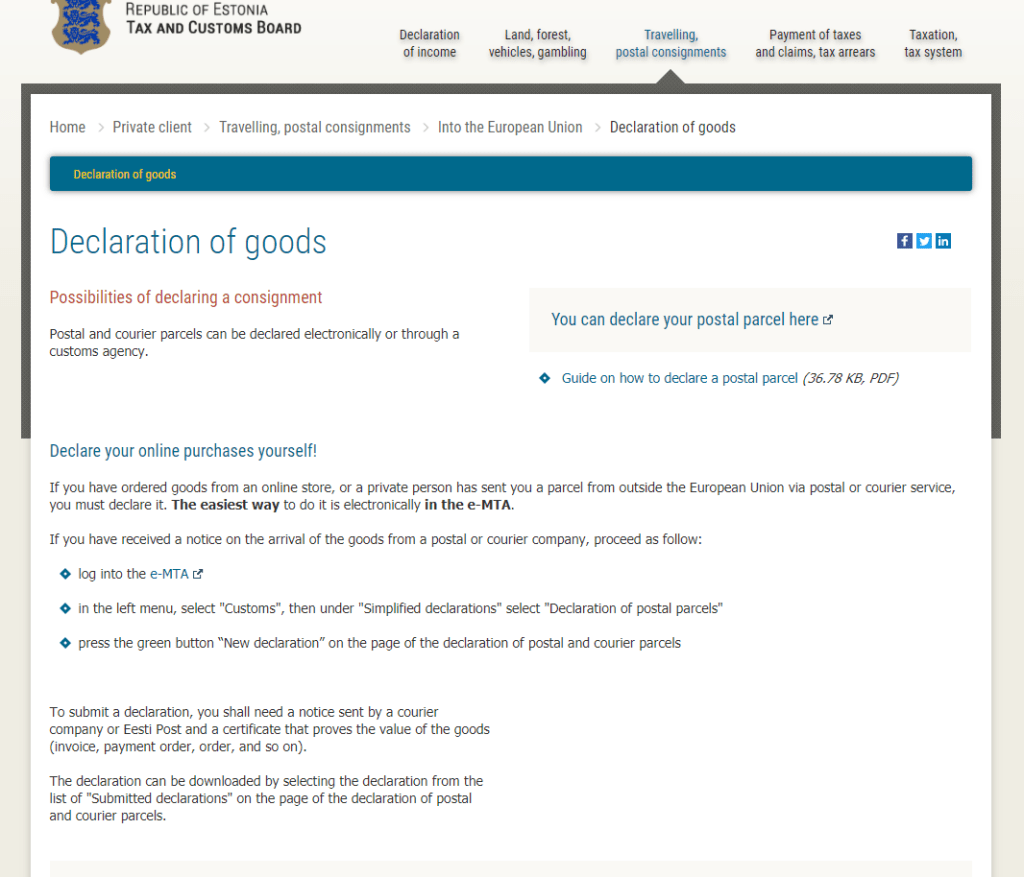
2) Access MTA

In my case section 1 had a link to access the MTA to know how to declare, so I did.

3) Log in EMTA

EMTA is an Estonian tax portal. In the page that I accessed above, it was written how to do it (briefly), so I followed.

4) Specifiy the Parcel

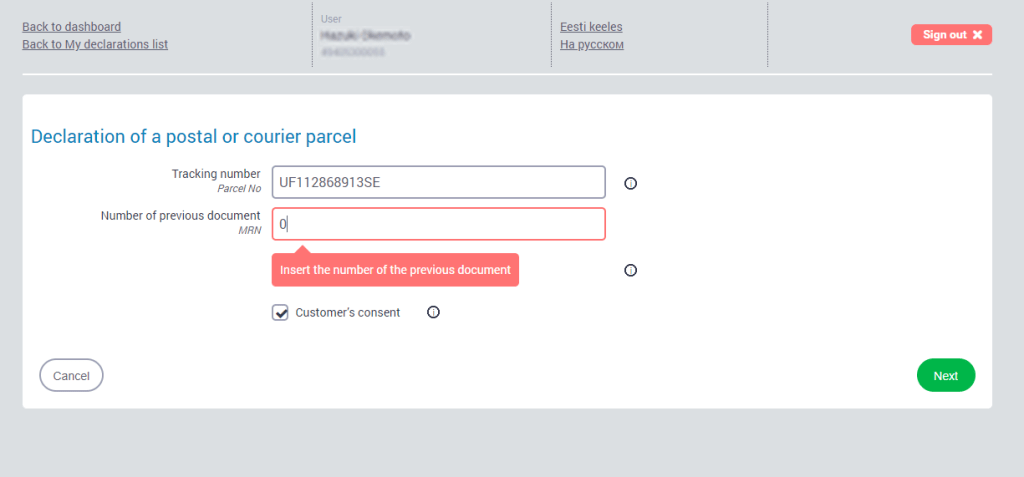
On EMTA, firstly, you need to specify the parcel that you are supposed to obtain. The tracking number is the one in the letter from Omniva, which starts ”Saadetise nr”.

Number of previous documents (MRN) is available from the link in the other section in the letter from Omniva. (At this point, I didn’t know what MRN was, so I randomly wrote “0”.)

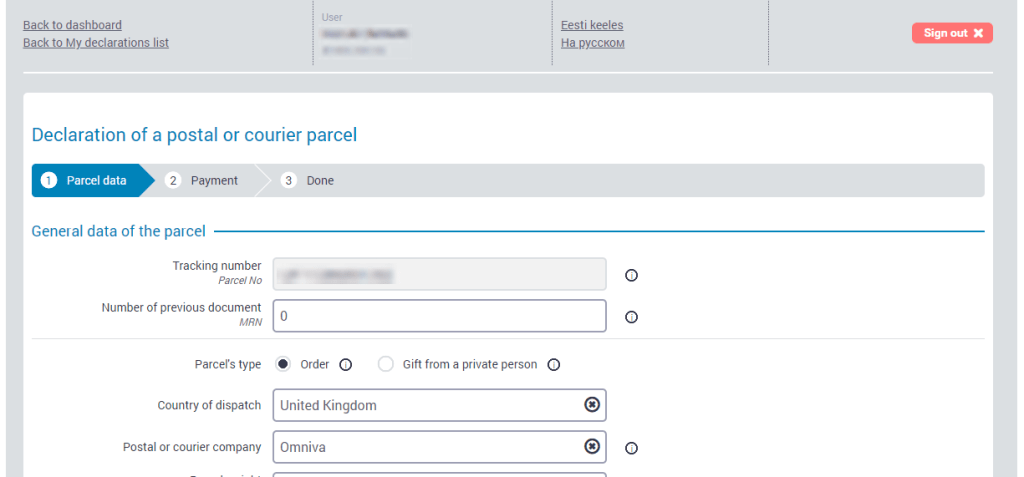
5) Enter Items

There are several items that you need to enter.

6) Error Occured

As mentioned, I thought the other link in the letter was the one to ask Omniva to declare, and I randomly wrote “0”, so I encountered an error. If you enter the information from the link in the letter, you can go next.

7) Payment

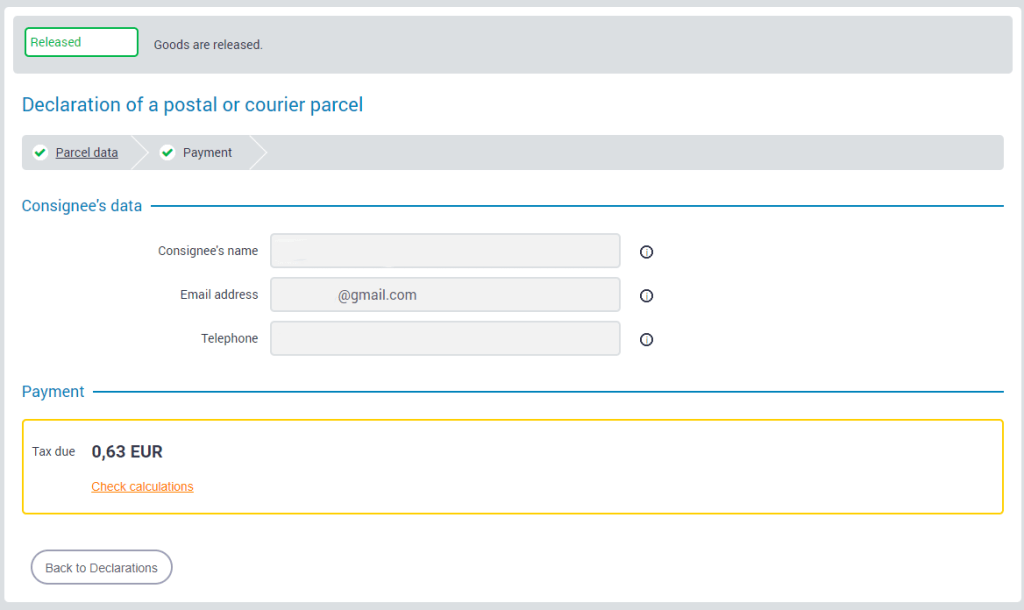
Once entering the items, you go to the payment page.

In my case I paid only 0.63 euro.

Considering the price of the book and the delivery fee, it was understandable, but I thought:

Do I really need to pay for such a small amount?

Anyway, without the payment, I wouldn’t have gotten the parcel so I paid.

8) Finishing

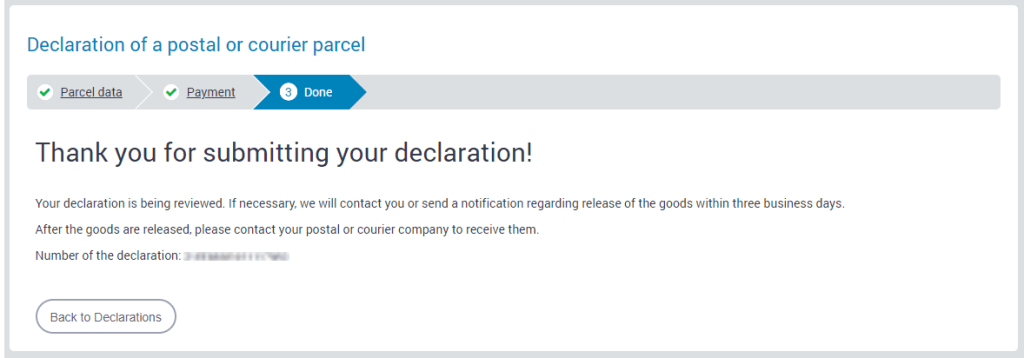
If you complete the declaration, the completion message will pop up.

All you need to do is to just wait for the parcel to arrive.

★Arrival of the Book

After several days, the book arrived.

It wasn’t a paperback but a hard-cover. I opened the book, and found something that it was used in the library.

I thought someone sold the book that they borrowed from the library, but I paid so I just started reading.

★In Case of Gifts

Also, after that, my friend in Japan sent me a super belated birthday gift, which value was less than 22 euro.

Therefore, I thought I could get like before, but the system had changed, and even though it was a gift, I still had to declare. (Omniva didn’t mention this at all!)

In terms of gifts, you would need the sender’s information, so when your family member or friends send you something, ask them to keep the receipts as well as other paper or digital information.

You may think:

But we can enter random information, can’t we?

You will need to upload proofs of the contents and their values. I didn’t know it either, and my friend already threw her receipt away too.

For this reason, she got the information online, and asked her to give me screenshots of that, and its (machine) translation.

I was still worried, but it went well. After that, I got a parcel from her.

So be careful when you get something from outside of the EU!

Aitäh! 🙂

Zooks Got the Work Ability Card Issued in Estonia.

Tere!

Sorry to be sudden, but I’m going to talk about the Work Ability Card this time. (Though I don’t have much to say.) I’m going to write what kind of card it is, how long it is valid, and if there are any benefits. You won’t experience such a thing as long as you are just normal.

In April 2021, my mental condition was not really good (which I will explain in the future). Around March or April in 2021, due to COVID-19, we couldn’t communicate with people, and had to work remotely.

I believe this was a tough time for everyone, but in my case it was too much. I have shut out most of my friends that I made in the postgraduate school, and didn’t have many friends though I usually have. (However, I often hang out with just a few of them, even in Japan.) So I thought I need to make friends somehow.

Then one day when I had a regular visit at the hospital, my nurse gave me a brochure of Tallinna Vaimse Tervise Keskus. There are some group activities, and she said that maybe some of them could be good for me.

After that, I contacted the Health Centre, and the staff said she wanted to meet me first.

When we met, she told me and determined to:

  • Participate in the art therapy
  • Use a supporter

I omit details about the above here, but someday I will write.

Anyway, when I met a supporter, doing some procedures, we registered to get benefits of incapacity of work.

To proceed with this, it is required to have a talk with a doctor, but in my case I already saw her during the last six months, so we corrected some information, and applied for it.

This is not something that everyone can do, and when proceeding, you need to answer a huge amount of questions. This was the first step. I think it took a few hours to answer all the questions. The questions were all in Estonia, so I was glad that I had an Estonian supporter. I’m not sure if there is an English version, but perhaps there is.

After applying for it, we met the person-in-charge of my application. This process is managed by Töötukassa (the Estonian Unemployment Fund), and they have some offices in Tallinn.My supporter and I chose an office where an English speaker works. (I think it was in Endla street.)

Until I got an appointment, my supporter took care of the communication.

Then at the office of the Fund, she asked me very similar questions a lot. I think it took about one hour. This was the second step.

At the third step, the answers of the questions were received, and we checked it. Then we waited again.

This is the fourth step. When getting a result email, the email has two files: PDF and the file to do a digital signature. I checked the PDF file.

It was all in Estonia, so I used Google translate, but anyway the results were:

  • Partially able to work
  • Valid for five years

The reason why “I am partially capable of working” is because although I have autism, disorders and depression, those don’t significantly affect my living life.

In this PDF file, it also mentioned how much I can get as its benefit. If your result is “completely incapable of working”, the calculation is 15 euro per day, and if it’s “partially incapable of working”, it’s 8 euro per day. More details available at their web page.

Several days after I got a result and completely forgot about it, I suddenly got a letter from the Fund which included the Work Ability Card. The information on the card is:

  • My full name
  • My Estonian ID
  • Birthday
  • Work condition (“Partially incapable of working” in my case)
  • Validating date
  • Expiry date

In fact, by having this card, there is a hint of goodness. When I travelled in Viljandi, I could buy discount tickets with the card.


Lucky!

However I had concerns about the valid period and the condition of work.

It’s not easy for foreigners to find part-time jobs in Estonia. It is very difficult. Timbeter where I used to work was really flexible, but it was special and exceptional because it was a very start-up company.

So the reality was “the job is full time although the condition is partially capable”..

I thought that might be unfair with that situation, so I asked my supporter, but she said it was okay.

The reason is “we don’t know what will happen/worsen” (the health condition is different).

So it’s like compensating for health conditions with money.

For example, let’s compare two types of people:

  • An individual who is healthy and 100% capable of working at full time
  • An individual whose depression is not fully healed this year, who has autism and disorders, and who is only 50% capable of working full time.

Apparently the latter one is “weaker” and handicapped.

And the benefits compensate for it, so it’s fair.

Thus my monthly income is a salary at full time + the benefits.

I did not feel good about getting special money compared to other colleagues in the same position, but considering the differences of the health conditions, it’s not unfair.

In fact, I have paid for the medicines and the psychological therapies.

I have this Work Ability Card in my wallet with the Estonian ID card as they ask me to show the Estonian ID card when using the Work Ability Card.

It’s literally a card, so it’s not like a disability certificate which looks like a thin notebook issued in Japan.

In Japan and until I got the Work Ability Card, I had never had a disability certificate. I didn’t make one because the services in Japan for the holders were basically available for the physically disabled people. (I wasn’t depressed when I was in Japan, but autism and mental disorders could be considered.)

However, although I live in Estonia, anyway I won’t use the card that often.

So here was my story about getting the Work Ability Card.

Aitäh! 🙂

Zooks Sets Three Things to Use SEB.

Tere!

Do you remember that I talked about the change of the bank in Estonia? This article is the third chapter (?) of it. (There will be four chapters in total.) This time I will develop the text regarding how to set the language on SEB’s account page, activation of SEB’s debit card as well as SEB’s mobile app.


★How to set the language on SEB’s account page

To begin with, the UI of SEB’s account page is not that user-friendly. In terms of the UI side, Swedbank has the better platform in my opinion. This is because on Swedbank’s website, you can change the language on both the public web page and your account page, and because you can change the language to English immediately from a language gateway on the top of the page.


But SEB is different!


I was so flustered.

Because I thought I might not have had English after changing the bank.

So I asked on the help chat and the support explained, but I thought: 


Wait, even if you explained in English, I still cannot change it as the website is in Estonian.


Then,


I asked how it was in Estonian, and they told me – that there is indeed English on SEB’s account page. The texts below are how to change the language on SEB’s account page.

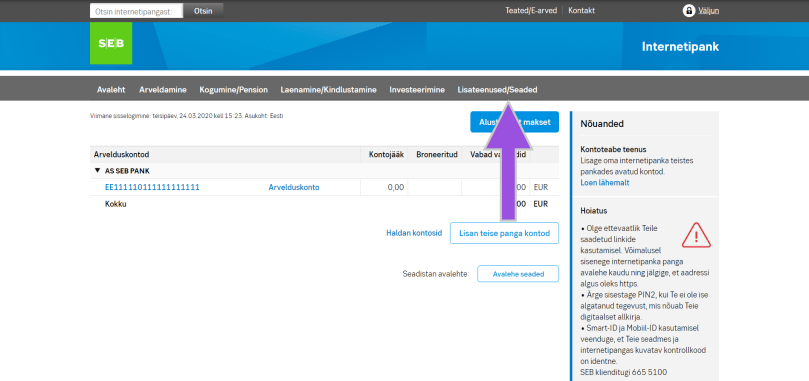
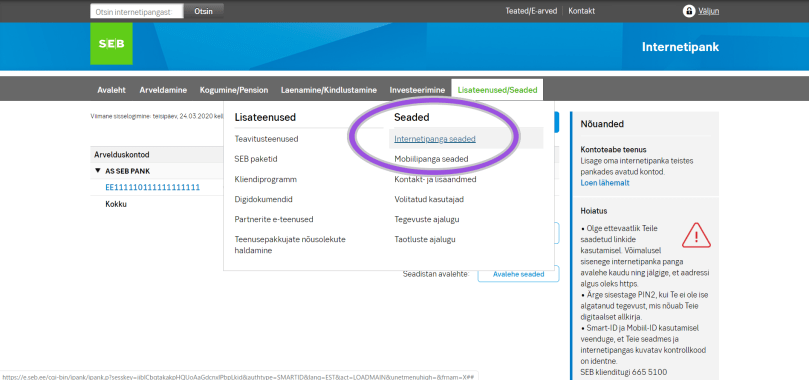
First of all,  you will see the screen like the image below after logging in SEB’s account page, and click “Lisateenused/Seaded” (indicated by the arrow).

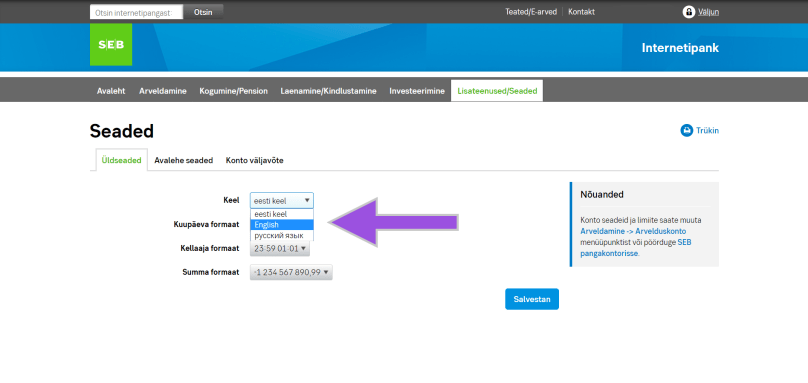
Next, there are some options shown, so click “Internetipanga seaded” (indicated by the circle).

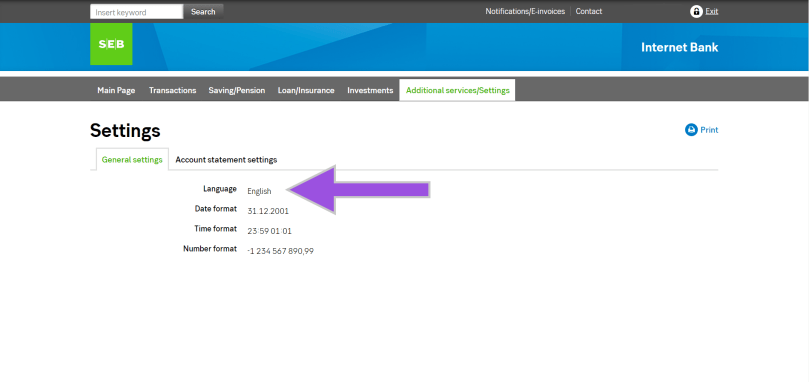
Moreover, you will see the drop-down list beside “Keel”, so select your language preference and save it. Once you saved the change, you will see the entire account page in English (if you chose English), and the language option also says “English”.

That’s it.

Congratulations! Now you completed the language setting on SEB’s account page.


★Activate the SEB card

Furthermore, let’s activate the card that you have got from SEB. Apparently it’s easier to do it after the language setting. 

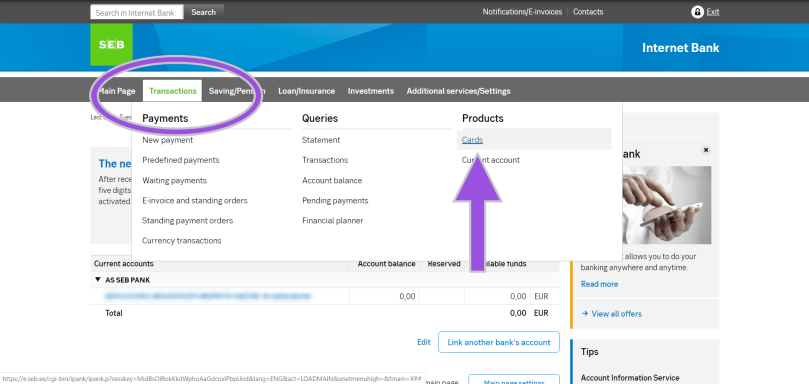
Firstly select “Cards” from the “Transaction” (indicated by the circle) on the account page.

Then you will see the type of cards that you have, so click “Activate the card” and follow the instruction on the screen.

THAT IS ALL!

However, you should keep in mind that the PIN code is initially something that you can see on the screen. You cannot change the PIN code on the online banking, but no worries, you can change it at the ATM so just find the nearest SEB’s ATM.


★SEB’s mobile app

In addition to the procedures above, you might want to manage your assets from the mobile device. Of course SEB has its mobile app, but on iOS you need to set the app store Estonia first. Otherwise you cannot download the app. (Perhaps on Google Play as well but you cannot change the store again on Google Play until next year, so be careful.)

I changed the app store from Japan to Estonia, and actually nothing big has happened basically. (In more detail, as of the beginning of May 2020, I couldn’t download the apps of xID which is a Japanese version of Smart-ID and Brain Focus which is a pomodoro timer in the app store Estonia.)

Anyways, I have set something necessary and fundamental on SEB’s account page. You might be wondering why the post date of this article is the end of March is simply because I did the first two things in this article (the language setting and the card activation) on that date. As for on SEB’s app and the app store, I have another story later on. 

Aitäh! 🙂

Zooks Applies for Tax Return in Estonia.

Tere!

In October 2019, I was so ready and willing to draw pictures digitally a lot with my pen tablet and brought the tablet and the pen from my family place; the tablet was in my backpack and the pen was in my glasses case.

Then I took a flight from Tokyo Narita airport to Chopin Warsaw airport by LOT Polish airlines. The tablet was in my backpack as mentioned but I completely forgot my glasses case in the pocket of the seat in the plane. Yeah, what a surprise.

After coming back in Estonia, I contacted LOT Polish airlines and the airports both in Narita airport and Warsaw airport but eventually no one could find… For this incident even though I was really eager to draw digitally with my pen tablet, I was fucked up with only the tablet so I started thinking of buying a new one. However, the pen tablet is pretty expensive.

This model. Now I have only the tablet.

Of course the price changes depending on the brand or specification but if you want it with certain quality, it can be more expensive than iOS devices. However, it’s necessary to invest some more because I didn’t want to lose money by purchasing a cheap tablet with low quality.

Then I googled and found one: Samsung’s Galaxy tab S6. I still remember that Samsung’s Galaxy models are as good as iPhones when I went to the promotion event of Galaxy 8 or something in Tokyo with my friend.

According to some online information, the latest Galaxy tablet model has a pen and the review or word of mouth says it’s as fine as iPads even when it comes to drawing digitally. However, this tablet doesn’t seem to be sold in Japan. Conversely saying, it’s being sold in Europe!


Okay, I’m gonna save money…


I remember secretly swearing to myself.

Then, one day a few friends came to visit me and talked about tax return in Estonia. According to them, I should get more than what one of them would get because I have worked since 2018.


It’s a windfall, mate.


So we accessed the website of Estonian Tax and Customs Board and logged in but:


You are not allowed to use this service because you don’t live in EEA.


No freaking way.

I have freaking lived here.

After all we couldn’t do anything that day so in another day I asked my CTO since he’s handling something financial in addition to something technical in our company. He advised me to call them so I accessed the Estonian financial portal site called e-MTA again and rang them.


Could you speak English?

No, I tell you number. Please call there.


Jesus she immediately declined.


Then I rang the number that she told me and another receptionist explained the procedures very politely and nicely. The reason why I saw the message like “You are not a resident in EEA” was because I hadn’t submitted the residential information to Tax and Customs Board. The followings are the procedures for both those who saw the same message and didn’t see the message to avoid being upset.


Contents
・How to proceed the tax return application in Estonia
・How to use Estonian digital signing system, DigiDog
・★ Additional comments (17/March)
・★ Additional comments (19/March)


1) Access e-MTA

First of all, access e-MTA. You can view and check information related to the tax in Estonia or submit the tax return application like this time.

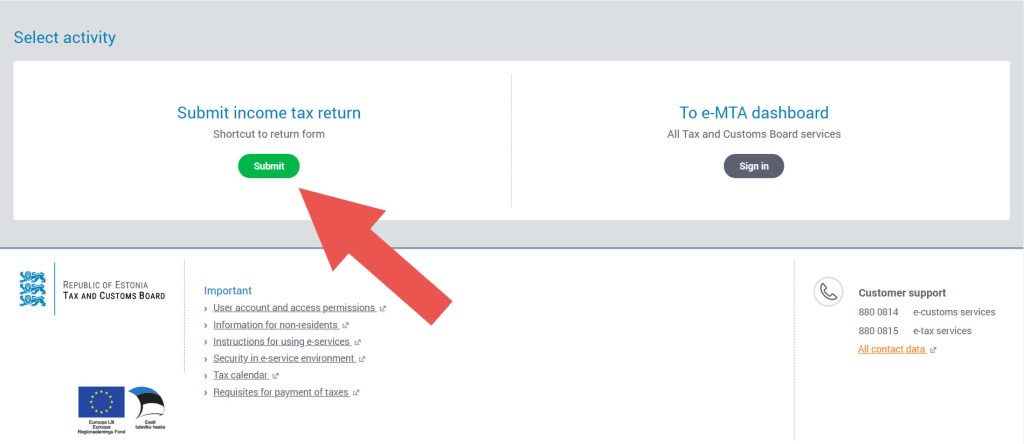
After accessing e-MTA, click “Submit” in green on the left “Submit income tax and return”. If you see the message like I saw, as mentioned there, it’s because you haven’t submitted the residential information. No worries, read the next paragraphs and go to Step 2.

If you have already submitted the residential information, you should see the details about your income and/or tax year by year. You see such information from the previous year. In other words, in 2020 you should be able to implement the procedure for the tax that you paid until 2019. (In this case go to Step 6.)

Given that you have something unclear, you may contact the customer support but as mentioned earlier, when I rang them they could speak either Estonian or Russian, they gave me the number for the English speakers. (Why don’t they have it in public.) So in case you want to know something further, call 6764132.

As I rang them, during the talk, my SIM’s charge was run out so I topped up and called eight times. Maybe it was a busy time due to the daytime. Not sure.

Anyways it’s time-consuimg and hard to reach them. Just keep it in mind.


2) Download Form R

Next, if you see the popped-up message on your screen in Step 1, as repeated you are “not” in EEA so download the document to fill out and submit to Tax and Custom Board, here. (NB! Download it first and fill it out!)


3) Sign the file with DigiDoc

After downloading the file, open it with Adobe Acrobat or whatever you prefer and fill out the necessary boxes. Since I have a “permanent” residential right in and don’t know when I will leave Estonia, I entered the fundamental information about myself in the first box of the document, filled out the second part about my arrival in Estonia and typed my name, the date that I filled out and left the signature box in the last part. (The reason why I left the signature box empty was to sign digitally with DigiDoc.)


★How to sign digitally with DigiDoc

From now on here’s an explanation on how to sign digitally on the Estonian signing system called DigiDoc. DigiDoc is a system and/or software to sign the document digitally (as repeated). As far as I know any libraries in Estonia have this system installed in the computers. Also it doesn’t take time to install DigiDoc’s software so if you download it while filling out the document, you can also use it in the future too.

I had one in my previous laptop but at that time DigiDoc was available with either mobile ID or an ID card reader. For this reason, nevertheless I had the software, I didn’t use it at all on my laptop but signed the document on the library’s computer.

The ID card reader costs (only?) 9€ as far as I remember but I didn’t sign the documents that often so I thought “why not go to the library”. (It didn’t affect my life at all. It was just troublesome for me and I had to set my mind ready every time.)

However, recently they developed DigiDoc available for Smart-ID as well, which means we no longer have to buy a card reader or go to the library to sign the documents with DIgiDoc. Smart-ID is a mobile app to identify yourself and once you open a bank account in Estonia, they would tell you to download Smart-ID. By linking your own Estonian ID, Estonian bank account as well as Smart-ID, you can make purchases online in Estonia without a bank card.

So I had used Smart-ID only to top up my phone or buy contacts (I mean, lenses) online or check the balance in my bank account. However, as mentioned above, (finally) they developed DigiDoc available for Smart-ID, I could signed the document to prove that I live in Estonia in order to get the submission right for the tax return.

Anyways, below there’s how to sign the document on DigiDoc with Smart-ID.

Firstly, after downloading DigiDoc, you would get two softwares, choose one of which named “DigiDoc4 client”. If this is the first time to open the software with your device, the language setting will appear so choose the language that you prefer and go next. I cannot understand either Estonian or Russian so I keep English. 

Next, upload the file that you want to sign digitally.

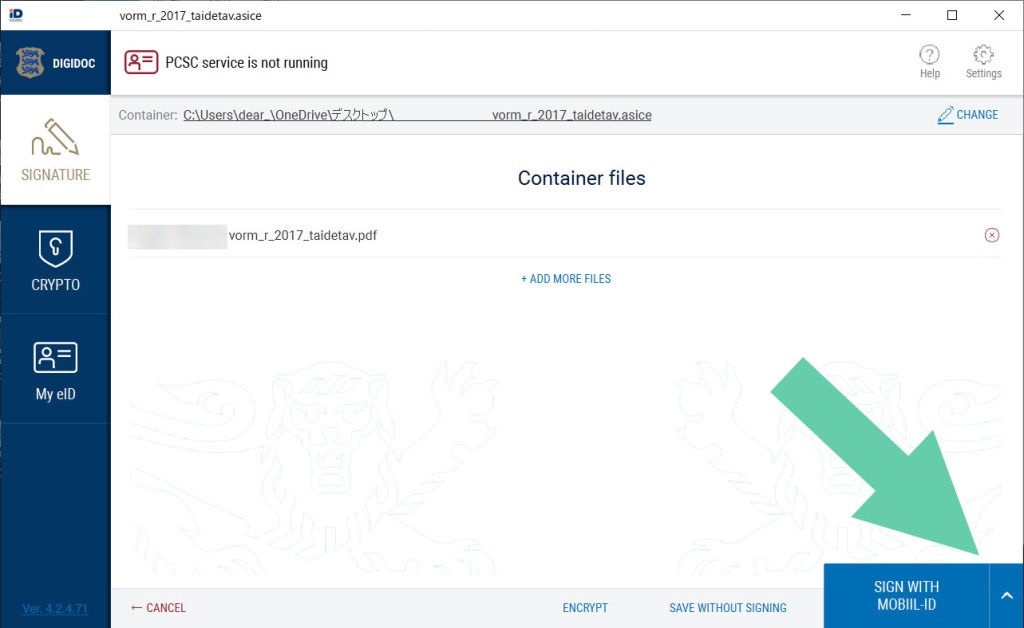
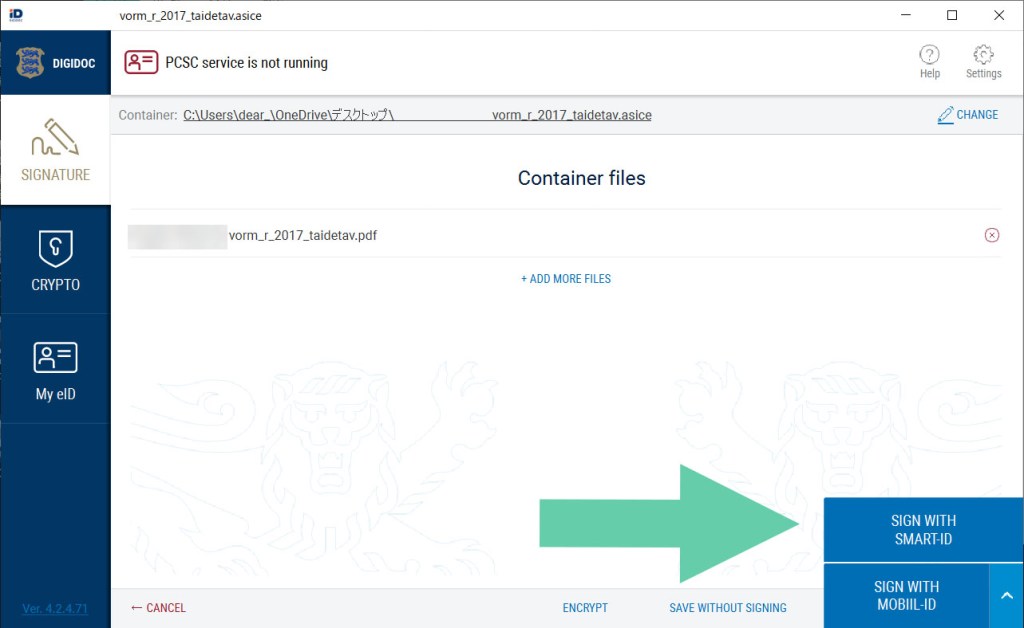
Then, click the caret symbol (“^”) in the blue box at the bottom of the DigiDoc’s screen, and choose “SIGN WITH SMART-ID”.

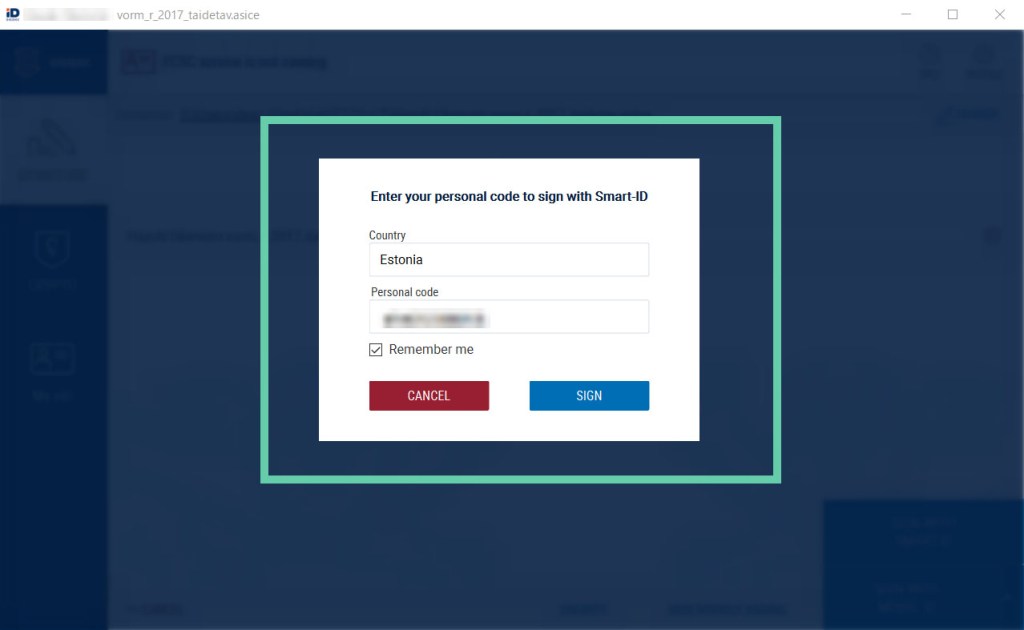
After that, it will show the name of the country that you are using DigiDoc and the entry box for your personal ID, so keep “Estonia” and type your ID (starting 4 if you’re female and starting 3 if you’re male as far as I remember). Then, decide whether you want your DigiDoc to remember your personal ID.

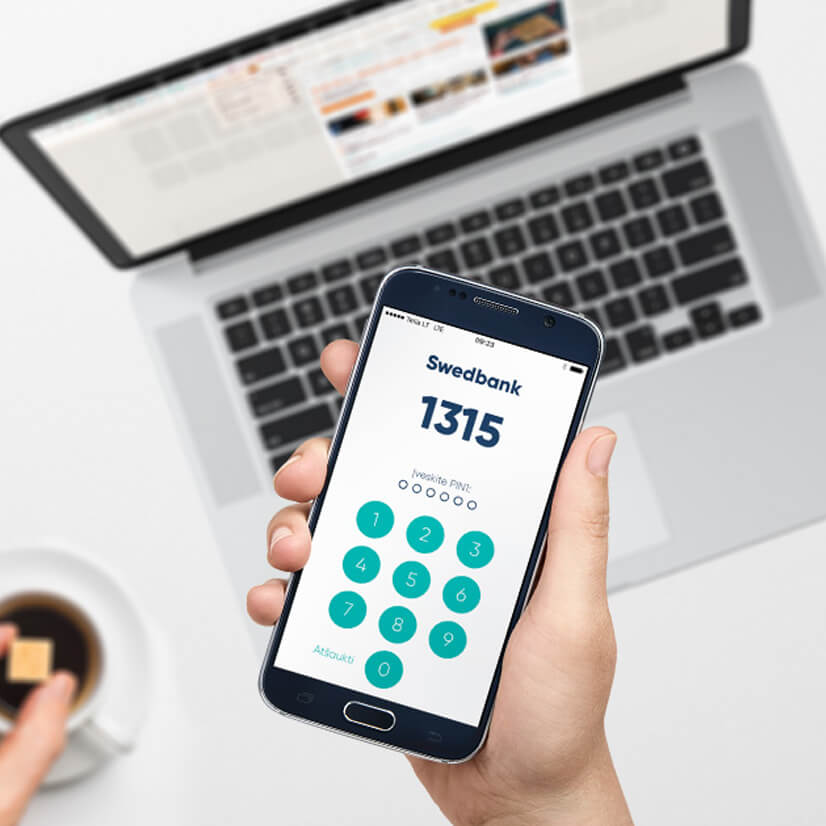
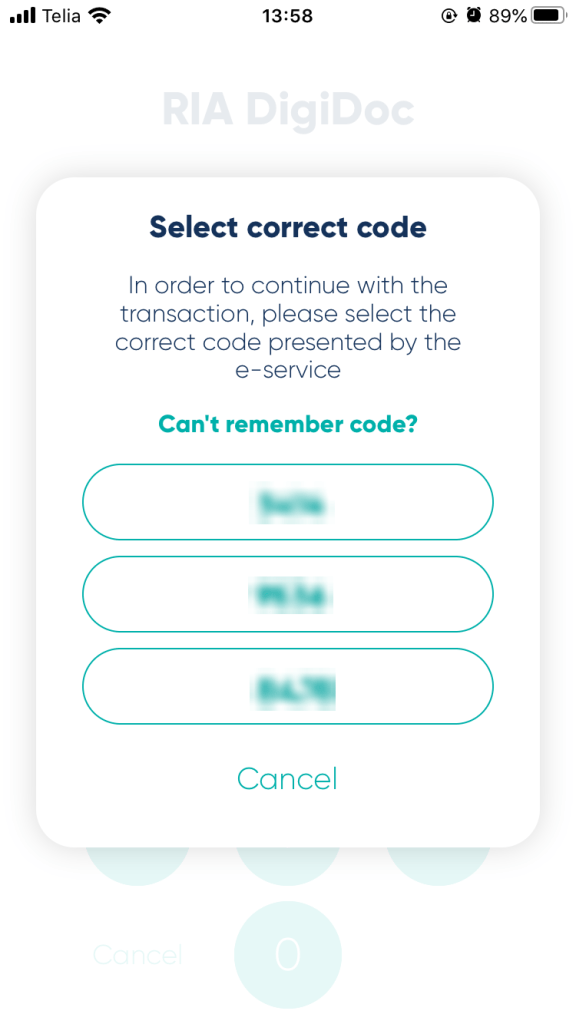
After clicking “SIGN”, open Smart-ID, the mobile app. This is something different from the usual use; the screen shows four digits and then you enter your PIN 1 or PIN 2 on your Smart-ID on the phone. However, this time you choose the set of number on the app, which is shown on your computer screen. Then you will enter your PIN code.

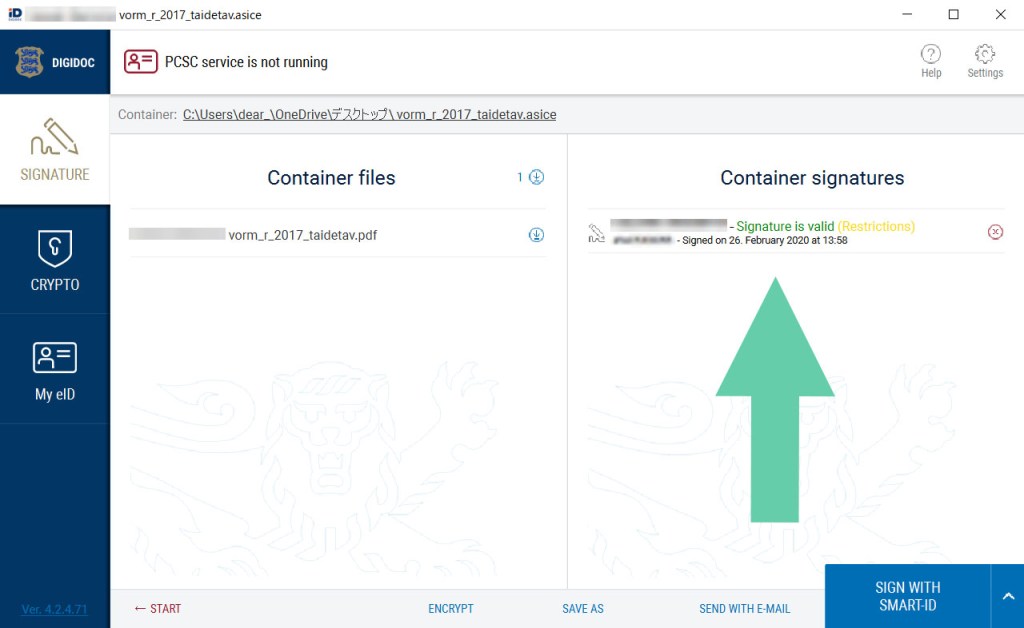
Once you’ve done with entry, make sure if the document has your digital signature on DigiDoc on your computer. (If it’s written “valid” in green, everything is alright.)

That’s all about how to use DigiDoc. For your information, I don’t know how your country is digitally developed but Japan is a digitally developing country. We have a similar thing like Estonian ID cards but so far it’s much less authentic than the driving license, absolutely weaker than our passport and really insufficient for identification.

It means we just have ID cards, whose diffusion is only around 13% of 100 million population.  Due to this poor fact, someone established an e-resident company in Estonia, which called blockhive that has developed such Estonian systems using our Japanse ID numbers.

Surprising fact for you?


4) Send the file by email

Anyways, let’s get back to the main topic: how to submit the tax return application. Now you know that you completed signing the document to prove that you are a resident in Estonia legally, so send the file with the digital signature to Tax and Customs Board.

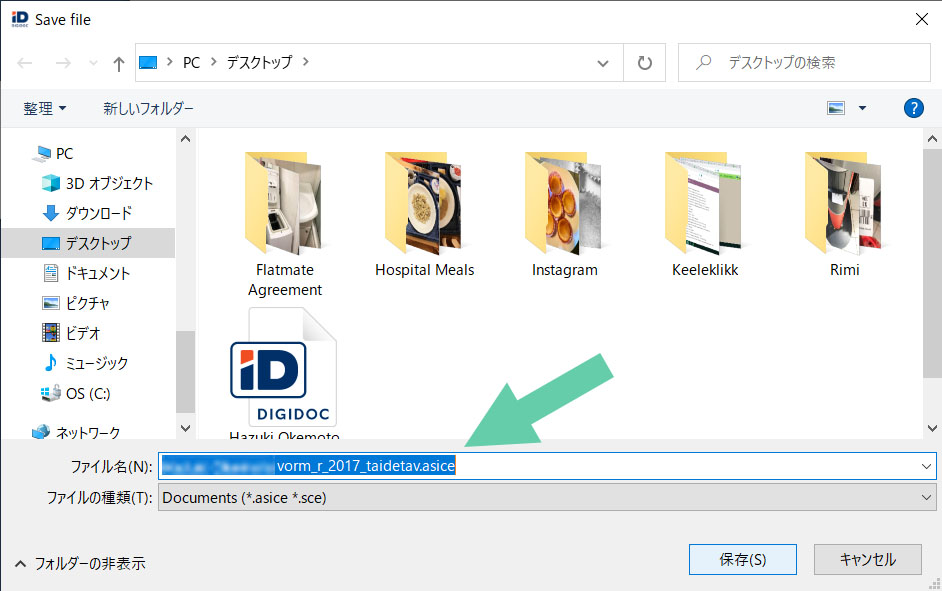
You may do through DigiDoc but you need to check which email address you should use, don’t you? Usually this happens or I don’t remember the precise email addresses whenever I sign digitally with DigiDoc and send the file so I always save the file somewhere on the computer once (just in case). As saving the file, you would see an unfamiliar filename extension “.asice”, which is correct.

Then you just send an email to emta@emta.ee with the digitally signed file attached, describing that you are sending such a file for the tax return application submission or something like that in both the subject of the email and the main text box.

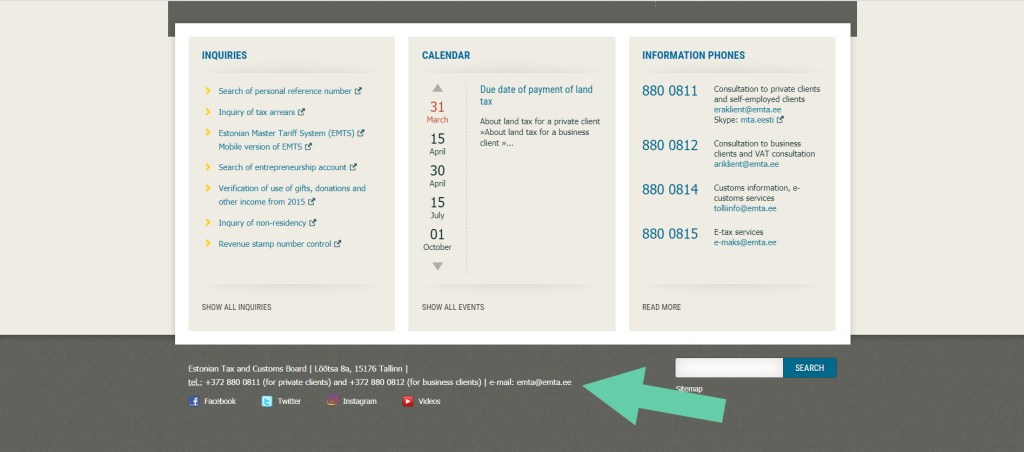
Now you may wonder how I got this email address because you probably couldn’t find. Open the Tax and Customs Board webpage, scroll down until the end of the page, find social media icons and there you go! There are their postal address, phone number and the email address in super hyper teeny-tiny letters. (Of course the lady that I spoke with on the phone told me this address. :P)

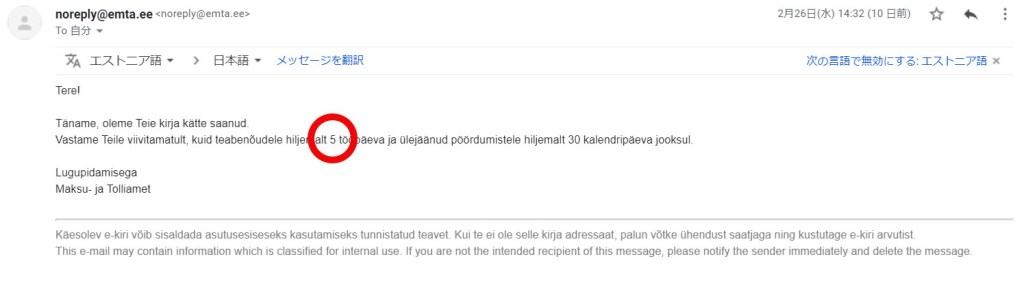
Once you sent the email, you get the auto/no-reply email, saying something like “we will reply you within 5 days” in Estonian so check it just in case.


Well, it said five (5) clearly there and I don’t know why but I thought it would take around three (3) days to get their reply.


Then only in about one hour,


You have registered as a resident in Estonia since DD MM YYYY!

They granted my residence in Estonia in Estonian.


Super hyper quick.


After that the success is mine (or yours).

(I really thought it would take around three (3) days so I was fearfully surprised. Really. My document was totally innocent.)


5) Access e-MTA again

If your reply is the same as the above, log in e-MTA again. Then, like what you did already in the beginning, click “Submit” in green under “Submit income tax return” on the left box of the screen.


6) Confirm your income and tax

Once you successfully go to the application screen, you will see the information regarding your income and tax that you paid until the previous year of the year that you are logging in, that is, if you see the information in 2020, the shown information is up to 2019.

Also the information is shown year by year so choose the year that you want to submit the tax return application for. (As a default, it should show the previous year’s income and tax information.)

Moreover, if you are looking at the information of year 2019, you see the application progress of your tax return submission on the top of the information, which are only three steps. Check the amount of your income and tax and go next.


7) Confirm the tax return application and submit

When you go next, you will see how much you will get as the tax return of the year that you apply for. Confirm the amount and enter the bank account and just submit. (If you use your Estonian bank account, the account number is the set of alphabet and number starting “EE”!)

Finally some message pops up and it’s done. Given that you have multiple years for the submission of the tax return application, just go back to the dashboard and apply for another year’s tax return.

(This happens every year, but last year they were fucked up according to my CTO in our company, so the application process was messed up and I hadn’t known the tax return in Estonia until this February. That’s why I’m writing now. Due to this I’m supposed to get quite a lot.)

By the way, this tax return application is not valid for everyone. As I was talking with my friends, I didn’t know that I needed to submit the residential proof in Estonia to them so we were just wondering why I couldn’t do anything.

Then one of the friends remembered my Estonian colleague who worked at part-time so I asked him and he said “I don’t know about it and I think you probably won’t get anything”. This friend is Estonian so she was sure that he should have known the tax return. Then I remembered one fact:


This colleague is a programmer so even though he works at part-time, he should earn more than I do.


Yep, as you may guess, the tax return has a “trick”. The person who can get the tax return is someone who earns money less than 1000€ every month no matter what kind of agreement (part-time or full-time work) they have. (I have had a period that I had 1000€ and over but mostly less than that since I started working at my current company in 2018.)

Now I work for 30 hours per week so I probably will get the right to submit the tax return application again next year. Probably. I’m actually happy without the tax return since I can live a life without any financial struggle in my opinion/case but why not get something I can get?

You now know how much I earn every month but actually I have worked as a freelance translator and community manager for a Belgian company so occasionally I make more money than the other regular colleagues, not programmers. (Of course it depends on the workload and from time to time I can’t make enough money with this freelancer’s job to withdraw.)

Welcome to my life.

Once I could confirm the tax return on my bank account, I will renew the article.

According to my Hong Kong flatmate, we should get the tax return within a month after the application submission.

I’m also thinking of buying IKEA’s sit/stand desk for my room…


★ Additional comments (17/March)

Yeahhh, I’ve got my tax returned!
However, I still haven’t got last year’s tax returned maybe because it’s much more than this.
I’ll renew the article when I got last year’s tax returned.


★ Additional comments (19/March)

I’ve got last year’s tax returned! I immediately bought a tablet that I mentioned above. I was super wondering which colour to choose but I thought I could have a bit more expensive beer with 5€ so I simply bought it at euronics. If I can buy a desk at IKEA, everything will be perfect.

Aitäh! 🙂

Zooks Registers Family Doctor in Estonia.

Tere!

Listen, I finally registered a family doctor (or home doctor or GP, whatever you want to call).

You may wonder how to register a family doctor in Estonia. This article handles topics from how to find a family doctor to how to “use” them, dividing into four sections.

1) Who can register a family doctor?

In order to register a family doctor, you need a residence permit. In other words if you are working for an Estonian company or a degree student in Estonia, you automatically have the right to register a family doctor in Estonia. (See this for more information.)

In my case, since my purpose to come to Estonia was study as a master’s student, two years ago in 2017 I could have registered a family doctor when I got the TRP. With a family doctor, you may get treatment at quite cheap fee or some special services for free so it’s better to register one. When I was in Ireland as an exchange student in 2015-2016, I didn’t catch any cold or get ill at all so I had spent time in Estonia without a doctor. However, I really felt I needed a family doctor as my depression level was still low and tried finding but at that time I was working at full time, suffering from many things and spending time as a depressed individual. It was eventually after leaving the hospital when I got a family doctor.

Also, if you can speak Estonian (or Russian), you may not find any difficulty in getting a family doctor, but in addition to the fact that there are more immigrants in Estonia and that we automatically require English speaking doctors, it’s not easy to find a family doctor in Estonia. In the following sections, I’m writing about how exactly to find a family doctor.

2) How to find a doctor?

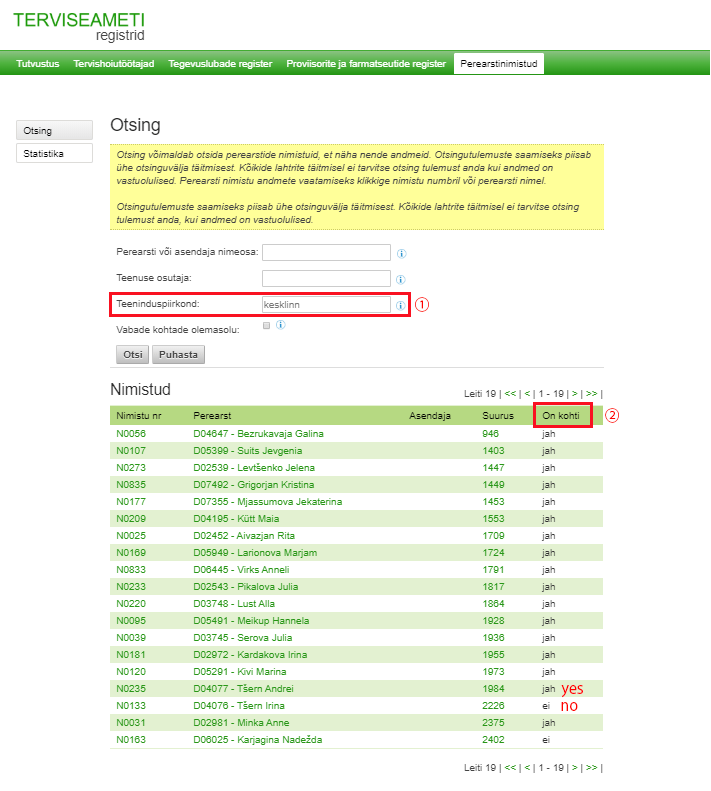
First of all, access the website to search family doctors in Estonia. It’s available only in Estonian but it’s not that difficult to use this website. As accessing, the third box is a search box depending on areas so enter your area that you live in. After the entry, click “Otsi”. The example is below.

I entered “Kesklinn” as an example. (2) in the image measn doctors’ availability. If they can accpet new patients it says “jah” and if not it’s “ei”.

If you found someone who seems to accept new patients, click their name under “Perearsti” column and call or email them.


Usually they say they don’t accpet any new patients.


“What the hell! You just told us!”

You may have thought like that. Sorry 😛 but no worries, I’ll explain another “hack” in the following section, which might surprise you.

3) My case?

Listen, I tried the method above like you might have done. I called and asked them if they could speak English and told them that I wanted to register a family doctor – none of them could accept me.

Then I did this:

Search “Perearstikeskus”.

While in the hospital my friend advised me to ask my doctor there how to find a family doctor. He told me perearstikeskus in Laagri, where are lots of young doctors who might speak English more or less compared to elder doctors in Estonia. However, as mentioned above, they couldn’t accept me as a new patient.

“Perearstikeskus” means “family doctor centre”. I thought there would be more perearstikeskus in Estonia so I searched by this word.

I got multiple results online and chose one of them in Lasnamäe. From my experience I thought it was better to use Google translate and read Estonian. Then I found one doctor who seemed to be able to have new patients and called him:

Hi, could you speak English?

Yes I can.

I’m looking for a family doctor but could you accept me as a new patient?

Of course!

Well, I live in XX (the name of my living area) but is it okay?

Sure! Just come here and find my name!


I got panicked.


I called him desiring to get one so I was incredibly happy. It was Friday when I called him so I decided to visit him on Monday. The reason why I asked him the area is because some doctors (are said to be able to) accept only those who live in the area that they are in charge of. (Does this make more sense why I explained to search doctos by area above?)

The medical centre was in a tricky place and quite far from my (previous) place but I was sure I wouldn’t need him that frequently so the distance was not anything big for me.

4) Registration and after that….

Then on Monday after working I went to the medical centre. I asked a nurse and she gave me an application from (paper!) and I just wrote necessary information and the doctor’s name that I wanted. That was it. She said the system would have this information immediately.

Actually, however, it’s from the next month after the registration to have the family doctor available, which means your State Portal wouldn’t have a famly doctor information yet right after the registration. For example, given that you registered a family doctor in January, your doctor is available for you from February.

(However, as February started I checked the portal site but it didn’t have my doctor’s name so I asked Haigekassa and then mymed, which said my doctor would be available for me starting in March. Why the heck…)

It’s hard to find an English-speaking family doctor in Estonia but once you found one everything would be alright. Keep searching and this is the reality to live in a non-English speaking country.

I hope you can get one.

Aitäh! 🙂