
Tere!
This time I’m going to talk about voting for elections in Japan.
Four years ago, I heard that those who live in foreign countries can have a voting certificate, so I went to the Embassy of Japan in Estonia, but they told me that I needed to lose my certificate of residence. Therefore, I did not apply for it. At that time I was still a student, and I was not sure if I would go back to Japan.
Then in Autumn 2021 when the Prime MInister in Japan changed, there was a election of House of Councillors.
I didn’t really let Liberal Democratic Party win, so I wanted to vote. For this reason I applied for the voting certificate.
I emailed the Embassy of Japan in Tallinn, and they said that I would have needed to wait for the certificate for about two months.
Freaking too long.
However, it’s better than nothing, and elections might happen in the future as well, so I applied for it.
I asked the staff of the Embassy, and made an appointment. (This is a necessary step to apply for the certificate.)
In order to apply for the certificate, you will need a passport. Since I had not submitted a notification of residence, I also brought a contract for the flat. (This is used to prove my residence in Estonia.) The application form is available at the Embassy, hence you do not need to worry.
Then I went to the Embassy, and I filled out the form, in which I needed to write a place where I waived the certificate of residence in Japan as well as the date when I did. I had never made any changes in the certificate of residence in Japan, so the place was definitely Tanabe. On the contrary, I did not know when I waived. I asked the staff in the Embassy, and he said:
A rough date is fine
So lax.
Overall it took around 30 minutes to complete the procedure.
Then on the 30th of November 2021, I received an email from the Embassy that I could receive the voting certificate. I had a day off the following day, so I had an appointment at 10.
When I went to the Embassy, a staff member asked me:
Do you have your passport?
What? I hadn’t heard of such a thing…
However, she said something to prove myself, so I passed the TRP card, and waited for a while, after which I got some documents.
These documents are the ones I need for voting at elections.
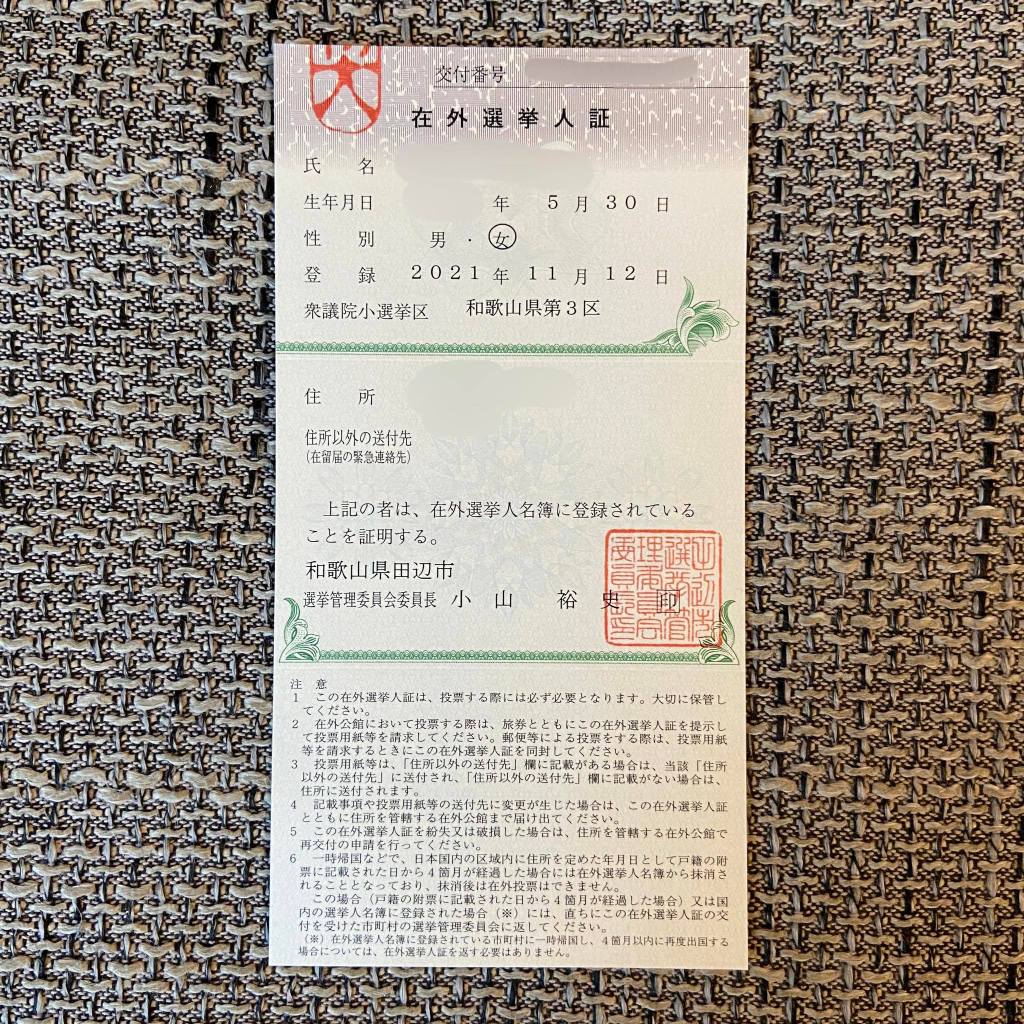
Honestly I don’t know when I can join elections next time, and there is an online strike to make online voting possible, but anyways, I’m glad that I can finally join the elections.
★Zooks Votes for an Upper House election in July, 2022
Between the end of June and the 1st of July in 2022, the Embassy of Japan in Estonia had accepted votes for the Upper House election, and I went there on the last day. (Because the reception started while I was travelling in Ireland, that was the only day I could go.)
If a Japanese resident in a foreign country has an overseas vote, they also have an option to vote by mail to the Embassy, but since I live in Tallinn where the Embassy of Japan is, I travelled there.
In Japan now they can obtain the voting right when they turn 18 years old, but in my generation it was 20 years old. Since then this is merely the second time for me to vote for an election. That day, since I had work at noon, I wanted to visit the Embassy of Japan before that, so I asked them how long it would take to complete the voting process, by email. Then they said it would usually take 20 to 30 minutes. (I honestly thought “That long!?”)
The reason why it takes such a (long) time for the process is probably because of the situation. When we vote in Japan, we must vote where we have our residence registry. When it comes to voting overseas (especially for a Constituency election), there are other Japanese citizens from other prefectures, so the voting destinations are different. (For example, in my case, when I was a university student in Kyoto, living there, my residence registry was still in Wakayama, so I was not able to vote for the candidates in Wakayama from Kyoto.) Moreover, we need instructions from the Embassy when voting overseas, which takes time. (It’s not like just writing the Party’s name or the candidate’s name.)
Hence, I booked an appointment in the late morning so that I could go to work straight after that. (As I lived in Ireland, I never asked the Embassy of Japan for anything, so I don’t know in the case of Ireland, but) in the Embassy of Japan in Estonia, we must make an appointment in advance. I asked them if I could visit there on Friday, 11th of July at 11.30.
When voting at the Embassy, we need a certificate of the overseas voting right. That proves that “I am eligible to participate in elections in Japan”. In the process of voting at the Embassy, representatives of the Embassy will give us a stamp of the participation. (Also, for voting overseas the voting certificate number is required, which is written in that certificate.)
At the Embassy, a staff member told me the representatives will instruct and explain to me, so I waited for them. Then two representatives came, and told me how to vote overseas.
This time there was a Proportional representation election and a Constituency election. The documents I needed to fill out were not only the papers for voting itself but also a paper to show which election/s I wanted to vote for. When I voted last time after coming back to Japan from Ireland, there was only a Proportional representation election, but this time there were two elections. I asked one of the representatives, and he said some people voted for one of them, others voted for both.
At one moment, “Maybe just one of them?”, but the idea “that one vote would change” came up to me, so I voted for both elections.
Before visiting the Embassy, I saw one web service where I could check which Party my way of thinking is similar to on Twitter, and I tested. As a result, there was no remarkable answer saying “This party is definitely closest to your way of thinking!” but it was a good reference.
Furthermore, I checked the candidates from my prefecture beforehand. (At the Embassy there is a list, but it contains only the candidates’ names, so it was good to check in advance.)
Voting overseas is very strict. Once I wrote a Party’s name or a candidate’s name in respective papers, I put the paper in a smaller envelope, and glued it to close. After that, I put that envelope containing the voting paper in a bigger envelope with an address, and glued it to close again. Once I glued the envelopes for both elections, I passed them on to the representative at the EMbassy. They checked, and it was completed with their OK.
I know in Estonia they can vote for an election online. The problem in Japan regarding voting is that not everyone changes the resident registry after graduating from high school or universities, living in other prefectures, so such people cannot vote from where they live, and they must vote from the prefectures where they have resident registry. When I lived in Kyoto, it cost at least 3000 JPY (approx. 25 EUR) for a one-way bus trip to my hometown. Why would I pay that much every time? I believe if we were able to vote online, the percentage of voting would be increased. I have thought for years that the voting system should be changed.
Aitäh! 🙂





































 zooks.ee