Tere!
When travelling in Japan, what you need to take into consideration is absolutely transport. If you travel in a metropolis like Osaka, Tokyo or Kyoto, then you will use just trains and occasionally buses. However, sometimes this basic method doesn’t work.
On this trip to Japan, I had two 20-kg suitcases, a backpack and a haversack. Also, I used transport to go out with my friends. Therefore, I’m going to introduce the transport that I used during the trip in Japan. Also, I will explain why the basic method won’t work in some cases even if you are in metropolitan prefectures.
Table of Contents
1. Uber
2. Osaka city bus
3. Train and underground
★Summary
1. Uber
When arriving in Osaka from Tanabe, Wakayama, I’d already decided to take Uber to go to a hotel because it was a 10-minute walk distance with two suitcases. A 10-minute walk distance with the suitcases is much different from just walking for 10 minutes. It would make us feel longer than 10 minutes, and we would consume lots of physical energy, too.
In Japan, basically there are three taxi apps: DiDi, Go as well as Uber.
The former two apps were not downloadable on App Store Estonia, so Uber was the only option for me. It took some time to add my Japanese debit card because I was not familiar with Uber. In Estonia, I use only Bolt, which UI is much simpler and easier than Uber. After struggling for a while I called an Uber taxi. For the 10-minute walkable distance, I paid around 700 JPY (5 EUR). To me it was not that cheap in JPY, but if I calculate in EUR, it sounds okay…
Later on, I used Uber twice more.
2. Osaka city bus
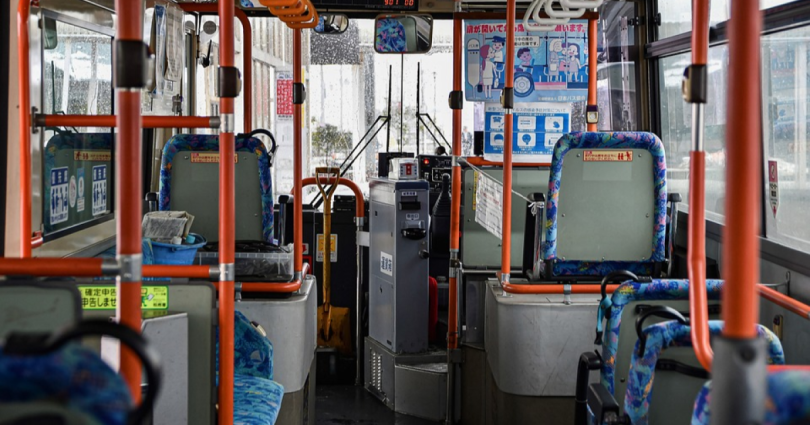
I barely used buses when I worked in Osaka. However, this time the Osaka city bus was the easiest option for me from the accommodation to Osaka station to meet my previous colleague.
In Japan, when you take a bus, you get on the bus from the back door. Sometimes you have to take a ticket at the door, but for the Osaka city bus that I took, I didn’t have to.
The price was all the same in that bus as well. In front, there is a small screen above, and it shows two pricings; the more expensive one is for adults and the cheaper one is for kids. I don’t know how old kids should be to get that price.
When you get off the bus, you have to pay at the checkout machine next to the driver and get off the bus from the front door. You can use notes as you can get changes at the checkout machine. Then, pay the exact amount.
Plus, I always say thank you to the driver whenever I take a bus in Japan though people barely do that.
3. Train and underground
In metropolises in Japan, it’s quite common to use trains and undergrounds. The residents in Japan often use a transport card such as Suica or Icoca. Depending on the city where they live, the transport card that they can use in their city differs. I used to have an ICOCA card which is available in the Kansai area because I lived in Kyoto.
On this trip in Japan, I planned to buy a new ICOCA card because I lost it, and it’s convenient to have one. However, I didn’t buy it eventually. If I had it, I just needed to top up some amount of money, and just needed to head to the gate by swiping the card there.
Instead, I bought paper tickets every time I took a train or underground as it appeared to be irritating to have one more card, and I didn’t know how much I would spend for the transport.
Buying paper tickets is also easy. First, check the station where you will start your journey. Then go to the ticket machine. Above the ticketing machine, there is a route map, and find out the station name that you want to arrive at. Under the station name, there is a number which is a price to go to that destination. Then pay in cash.
If you don’t know how to pay, call the station staff, and they will show up from the ticketing window. (This is what non-Japanese friends love.)
★Summary
You may feel that trains and undergrounds in Japan are faster than other countries while buses are very slow (based on my experience).
Also, if you travel around Japan, collecting the transport cards might be fun. In fact, I have met some exchange students in Japan who indeed did.
I hope this article will be helpful when you visit Japan.
Aitäh! 🙂
 zooks.ee