
Tere!
Sorry to be sudden, but I’m going to talk about the Work Ability Card this time. (Though I don’t have much to say.) I’m going to write what kind of card it is, how long it is valid, and if there are any benefits. You won’t experience such a thing as long as you are just normal.
In April 2021, my mental condition was not really good (which I will explain in the future). Around March or April in 2021, due to COVID-19, we couldn’t communicate with people, and had to work remotely.
I believe this was a tough time for everyone, but in my case it was too much. I have shut out most of my friends that I made in the postgraduate school, and didn’t have many friends though I usually have. (However, I often hang out with just a few of them, even in Japan.) So I thought I need to make friends somehow.
Then one day when I had a regular visit at the hospital, my nurse gave me a brochure of Tallinna Vaimse Tervise Keskus. There are some group activities, and she said that maybe some of them could be good for me.
After that, I contacted the Health Centre, and the staff said she wanted to meet me first.
When we met, she told me and determined to:
- Participate in the art therapy
- Use a supporter
I omit details about the above here, but someday I will write.
Anyway, when I met a supporter, doing some procedures, we registered to get benefits of incapacity of work.
To proceed with this, it is required to have a talk with a doctor, but in my case I already saw her during the last six months, so we corrected some information, and applied for it.
This is not something that everyone can do, and when proceeding, you need to answer a huge amount of questions. This was the first step. I think it took a few hours to answer all the questions. The questions were all in Estonia, so I was glad that I had an Estonian supporter. I’m not sure if there is an English version, but perhaps there is.
After applying for it, we met the person-in-charge of my application. This process is managed by Töötukassa (the Estonian Unemployment Fund), and they have some offices in Tallinn.My supporter and I chose an office where an English speaker works. (I think it was in Endla street.)
Until I got an appointment, my supporter took care of the communication.
Then at the office of the Fund, she asked me very similar questions a lot. I think it took about one hour. This was the second step.
At the third step, the answers of the questions were received, and we checked it. Then we waited again.
This is the fourth step. When getting a result email, the email has two files: PDF and the file to do a digital signature. I checked the PDF file.
It was all in Estonia, so I used Google translate, but anyway the results were:
- Partially able to work
- Valid for five years
The reason why “I am partially capable of working” is because although I have autism, disorders and depression, those don’t significantly affect my living life.
In this PDF file, it also mentioned how much I can get as its benefit. If your result is “completely incapable of working”, the calculation is 15 euro per day, and if it’s “partially incapable of working”, it’s 8 euro per day. More details available at their web page.
Several days after I got a result and completely forgot about it, I suddenly got a letter from the Fund which included the Work Ability Card. The information on the card is:
- My full name
- My Estonian ID
- Birthday
- Work condition (“Partially incapable of working” in my case)
- Validating date
- Expiry date
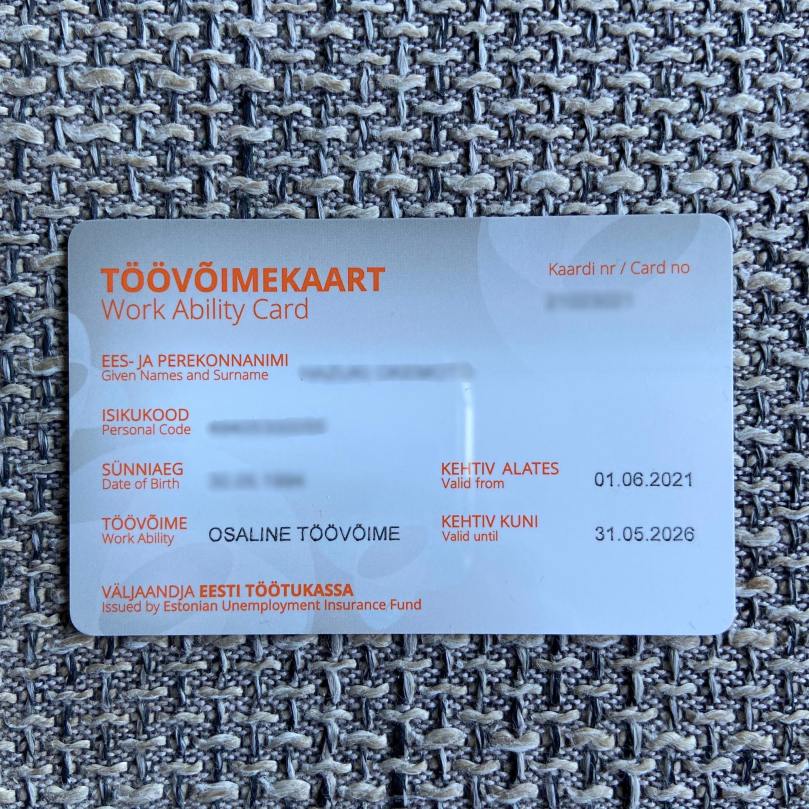
In fact, by having this card, there is a hint of goodness. When I travelled in Viljandi, I could buy discount tickets with the card.
Lucky!
However I had concerns about the valid period and the condition of work.
It’s not easy for foreigners to find part-time jobs in Estonia. It is very difficult. Timbeter where I used to work was really flexible, but it was special and exceptional because it was a very start-up company.
So the reality was “the job is full time although the condition is partially capable”..
I thought that might be unfair with that situation, so I asked my supporter, but she said it was okay.
The reason is “we don’t know what will happen/worsen” (the health condition is different).
So it’s like compensating for health conditions with money.
For example, let’s compare two types of people:
- An individual who is healthy and 100% capable of working at full time
- An individual whose depression is not fully healed this year, who has autism and disorders, and who is only 50% capable of working full time.
Apparently the latter one is “weaker” and handicapped.
And the benefits compensate for it, so it’s fair.
Thus my monthly income is a salary at full time + the benefits.
I did not feel good about getting special money compared to other colleagues in the same position, but considering the differences of the health conditions, it’s not unfair.
In fact, I have paid for the medicines and the psychological therapies.
I have this Work Ability Card in my wallet with the Estonian ID card as they ask me to show the Estonian ID card when using the Work Ability Card.
It’s literally a card, so it’s not like a disability certificate which looks like a thin notebook issued in Japan.
In Japan and until I got the Work Ability Card, I had never had a disability certificate. I didn’t make one because the services in Japan for the holders were basically available for the physically disabled people. (I wasn’t depressed when I was in Japan, but autism and mental disorders could be considered.)
However, although I live in Estonia, anyway I won’t use the card that often.
So here was my story about getting the Work Ability Card.
Aitäh! 🙂
 zooks.ee
[…] summer in 2021, I published a blog article titled “Zooks Got the Work Ability Card Issued in Estonia.”. This was it. The certificate of “partial incapacity of work” took advantage at this time. […]
LikeLike