Tere!
Do you remember that I was going to publish blog articles about my Estonian language course? Due to hospitalisation, I couldn’t actually continue. (Sorry to those who were looking forward to it.) Ergo, I’m summarising how my Estonian B1 course was this time.
After getting back to the Estonian language course, I went to the language school, but since the 25th of November we started learning online. This is because the Estonian government announced that hobby classes can be held in class only if the number of participants is below 10 or 15 or something like that. (I can’t remember that much.)
In summer I also had an Estonina language course online, but my teacher wasn’t used to the IT gadgets. This time my teacher is an expert of Zoom (she looked like that), so the quality of the class was way better. (I thought if the online class was like this, it could be an option.)
Anyways, I’m gonna introduce what we learnt from week 9 that I got back from the hospitalisation.
★Week 9★
It was the first language class since I was discharged from the hospital. There was nothing new for me. We learnt how to use “kuhu” (to where), but I already learnt in the A1 course last year, so there was no difficulty.
★Week 10★
I learnt two things this day — how to use “kuhu” and “kus” as well as the conditionals.
Regarding “kuhu” and “kus”, I write down for those who are not familiar with them below. “Kuhu” uses the verb “minema”, and “kus” uses “käima”, both of which mean “to go”. They use the former one when expressing going somewhere (one direction), and use the latter one when stating going somewhere regularly. Also, according to the interrogative, the form of the noun of the destination also changes.
For example,
- Ma lähen koju
- Ma käin kodus
Both mean “I go home” but the former one indicates “I’m going home (returning home)”. The third word of each sentence means “home”, but the case changes based on “kuhu” or “kus”.
In terms of the conditionals, the Estonians use -ks-. For instance, “tahtma” (which means “to want”) will be
Ma tahaksin
to be more polite. (In English it means “I would like”.) There is another example. They have a verb “saama” (which means “can”), and they say “I could” by inserting -ks- and making it “Saaksin”.
We learnt such things that day.
Also, I got a small glossary book, which seems very useful.
★Week 11★
This week we shifted learning from offline to online. On Monday we learnt how to express time. I learnt time at A1 level, but this time it was “from what time to what time”.
As a grammar, the form is “kellast (from what time)” “kellani (to what time)”, and you need to insert the second case of numbers. For example, if it’s “from 8 to 5”, it wil be
kaheksast viieni.
We also learnt how to express “8.15” or (8.30).
From this Wednesday, we had an online class. We kept learning “time”, but this online class was splendid.
When learning or acquiring a language, speaking is a tricky part because it is hard to practise on our own. However, my teacher knew Zoom so well, so she created pairs or groups in three, and we could practise speaking by using breakout rooms.
In such a situation I do agree to learning a language online.
★Week 12★
We continued “time”, but this time we learnt “at what time”. To express such, they use “-ks”. For instance, if you want to say “at 8”, it will be
kaheksaks.
Like the previous section, it also uses the second case of the numbers.
Plus, we learnt half of the time (e.g. “8.30) or 15/45 (e.g. 8.45) as well.
On Wednesday the class was about verbs. In Estonian there are the -ma infinitive and -da infinitive. Which form we use is depending on the first verb. Here “verbs” includes auxiliary verbs in English too. I had a pair practice with an Russian student, who advised me
- They use the -ma infinitive when the first verb is some sort of action (in many cases);
- They use the -da infinitive when the first verb is some sort of emotion or ability (in many cases).
For example, “I have to read a newspaper” will be
Ma pean ajaleht lugema
We didn’t deepen into the -da infinitive this time, and finished with the -ma infinitive.
★Week 13★
We learnt the -ma and -da infinitives, and a different case of numbers.
I’m gonna explain how to use the -da infinitive as I did for the -ma infinitive above. If a sentence is like “I can find a solution”, the Estonian sentence will be:
Ma saan lahenduse leida
You don’t have to pay attention to the position of the objective.
In terms of the numbers, we learnt the second and third case. (It means the way to use numbers differs depending on the context. It’s a bit complicated so it may be time-taking to get used to it, but I believe that practice makes perfect!)
When they use such weird forms of numbers is when saying “from when to when” or “before” and “after”.
The below is how to say “from when to when” in Estonian. Here “from when until when” is in Estonian is ”Mis kuupäevast mis kuupäevani”.
I exemplify from the 14th of March (Märts) to the 18th of April (Aprill), it will be
neljateistkümnendast märtsist kaheksateistkümnenda aprillini.
Fucking long.
Grammatically the second case of the numbers and months have “-st” or “-ni”.
Another explanation is about enne, pärast — “before” and “after” (in Estonian). They use the third case here. For instance, “What don’t you do before the 1st of January?” will be
Mida te ei tee enne esimest jaanuari?
We use the same logic to “pärast”.
These were quite hard exercises.
★Week 14★
We had a class on Monday and a test on Wednesday.
We learnt the third case of plurals of nouns and adjectives. Oh, these are harder to acquire!
Some nouns and adjectives require us to add a few alphabets to the second case of their singular form. Others need to change the third cases of their singular forms. It’s so hard to remember. By the way, the Estonian language is like Spanish, so the adjectives get influenced by the nouns that attach those adjectives. In short, if a noun is a plural, its adjective is also a plural, and the noun is a third case, the adjective also becomes the third case.
I believe all I can do is just practise.
On wednesday, we checked the homework, and spent the rest of the time for the test. I felt the test was easy.
★Week 15★
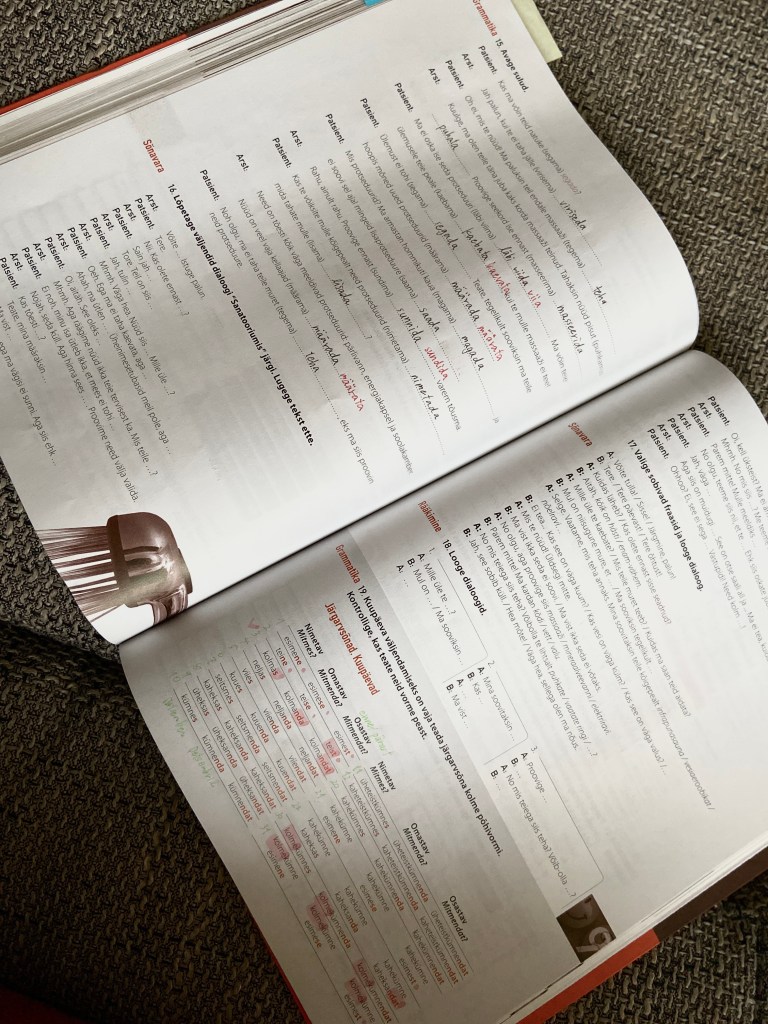
We checked the points at the test, and then talked about how the Estonian language course was in a pair in Estonian. After that we presented our partner’s difficult points and good or interesting points regarding the class.
As for the test, I do have no idea where I made mistakes, but my point was so few.
Since I don’t know my mistakes, I cannot do anything for that.
However, although I don’t have much vocabulary yet, indeed I gained a few, and could speak more freely than before.
In terms of the afterwards, since I’ll start a new job in January, and I think I should get used to it first,I decided not to take any Estonian language course for this semester. Instead, I will do self-study by using my spare time.
Aitäh! 🙂
 zooks.ee